
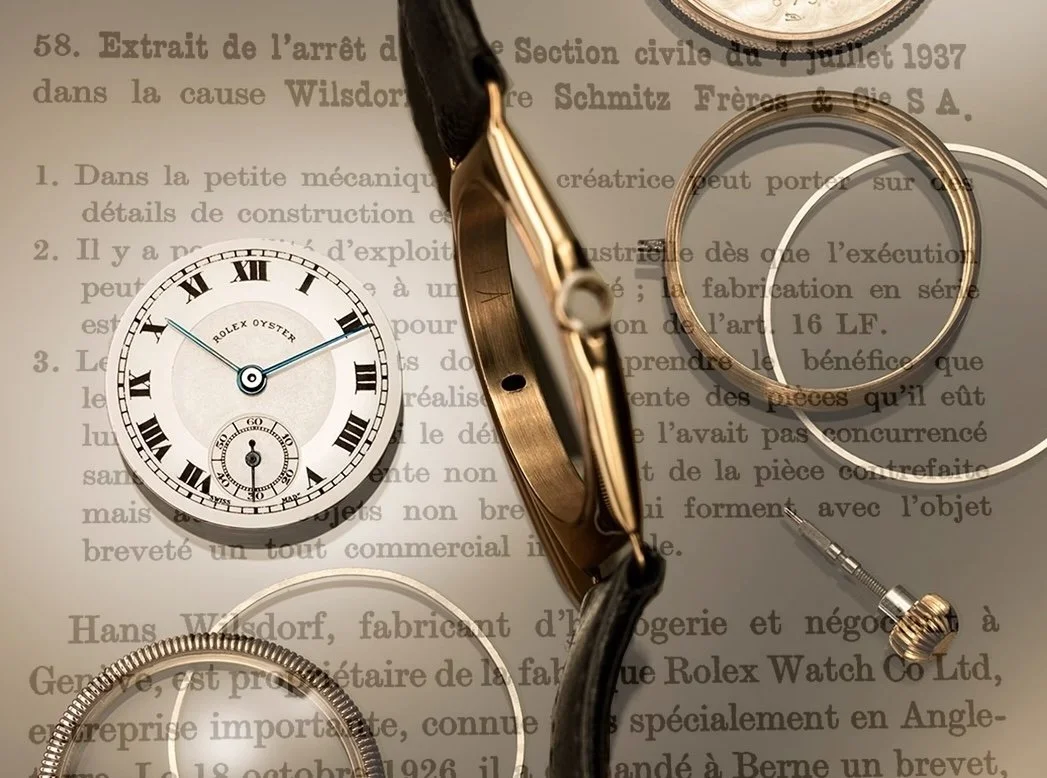
(Photo credit: Rolex & Fallrecht.ch)
As Rolex marks 100 years of the Oyster, a remarkable part of its history has resurfaced. A Swiss court ruling from 1937 appears to document the earliest known case of Rolex founder Hans Wilsdorf going to court to defend a patent, fighting for the invention that would define Rolex. The case reached Switzerland’s highest court, which brought in experts before siding with Wilsdorf. The ruling shows that at least one key moment in Rolex’s history has played out in a courtroom, with its fate in the hands of judges, perhaps one reason the brand continues to be litigious today.
The nearly 90-year-old case, discovered by watch writer Nick Gould on Monday, tells of Wilsdorf confronting a rival over a key Rolex invention. In 1934, Swiss watch-case maker Schmitz Frères & Cie told Rolex it planned to market its own waterproof screw-down crown, acknowledging “much analogy” with Rolex’s 1926 patent while insisting its construction was different. After Schmitz began selling the crown, Wilsdorf had one examined by an engineer, who concluded it infringed the Oyster system.
Wilsdorf filed a criminal complaint in 1935, and the dispute ultimately went before the Supreme Court after Schmitz challenged the validity of the Rolex patent. The court’s experts found the Oyster crown represented a meaningful technical advance. “L'idée n'est pas ‘géniale,’ mais c'est une bonne idée” (the idea was “not brilliant” but “a good idea”), the court said, meaning it needed not be brilliant to qualify for protection, especially in watchmaking, where innovation lies in small details. It upheld Wilsdorf’s patent and awarded him 10,000 francs in damages because Rolex had lost sales of complete watches, not merely crowns.