

Companies are talking more and more about sustainability in marketing materials, financial disclosures and earnings calls.
Apple, for example, mentions its green goals for 2030 multiple times during each new-product event — and even created a clip with “Mother Nature.” Business leaders in most industries have faced political and legal pressure to tackle greenhouse gas emissions.
(And some have been accused of greenwashing, misleading the public by overstating how much they do for the environment.)
Rolex is more discreet and, as a privately held company, doesn't hold earning calls. But its internal sustainability goals are worth writing about, as they reach beyond the well-publicized Perpetual Planet Initiatives that support environmental issues.
Coronet was first to report on Rolex's sustainability policy last year.

(Photo credit: Rolex)
Rolex, like Apple, says it has a 2030 goal to reduce its impact on the planet, including greenhouse gas emissions (GHG).
Rolex wants to cut GHG by 25% before the end of the decade. “This target is aligned with the decarbonization requirements needed to keep the rise in global temperatures below 1.5°C, in accordance with the Paris Agreement,” Rolex said.
Rolex said its GHG reduction targets are not just for its headquarters in Geneva, but also for Manufacture des Montres Rolex SA, Roldeco SA and affiliated companies of the Rolex Group in Switzerland, as well as service and distribution affiliates abroad.

(Photo credit: Rolex)
Four years ago, Rolex CEO Jean-Frédéric Dufour created the Sustainability Strategy Committee to help craft environmentally friendly policies. Last year, Rolex also created an advisory council by bringing together external experts who advise the company on sustainable development challenges, especially for the watchmaking sector, such as raw material traceability, human rights and other environmental issues.
One strength that Rolex has over most tech companies is circularity, as Rolex products last a long time and can be sold multiple times. The company even launched a Certified Pre-Owned program that allows customers to purchase second-hand models with peace of mind because they are guaranteed by Rolex.
Earlier this year, Rolex's goals for reducing greenhouse gas emissions were reviewed and approved by the globally recognized Science Based Targets initiative, which was founded in 2015.

(Photo credit: Rolex)
Rolex said its goals are to reduce direct GHG emissions from sources within the company — including purchased electricity consumed by the company — by 42%.
Rolex also wants to reduce by 25% indirect GHG emissions, meaning those GHG emissions that are not under Rolex's direct control because they are linked to activities upstream and downstream of the company. For Rolex, indirect GHG emissions currently account for the majority of its carbon footprint.
“We have been measuring our GHG emissions annually since 2019. Based on the results of our 2021 carbon footprint, we have set targets for reducing our GHG emissions and prioritized the actions with the greatest impact,” Rolex said. “These actions include sourcing raw materials, reducing the proportion of mined gold, switching from fossil fuels to renewable energy, purchasing efficient machinery and optimizing transport, mobility and packaging.”
To reduce the carbon footprint associated with its Oystersteel supply chain, Rolex said it has launched a pilot project for recycling production waste.
Oystersteel is an alloy manufactured by Rolex’s suppliers using waste from European industry. This waste represents 60% of the volume of castings on average, and consists of alloyed and non-alloyed waste. Rolex also said it knows the geographical origin of each of the minerals used in the steel alloys delivered by suppliers thanks to accurate mapping.
Earlier this year, Coronet reported on how Rolex was able to create a closed-loop refining of its gold waste — a recycling system of sorts — which allows most of its sourced gold to come from Rolex's own production waste; only 18% of the company’s sourcing comes from actual gold mines, and none from Africa.
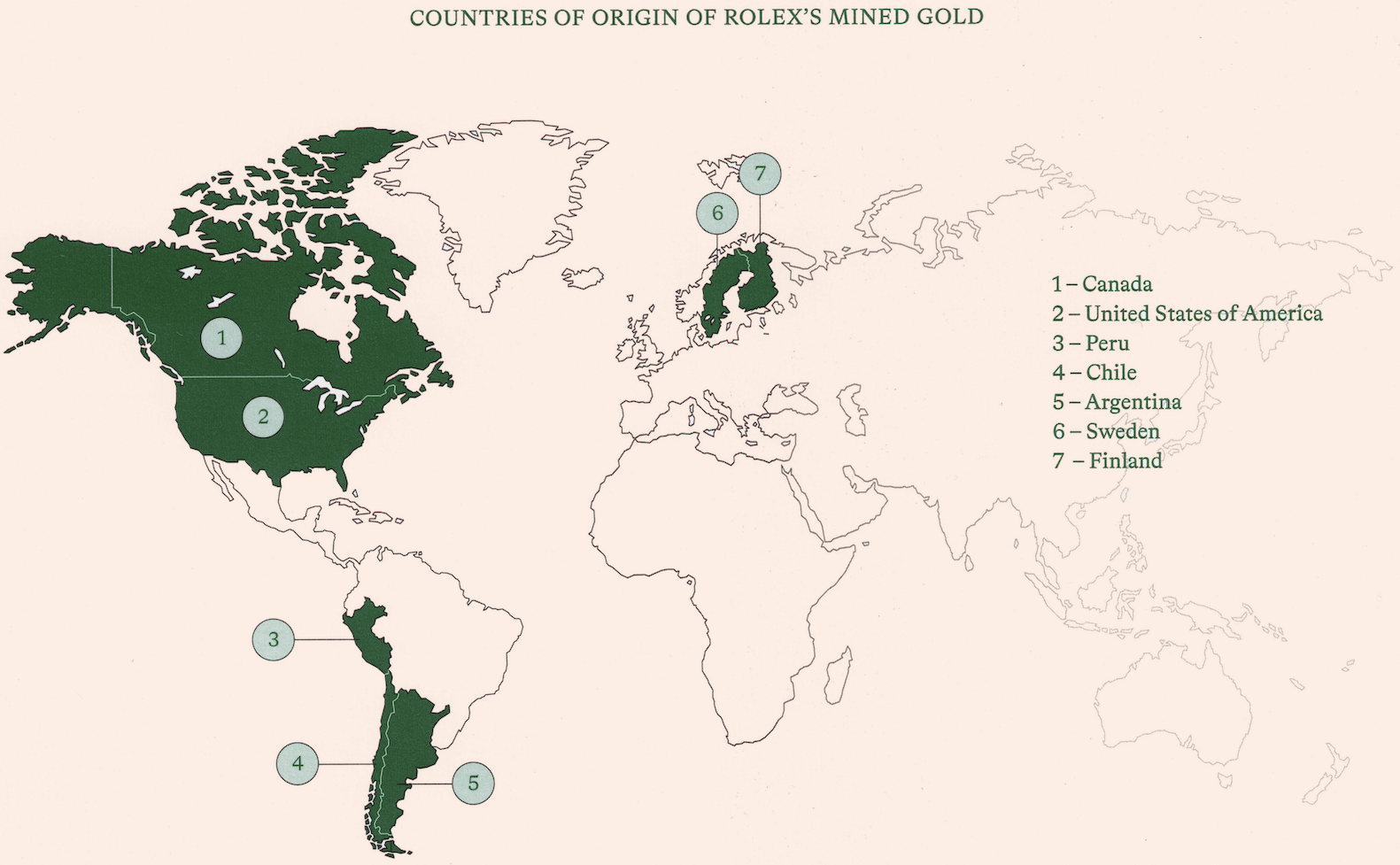
Source: Rolex
Rolex says being able to trace the entire journey of a material, from source to end use, “is crucial for us.”
Rolex's diamonds have no links to conflict-affected areas, the brand said. It uses a third party — the Kimberley Process — to certify its origins. Rolex said it has 100% declarative traceability that lists the countries in which they are extracted and cut.

(Photo credit: Rolex)
And when it comes to tungsten, tantalum and tin, Rolex said its suppliers use foundries that are certified by the Responsible Minerals Initiative (RMI). The certification guarantees that the value chain has been audited right down to the mine, and that human rights have been respected throughout the supply chain, including at foundries and refiners.
Last year, the watchmaker also built an alert system for anyone to register concerns linked to harmful effects by Rolex’s supply chain related to minerals or metals sourced from high-risk areas or involving child labor.
Meanwhile, Rolex continues to donate money through its Perpetual Planet Initiatives and Rolex Awards for Enterprise program. Though those sponsorships are shared on Rolex's social media channels and may feel like publicity, Mother Nature, I’m sure, could appreciate the results:
Thanks to Rolex financial support, no fewer than 48 endangered species were protected, 32 essential ecosystems preserved, 35 million trees planted and 57,600 km² of Amazon rainforest protected.

(Photo credit: Rolex)