

Turning ideas into dials requires rare expertise. It involves reconciling two different worlds: art and aesthetic sensibility on the one hand, and scientific knowledge and technical know-how on the other. It is a fascinating undertaking involving exploration, intense exchanges and a combination of curiosity, tenacity as well as a keen eye for beauty.
Each dial is a precious and rare composition, the secrets of which Rolex has mastered perfectly. Its skilled teams have learned the art of turning ideas into reality. David Riboli, who never leaves the house without a sparkling natural stone around his wrist or as a brooch on his jacket, is responsible for driving this process.

David Riboli, head of watch prototypes and dial expert at Rolex. (Photo: Etienne Malapert)
Schooled in Geneva, Riboli started at Rolex in January 2002 where he would become Responsable R&D Cadrans, or head of dial prototypes. Now in charge of watch prototypes, this enthusiastic and tirelessly curious man has discovered a passion for the fruits of the Earth, which he tracks down in all four corners of the world so that one day they can adorn the dial of a Rolex watch.

The creation of new dials requires constant communication between Rolex employees. (Photo: Etienne Malapert)
But this is almost a kind of sideline for this specialist in watch decoration, who began his career at the age of 15 as an apprentice in precision mechanics with a bracelet manufacturer in Geneva. What followed was a stream of experiences, training courses and encounters. Riboli has never stopped expanding his knowledge and delving deeper into all the aspects involved in the creation of a dial. Today, his passion for his craft means he can talk endlessly about everything from the mineral origins of die-cut turquoise to the principles that shape the beauty of watch dials. With a sense of precision, elegance and warmth, he shares the secrets of his trade.
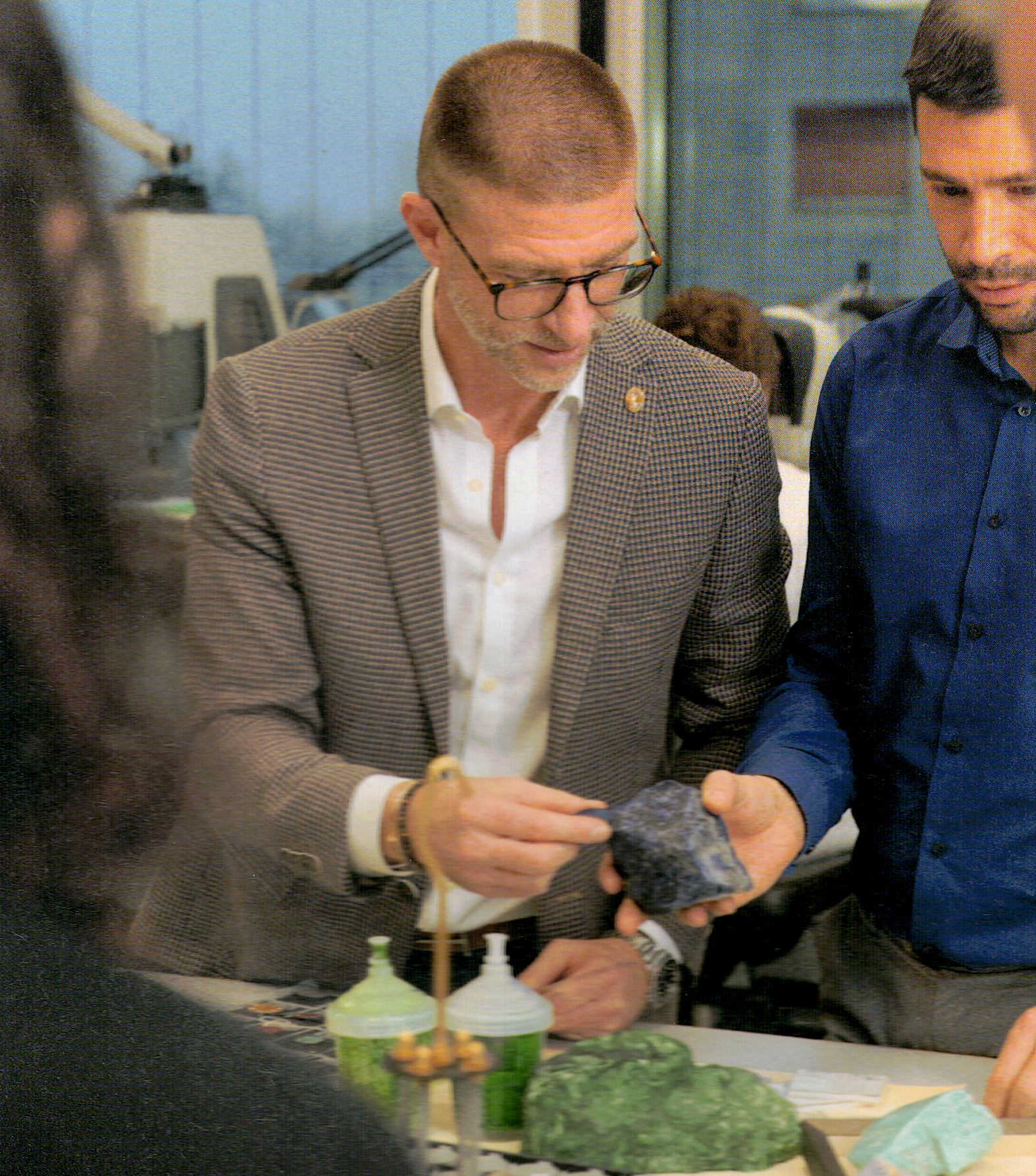
Rolex masters different techniques to color dials. (Photo: Etienne Malapert)
How do you go about creating a dial?
My work, along with my team, involves discussing a sketch with the designer to throw around some ideas or even just trusting our instincts and imagining how we might create a dial. The fact that a single idea can lead to four or five different dials based on various techniques and approaches means our role is unique and infinitely rich — combining imagination with technical expertise. Only one dial out of 10 — or even 15 — prototypes will make it into the catalogue. In other words, this is an exciting and ongoing process of exploration, in which we move forward by trial and error.

Filling in sections of a grand feu enamel dial using the champlevé technique. (Photo: Etienne Malapert)
What makes the development of a dial so unique?
It is often said that the dial is the face of the watch. It is the element that gives a particular model its individual personality. This dimension is even more pronounced when the dial is made of natural stone or mother-of-pearl because the natural material in question means that each dial is literally unique. As such, it is a key part of the overall design, the result of a rich and intense dialogue between the designers and the research and development teams.
What are the resources that go into developing new dials?
It is an almost paradoxical situation where the oldest techniques rub shoulders with the most cutting-edge technologies. Creating a new dial is a question of combining and reinventing the multitude of resources at your disposal. What makes this job so exciting is the constant challenge, which brings with it the need for hands-on innovation. For this reason, we keep abreast of the latest discoveries and technological advances, and constantly call on our colleagues in other departments, such as Materials, to explore new avenues.
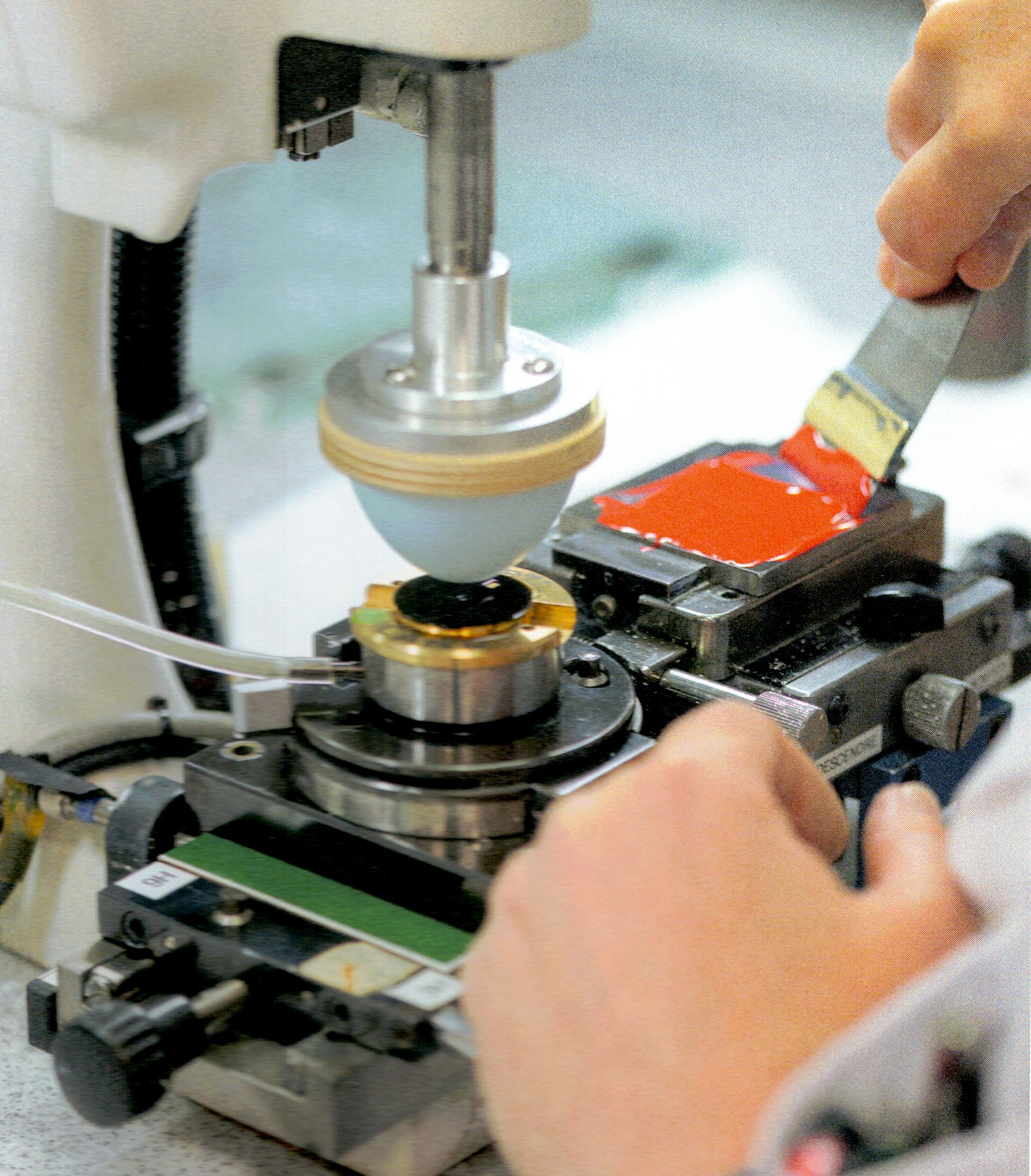
Pad printing a dial. (Photo: Etienne Malapert)
Do you sometimes come up against limitations?
By definition, the creation of new dials is not a path paved with success and success alone. However, we have the infrastructure and resources to go as far as we can or need to. For example, no fewer than four engineers may be working simultaneously on the development of a new colour. We also have at our disposal sophisticated facilities that are rare in the market and whose development we have frequently spearheaded. In addition, we are constantly improving the technologies we use. So, there are always new options to test, new concepts to explore. To give an example: we were able to create a design featuring small flowers by combining traditional sunray decoration with femtosecond laser engraving. The resulting petals have a sunray, matt or grained texture, creating a subtle play of reflections that gives the dial its personality. At the centre of each flower is a hand-set diamond.

Rolex individually selects each mother-of-pearl disc. (Photo: Etienne Malapert)
What know-how do you acquire when working on new dials?
Designing a dial, however flat and round it may be, literally means changing the way you look at things. And you also need to be able to listen, because inventing a new dial is first and foremost all about dialogue, exchange and even debate. It is important to be able to grasp concepts such as the depth of a color, the texture of a surface, the regularity of a decoration- for example, the striations of a sunray finish. But that is not the whole story. You also need to consider the environment in which the dial will be set: the color of the case and strap, the style of the bezel and the depth at which the dial is set into the case. My team and I also sometimes act as gatekeepers because it is not alwavs possible to achieve what the imagination wants, no matter how hard we try to make it work.
What is the purpose of developing a dial?
A customer is supposed to look at the dial of their watch with pleasure and eagerness. The dial has to make a natural statement through its beauty and harmony, captivating and impressing by virtue of the perfection of its design, its color or colors, as well as its decorative elements. To achieve this, you need a trained eye and a keen sense of observation - one of the main qualities that most of the people who work on the design and manufacture of the dials have. Of course, measuring instruments do exist, such as the spectrocolorimeter, which assesses the tone of a color. But there is no substitute for a well-trained human eye. This is why, for example, all the sunray-finish dials are checked one by one to ensure that the striations are uniform and regular. The beauty of a dial is what makes it so captivating. This is why it has to be crafted to perfection.