
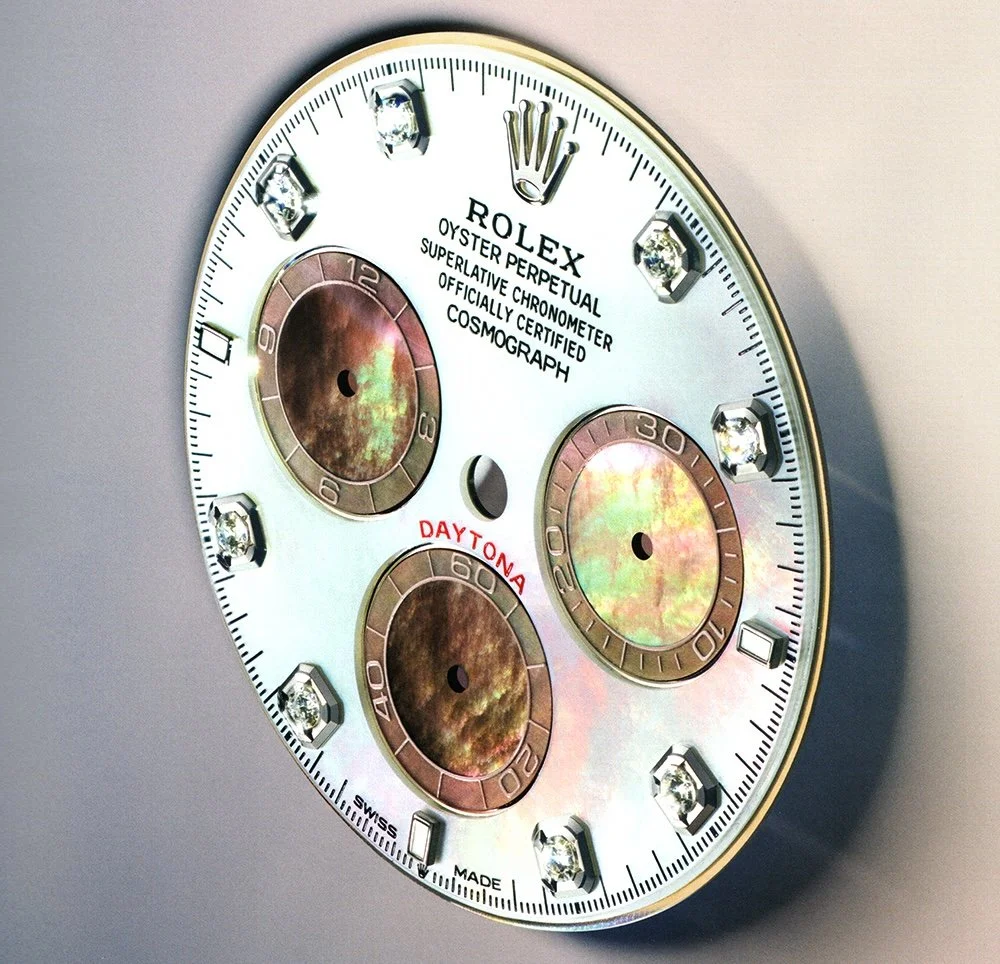
With Watches and Wonders less than two months away, it’s worth remembering how important the dial is to a watch, especially in Rolex’s collection, where models often share the same movement, and cases may vary by only a millimeter or two. Rolex’s new releases, whether a Daytona with a turquoise dial or the Land-Dweller with its honeycomb pattern, are often praised or criticized because of the dial.
The dial is the part of the watch that gives Rolex the most creative freedom, and it is considered a major component of the watch, so much so that an aftermarket dial can render the entire piece unserviceable at a Rolex Service Center, even if the movement and case are authentic.
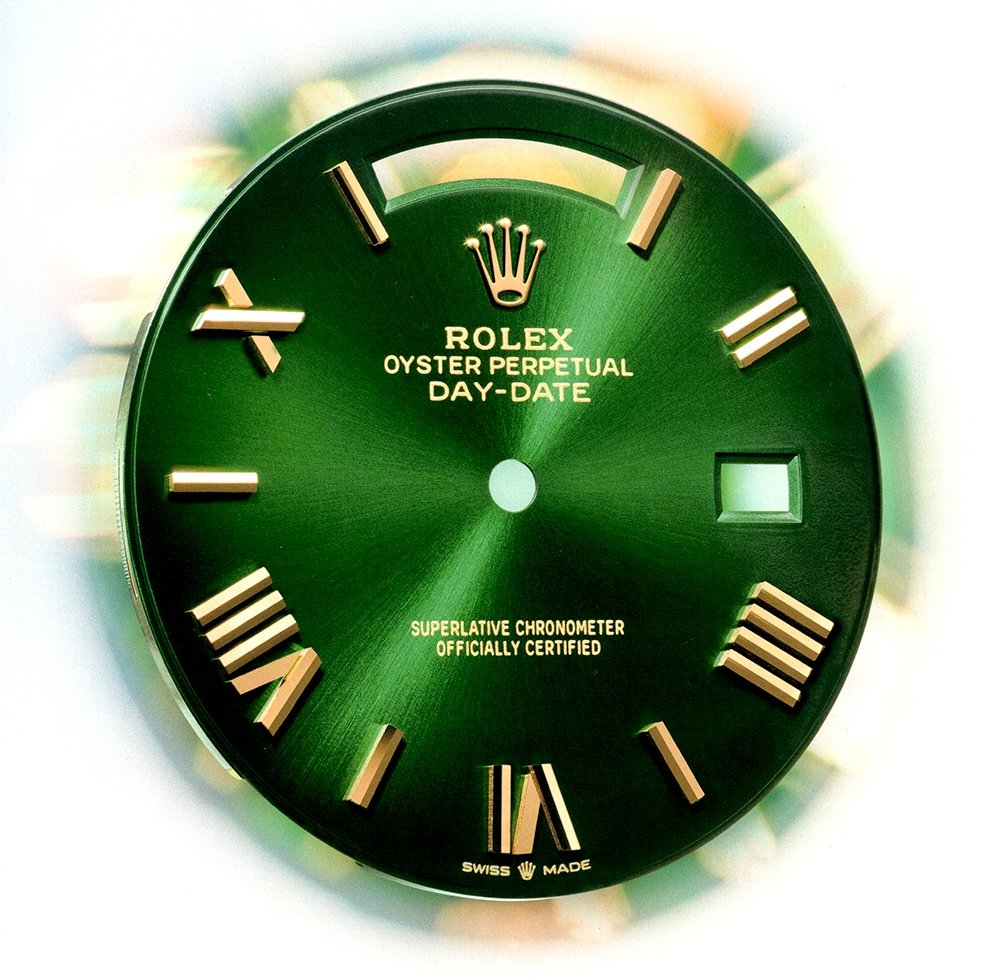
Sunray finish. Green ombré dial for a Day-Date 40 in yellow gold. (Photo credit: Rolex)
Unlike other parts of the watch that are exposed to the elements, the dial is protected, allowing Rolex to use it as a canvas in ways that would not be possible on a bracelet or bezel, resulting in textures and materials rarely seen elsewhere. From natural stones like opal, turquoise and eisenkiesel to diamonds and other precious stones, few other brands have Rolex’s production capacity in the art of dial making. Rolex says about 500 employees work every day to design and manufacture dials at its Chêne-Bourg site in Geneva. Another fun fact: Rolex dials undergo resistance testing. In addition to visual inspection, a sample of assembled dials is subjected to a drop test to ensure the hour markers remain firmly attached.
Although the dial gives designers the most creative freedom, it also requires adherence to a number of rules, many of them unspoken. “I can tell you, it is very hard to invent a Rolex when you look at all the Rolex models,” Jean-Frédéric Dufour said at Dubai Watch Week in November. “It has to remain a Rolex. You need to find something that means something for you and also for the final customer, a balancing act between tradition and the future.”
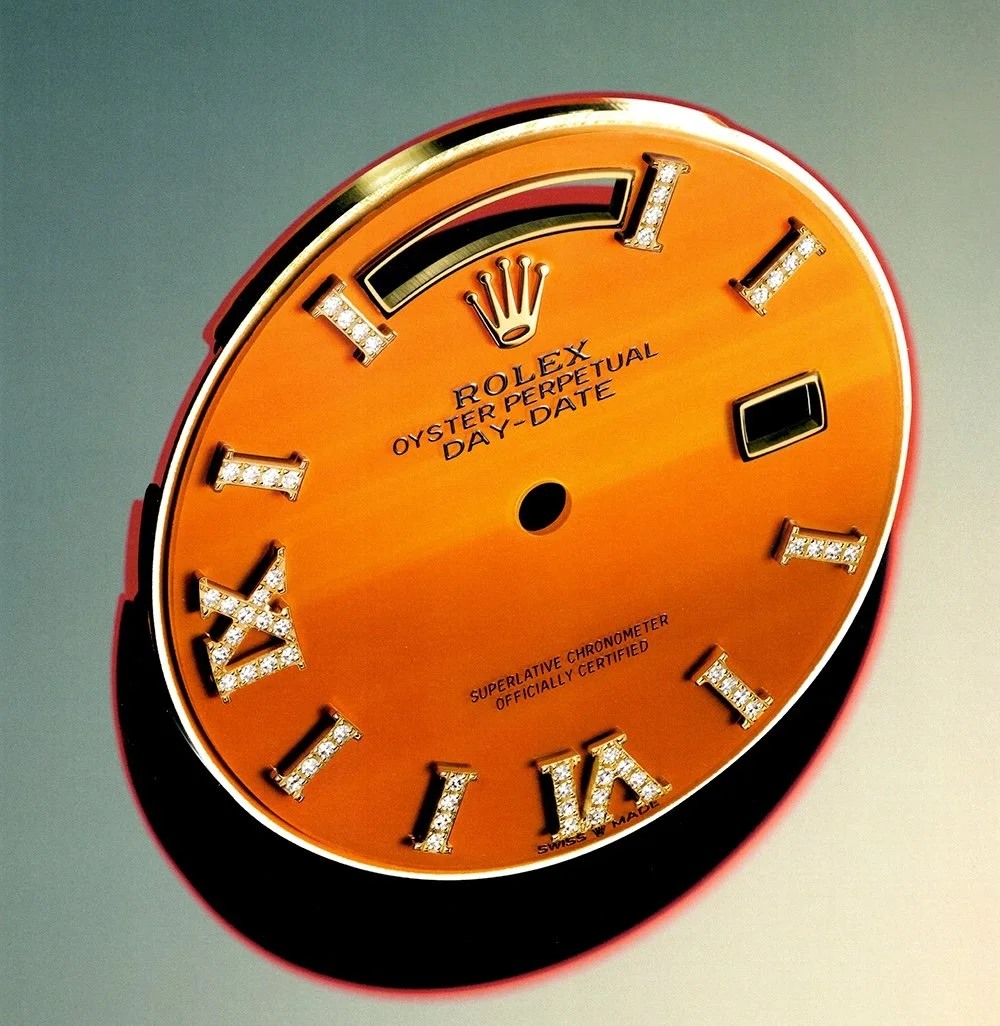
Natural stone. A carnelian dial in orange with a cameo pattern for the 36mm Day-Date. (Photo credit: Rolex)
Rolex wants a dial to be instantly recognizable, bearing the brand’s codes and visual signatures specific to each model. That creates boundaries for the designer. As an expert in shapes and volumes, the designer must also account for balance in lines, colors, textures, shapes and proportions. Without that balance, Rolex says, “the aesthetics of a dial will have no impact and the owner of the watch will tire of it quickly.”
In some cases, designers also consider external components. For example, the Datejust dial was developed with the fluted bezel in mind, even though it is not technically part of the dial.
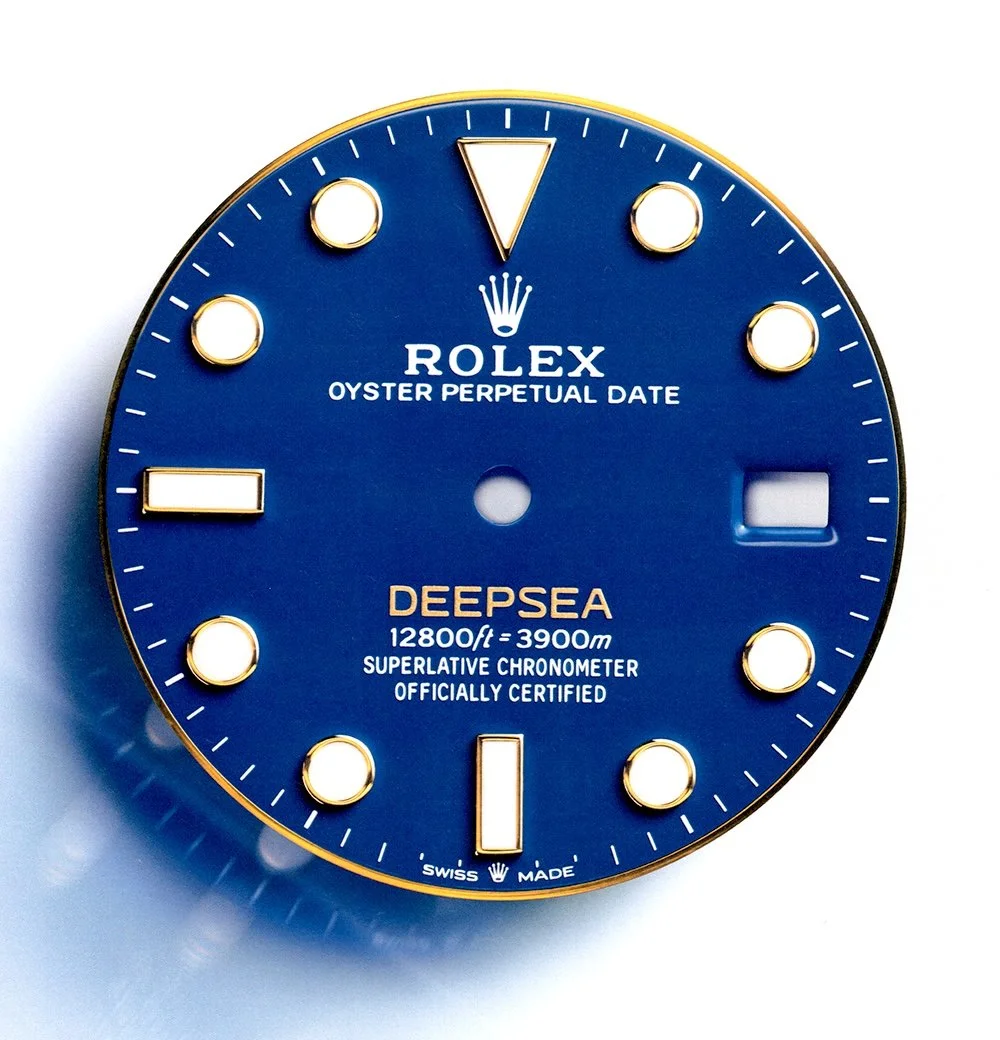
Lacquer dial for the Deepsea in yellow gold. (Photo credit: Rolex)
Design Development
Once the dial’s aesthetics are defined, a dial specialist from the Research and Development division at Rolex becomes involved. The specialist’s task is to translate the designer’s vision into something tangible by creating the first prototypes — a collision, of sorts, between artistic creativity and technical constraints.
Through trial and error, testing and re-testing, the final dial takes shape. Rolex says it may require as many as five prototypes before the design is finalized and goes into production. At each stage, the dial undergoes inspection and analysis to ensure the required level of quality. More than 60 operations are required to transform a brass or gold disc into a finished dial ready to be fitted into a watch, according to Rolex.
Rolex is also known for the quality of its natural dials, across both Classic and Professional lines, from stones such as green aventurine, carnelian and onyx to meteorite and mother-of-pearl.
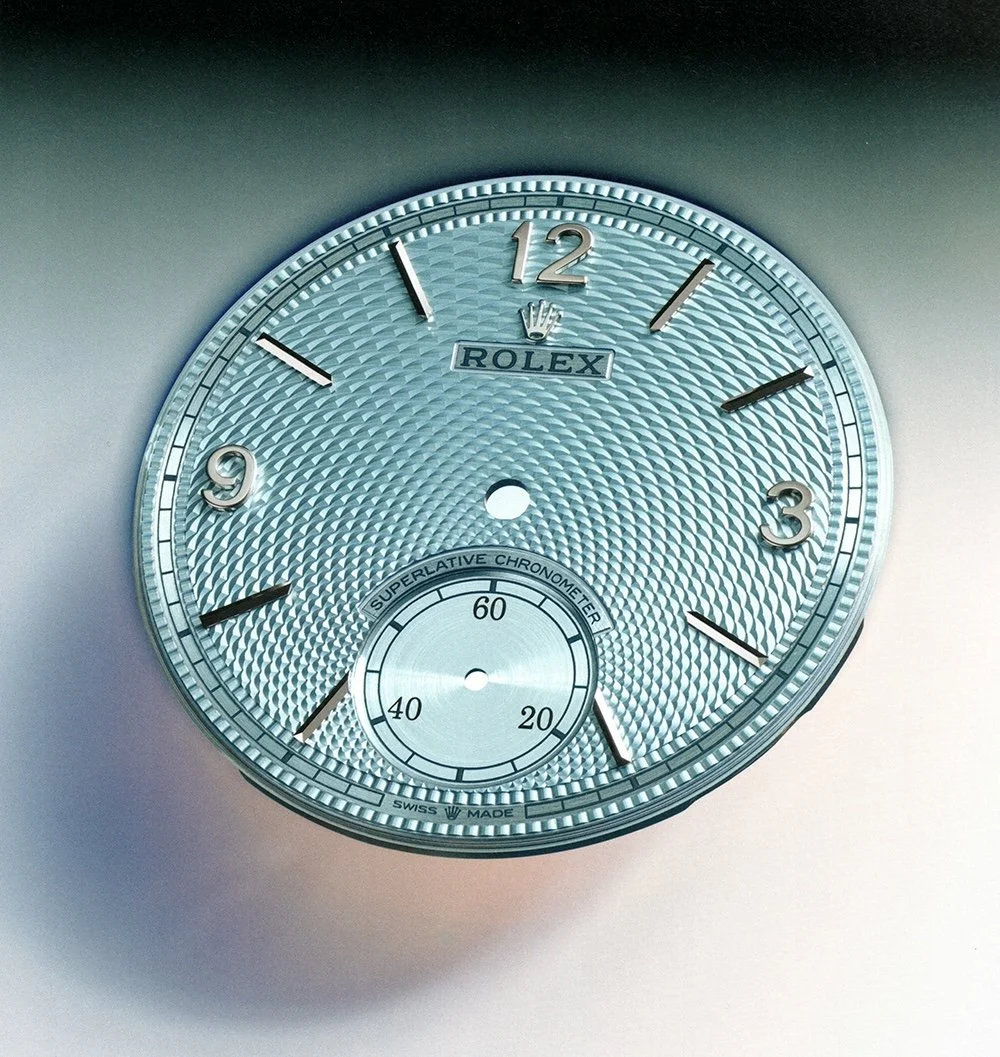
Guilloché. A rice-grain motif engraved on an ice-blue dial for the platinum Perpetual 1908. (Photo credit: Rolex)
The manufacturing process begins with what Rolex calls “les ébauches,” small round plates cut from strips of brass or gold, including those used for diamond-set or enameled dials. Each disc is drilled and milled to create openings such as the date window and holes for the appliqués. The dial is then polished to remove machining marks, before being sprayed and dipped in galvanic gold and nickel baths. This creates a protective layer that prevents oxidation and ensures the uniformity and longevity of the applied color. Gold dials are not treated in this way, since gold does not oxidize.
The Finishing Touches
The material used to color the dial gives it its distinctive appearance, as with lacquered dials. Lacquer is primarily used for deep, intense colors such as black and white, but also pink, turquoise and green. It is airbrushed in thin coats inside a clean room to prevent dust contamination. Rolex applies several finishes, the most traditional being the sunray finish. Traditional decorative techniques are also used, including guillochage and grand feu enameling using the champlevé technique.
Rolex also uses physical vapor deposition (PVD), a process that colors dials by depositing a layer of atoms less than one micron thick onto the surface. The brand says its color catalog includes dozens of proprietary shades and continues to expand.
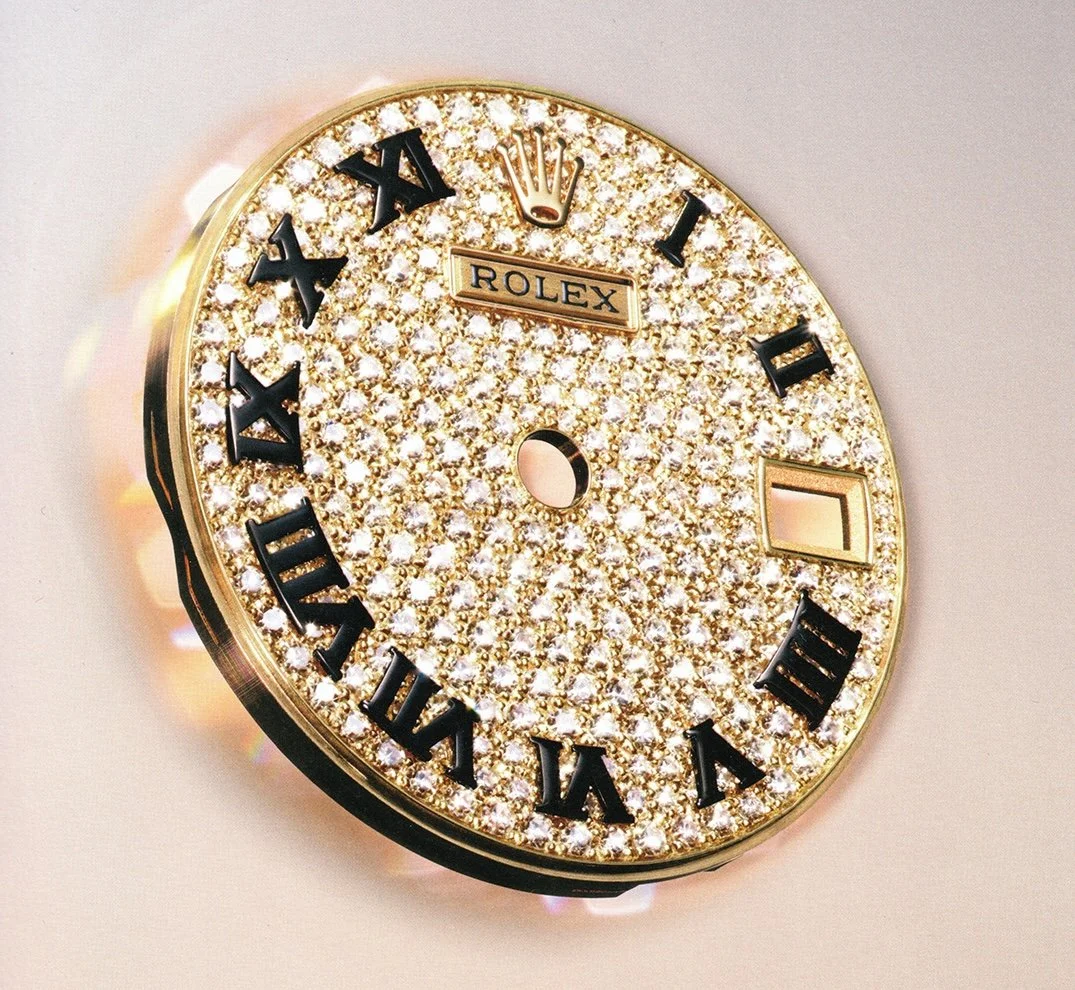
Gem setting. Gold dial entirely set with diamonds for Lady-Datejust in yellow gold.
Each year at Watches and Wonders, Rolex wants to highlight not only its expertise as a watchmaker but also as gemnologist. Sometimes only the hour markers are set with diamonds; other times the entire dial is paved with hundreds of diamonds, each set by hand on a gold base.
Final Assembly
The appliqués are then placed on the dial by hand. The watchmaker matches the feet of each appliqué to the corresponding holes using precision tweezers with paper-covered tips to prevent scratches. The feet are then riveted using a hand-operated press: fifty bars of pressure applied over a microscopic surface to secure them beneath the dial.
Amid all the talk of AI taking over jobs, dial manufacturing at Rolex may be among the safest crafts in Switzerland. More than any other part of the watch, it is where beauty, art, technology and expertise meet at the most visible level.