

How does Rolex define time? Rolex uses a Rubidium Optical Atomic Clock to help produce the very second used to calibrate its precision-testing machines.
According to Rolex, its atomic clock’s accuracy surpasses other atomic clocks by as much as 60 times, taking the brand beyond traditional timekeeping and into the realm of defining time itself. One of Rolex’s optical atomic clocks will be the first of its kind to contribute to the realization of Coordinated Universal Time (UTC).

(Photo: Rolex)
Humans have always relied on recurring natural phenomena to locate themselves in time: the alternation of day and night, the cycle of the seasons, and even eclipses; and more recently, the oscillation of a pendulum, the vibrations of a watch’s balance hairspring, the beat of a quartz crystal, and finally, the resonance of the atom.
Every atom has electrons that can jump between energy levels. When an electron changes state, it absorbs or emits radiation at a precise frequency unique to that atom. For example, caesium-133 atoms always resonate at exactly 9,192,631,770 cycles per second when stimulated in the right way. To compare, a quartz oscillator vibrates about 32,768 times per second.
So today, it is the atom, the building block of all matter, that is used to measure the most precise second and define the "international second."
To do this, modern atomic clocks stimulate caesium 133 or hydrogen atoms at a specific rate, much like a tuning fork. Next, they adjust their stimulation frequencies to achieve the maximum amplitude for the oscillation signal. This oscillation is then used as the reference standard. The higher the rate of oscillation, the more accurate the clock.

(Photo: Rolex)
In its quest for precision and integration, Rolex has created a "two-photon rubidium optical atomic clock,” the only one of its kind in the world. To achieve this, the brand has joined forces with the Swiss Centre for Electronics and Microtechnology (CSEM) in Neuchâtel.
The result of several years of research, the clock's technology relies on the use of atoms from rubidium, a metallic element that can produce frequencies 100,000 times higher than current atomic clocks.
In concrete terms, rubidium atoms are heated to a gaseous state and then stabilized to a thousandth of a degree. At the same time, an erbium-enriched optical fibre amplifies light from a laser which excites the rubidium atoms. Once they have been stimulated at a very precise, very high frequency (385 terahertz), these atoms emit blue fluorescent light when they return to their ground state. This blue fluorescence is what Rolex uses to define its reference second.

(Photo: Rolex)
The Rolex Rubidium Optical Atomic Clock's precision outperforms other atomic clocks currently available by as much as 60 times. Its operational stability is unequalled for a clock of this type. It has a drift that is less than 0.1 billionth of a second per day, which is equivalent to less than one second per million years. In an industrial, calibrated version, the clock provides the most accurate second — doing so continuously and with the greatest of regularity.
Three units of this new optical atomic clock have been produced: one each for Rolex's Geneva and Bienne sites, and a third for the Swiss Federal Institute of Metrology (METAS) in Wabern. Each of the two Rolex Rubidium Optical Atomic Clocks installed on the brand's premises are integrated into a time scale made up of Swiss atomic clocks.
They produce the second that is now used as a reference for setting Rolex precision-testing machines. The brand subjects each of its watches to rigorous internal tests that cover precision, self-winding, autonomy, waterproofness, resistance to magnetism, reliability and durability, as part of Superlative Chronometer certification, which guarantees each watch a precision of plus or minus two seconds per day.
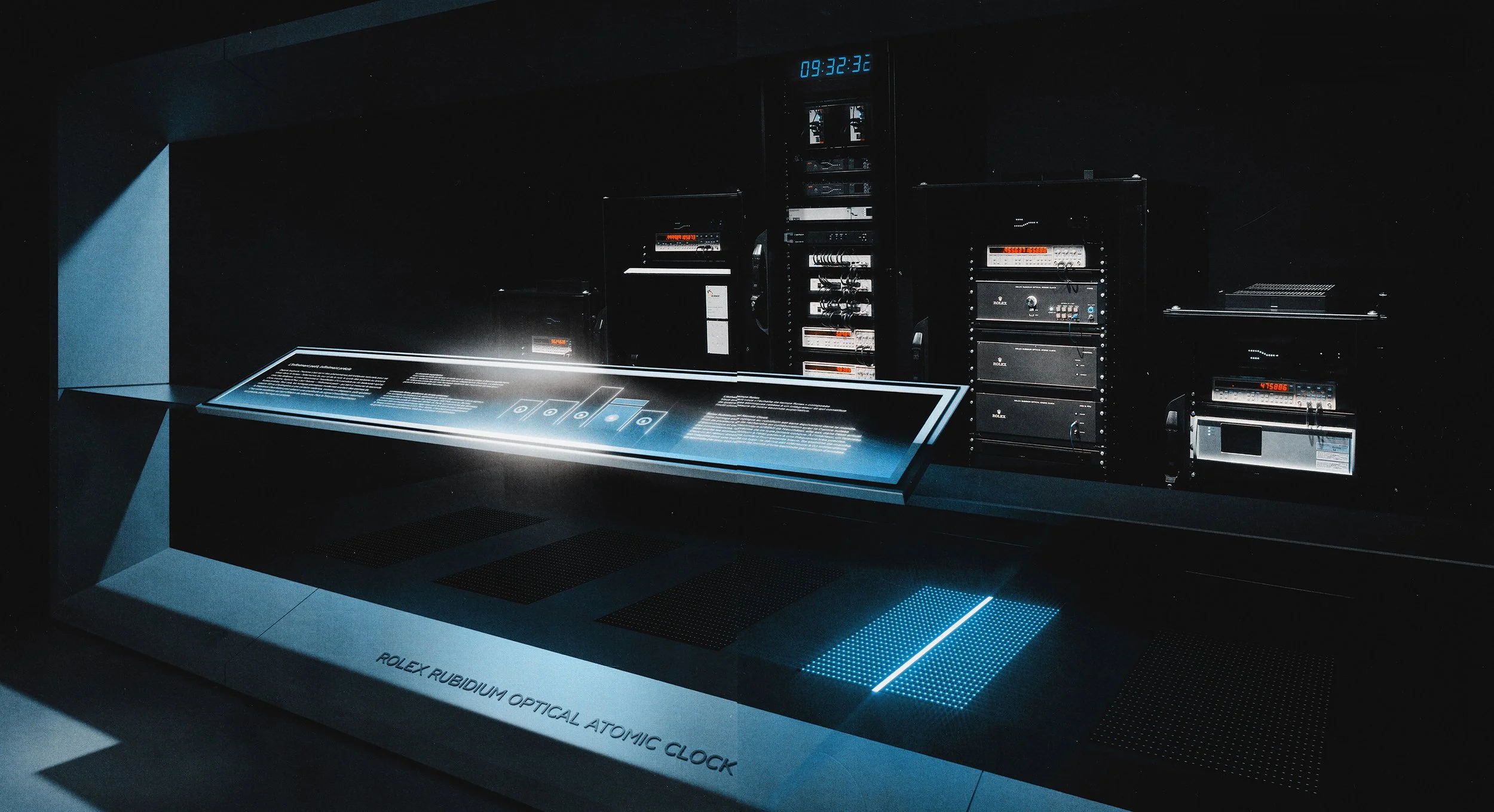
The Rolex time scale, comprising several Swiss atomic clocks, is located at the Les Acacias site in Geneva. Depicted in this photo by the blue pattern on the floor, the Rolex Rubidium Optical Atomic Clock is up to 60 times more precise than the other clocks in the time scale. (Photo: Rolex)
Coordinated Universal Time
The third clock, housed at the Swiss Federal Institute of Metrology, will also be integrated into a time scale, with the clocks contributing to Coordinated Universal Time (UTC).
A clock, even an atomic one, only tells local time. In order to get global — or universal — time, a reference time is needed, attained by combining measurements from several clocks. The signals from the third Rolex Rubidium Optical Atomic Clock will be transmitted by METAS to the International Bureau of Weights and Measures (BIPM) in Paris, where data from around 450 atomic clocks from all over the world is centralized to determine Coordinated Universal Time. As such, this third clock will become the first optical atomic clock to contribute towards the realization of international time.
Meanwhile, the signals from the other two Rolex Rubidium Optical Atomic Clocks will also be transmitted to METAS, and then forwarded to the BIPM, further helping to establish Coordinated Universal Time (UTC).
Rolex now sets and certifies its watches using its own second: a superlative second that will contribute to realizing UTC time. Rolex is doing more than keeping time accurately; it’s now helping define it.