
The watch market has gone through a turbulent phase since the emergence of the quartz movement. At this point in its history it finds itself at a bit of a crossroads, with the Chinese market slowly becoming saturated and more traditional markets facing stagnation, investors are starting to ask themselves - where do we turn for growth?

A vintage Seiko QR Quartz 3863-7010 for sale on TVW.
Markets, as with industries, have cycles and patterns. Oftentimes the role of an investor is to try to discern said patterns or understand those cycles, in hopes of taking advantage of them. I’d like to think I’ve formed some kind of hypothesis that could help answer the question above, where should watch brands turn for growth? The basis of said hypothesis, aspects of the economics surrounding the watch industry, is something that's come up recently in discussion between myself and Ariel Adams, things he discusses often in his articles for aBlogtoWatch. The hypothesis is as follows: first, to understand the best markets to pursue for growth, one needs to understand the stages of development of luxury goods markets, and therefore at which stage the market in questions finds itself. Second, you need to understand the underlying fashion trends most likely to lead to a healthy luxury goods market. This often entails looking at the culturally hegemonic country of the day, the country that is the de facto taste maker and culture exporter in our globalized world, to understand how these trends affect the market in question. With these two tools in hand you can understand, at least theoretically, which market should be next up for growth; be it for luxury goods as a whole or just watches. Do note that although I may describe things as relevant to the luxury goods market overall, the premise is that they are also pertinent to the watch market.
The luxury goods market moves through certain phases, from the earliest stage of a luxury goods market’s development; one where consumers want to be associated with brands and status, to one where consumers want to be associated with taste or sophistication. The premise of this theory is that as economic growth is undertaken – even on an individual level – consumers value different things, or rather, individuals are regarded better or worse in society for their association to different brands/products. To break down the cycles of the luxury goods market we first need to define what we classify as the phases of growth of a luxury goods market. For simplicity, we’ll stick to three phases: the Brand Association phase, the Great Schism phase, and the Reconciliation and Consolidation phase.
Phase 1: Brand Association
The Brand Association phase describes a nascent period in the development of a luxury goods market, where consumers seek to associate themselves with certain brands that in their minds are identifiers for wealth. This is due to the structure of the society, that, as follows with economic development, sees: an upper class that is extremely small, no significant middle class, and widespread economic disparity. As such, only the minuscule upper class can afford said luxury goods and their value is perceived to be much greater to the wider society. The effect of this structure is that the average consumers will view a luxury item as an object that automatically qualifies an individual as wealthy, given that only a small percentage of the population can afford it. This disparity is what leads individuals to seek association with brands themselves, because it will indicate to others that they belong to a certain elite social group. For luxury goods brands, this is not a good prospect for growth because: only a negligible percentage of the population can afford your products and likely already purchases them when they travel abroad, only a few brands will be noteworthy enough in the minds of the general population to get a hold of the market and the general economic, and political instability that can be expected from underdeveloped countries is extremely unfavourable for luxury goods products as they have elastic demand. In addition, this economic and or societal structure usually leads to the growth of a market for counterfeit goods, as is the case in many Asian, African, and Latin American countries – doubly detrimental to luxury goods brands. Summarily, the market is simply not mature enough or lacks the ‘luxury goods culture’ to appreciate a wider variety of brands, products, and styles. A brand like Rolex may do well in Indonesia, but NOMOS not so much. In this phase, the culture towards luxury goods is completely based on recognition as opposed to being based on quality and craftsmanship, as is the case in more developed countries or luxury goods markets. So, while a select few brands may see opportunity, in general, the investment is not worth it.

Baselworld 1986 / Credit: Baselworld
Phase 2: Great Schism
Then there’s countries in the second phase of development, the Great Schism. This is akin to a later stage in the economic development of a country. In this phase, there is a divide between those who still seek to associate themselves with brands or wealth and those who seek to associate themselves with sophistication and taste. The divide extends to the economic classes; the traditionally wealthy have now stopped seeking association with wealth and have moved onto seeking association with sophistication and high culture. In contrast, as the poorer segment of the population can now afford luxury goods, they now seek association with wealth through brands as they still perceive it to be a legitimate means of achieving social status. This is also why this phase is defined as the Great Schism, as there are essentially two completely different societies within one single market. This divide could be explained in that, the once absolutely (in the statistical sense) small upper class, has grown both absolutely and relatively in the last half century – as such, there is more wealthy people to compete with and it becomes more difficult to distinguish oneself with the same tired old brands. Moreover, since the lower classes are now both absolutely and relatively wealthier, they too can afford luxury goods, diminishing their association with status. Those who seek to be associated with status or wealth (the upper class) are forced to find other ways of representing themselves in such a fashion. The upper class stops flaunting certain brands or items to disassociate themselves from those of lower socioeconomic status and find more discreet or ‘sophisticated’ ways of displaying wealth, such as: living in certain neighbourhoods, sending their kids to certain schools, joining certain social cubs, and all the rest. Essentially, segments of the lower classes are left behind in terms of fashion trends or ‘luxury goods culture’. It is important, however, that the economy (and society) of said country is trending upwards; converging towards the third phase of luxury goods market development, as this growth is what creates opportunity for luxury goods brands.
Canada is an example of this Schism, its luxury goods market being a healthy mix of status-seeking and sophistication-wanting consumers. In general, the upper classes are unidentifiable by their attire alone given that luxury goods have been proliferated throughout Canadian society for decades. They choose to let their status be known by other means, like those mentioned above. The other, lower classes in Canadian society have great access to luxury goods; their salaries are on par with those of the upper class in less developed nations, there are credit cards, car loans, and a whole slew of factors that play into most Canadians being able to afford luxury goods. The difference, or Schism, based on socio-economic status, can be observed in ones’ behavior towards luxury goods items. To put it simply, some people wear Gucci belts with their shirts tucked in and others don’t wear Gucci belts at all. Or, in other words, some people seek to be associated with brands that they perceive to be indicators for wealth and others seek association with things like sophistication. Again, this interim phase is what presents opportunity for luxury goods brands as there is movement trending towards the third phase of development and the market is in growth mode. Ideally, brands want to participate in reaching that third phase as the brands themselves have the opportunity of becoming hallmarks in society. Moreover, most of the population can afford the brand’s products, economic and political stability should’ve been achieved, and different segments of the population are more open to variety than in the previous phase (bespoke styles, microbrands). Plus, counterfeiting has been phased out.
Phase 3: Reconciliation and Consolidation
Finally, there’s the Reconciliation and Consolidation phase, essentially what I’ve observed in Italy. In this phase the country is at a mature stage of development, both socially and economically. This is usually underlined by a long, (generally) uninterrupted and shared history – along with a very vibrant artisanal culture that has a deep respect for craftsmanship and the arts. Essentially, a country in the third phase has such a well-established culture and society that people, even subconsciously, have a firm idea of their place in it and feel less of a need to appear as something they’re not. Therefore, the propensity to use brands to misrepresent oneself as wealthy or otherwise is minimized as virtually the entire population now seeks association with sophistication and taste over outright wealth. In Italy, for example, a 2016 study by Guglielmo Barone and Sauro Mocetti found that the wealthiest families in Florence had remained so for the better part of 600 years. Just a piece of evidence to demonstrate how established their society is, as with many other Western European nations. What does this mean for luxury brands? Nothing really, chances are most brands are already present in these markets or even incumbents in them and are instead looking to get away from potential saturation. There is certainly opportunity, as competition is rampant, but less so for incumbents and more so for new entrants to the market. This is also the reason I call it the Reconciliation and Consolidation phase, because as opposed to the previous Schism phase, the population is somewhat in agreement as to taste and culture surrounding luxury goods, having already passed through the third phase.

So, to summarize the definitions of the three phases: the first, Brand Association phase presents a circumstance in which virtually all consumers seek to use luxury goods as an indication of their social status and the market is generally viewed as underdeveloped for luxury goods brands, usually including a healthy market for counterfeit goods. The second phase is a transitionary one, the population is divided between those that seek to be associated with taste and sophistication, through their luxury goods, as opposed to being associated with outright wealth. This is the best phase for the luxury goods brands as a large portion of the population is already familiar with the type of product and is open to variety, while another portion still associates products with wealth but trends towards an association with sophistication. The third and final phase is one in which the association made with luxury goods is purely based on quality, craftmanship, and taste. The opposite of the first phase, with crass displays of wealth being looked down upon by the majority of the population. There can be opportunity in this phase, however, as is reflected in the market today; saturation is prevalent.
How Is This All Relevant to Shareholders?
Well, to understand what markets to penetrate next we need to look to the future, having understood how luxury goods markets develop we need to be able to discern those that are truly in the second phase and those that are merely experiencing economic growth disguised as luxury goods market development. The difference is culture.
We know that Europe and North America are excellent markets, we also know that growth won’t last forever. So, to understand what markets will be prominent in the future we need to see where taste, trends, and culture is being exported by the leaders of today.
A favourite historical example of this is Japan and South Korea. South Korea has a very robust market for watch collectors, car collectors, and other luxury goods items. A culture it exported from Japan, who was at a more advanced stage of luxury goods market development, after centuries of domination, trade relations, and culture exchange. The result is a luxury goods market that is uniquely evolved in contrast to those that surround it. As evidence, in my research of Instagram hashtags I found that hashtags for things like ‘Seiko’, ‘Rolex’, or ‘Wristwatch’ were flooded with counterfeits and bots in languages like Thai, Malay, Indonesian, and even Mandarin. Meanwhile, in Japanese or Korean, the posts were mostly collectors, much like in Europe or America, sharing their passion. In this, Korea seems to have skipped a step in the chain of economic development, supposedly due to its association with Japan and decades of the domination that left a lasting mark on the Korean luxury goods sector. Korea was able to develop a luxury goods market akin to Japan or many other quasi-Western nations despite not having experienced the same history or development as those nations but by its association to a nation that had. Having understood how luxury markets develop in the early 20th century, one may have predicted that Korea would emerge as a strong luxury goods market given its history with Japan. Japan in turn could be said to have developed its luxury goods culture partially due close ties to the West, which likely accelerated it; although Japan has a centuries old tradition of high-quality craftmanship.
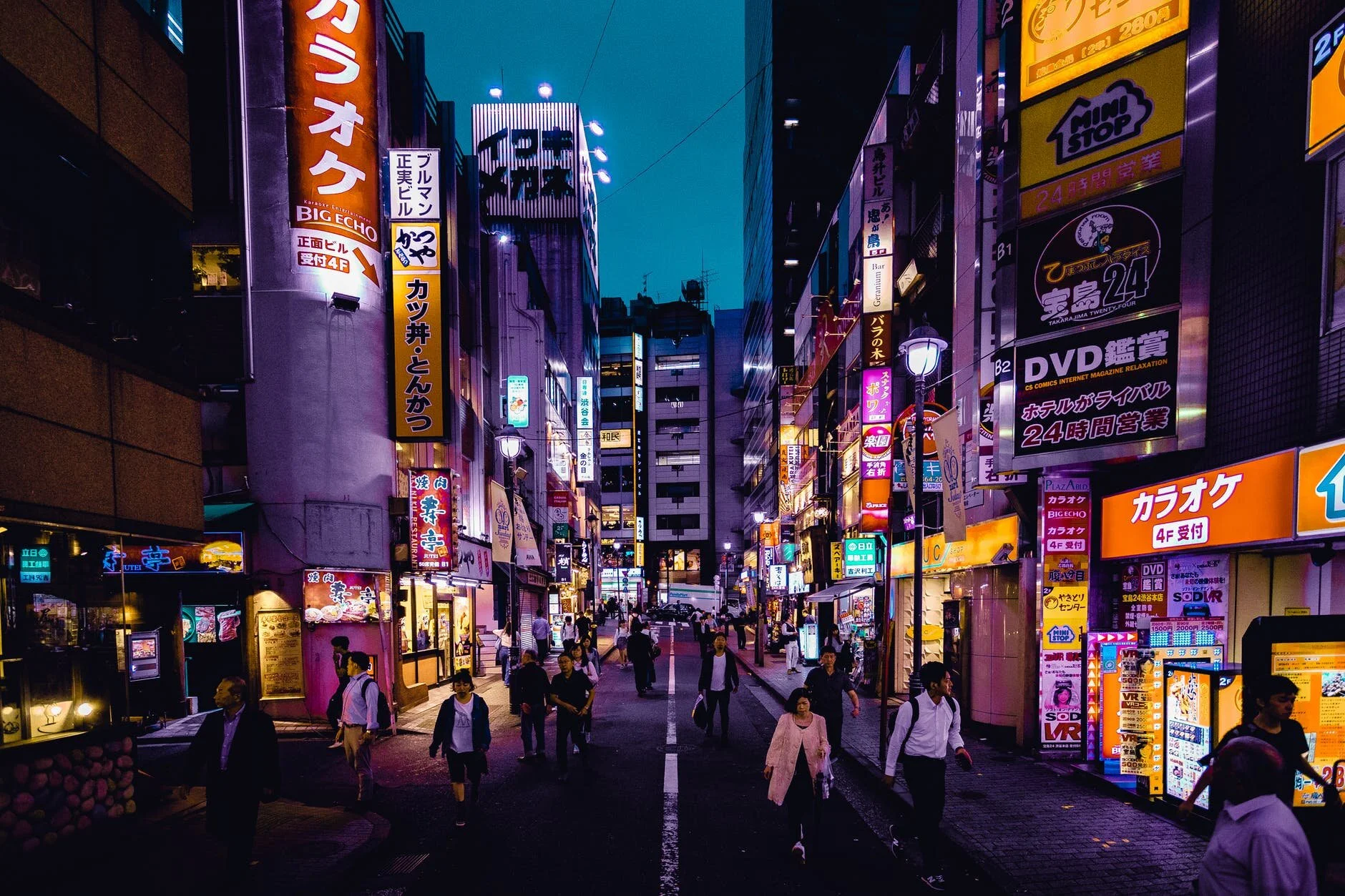
Tokyo at night
Another example in the region is the discrepancy between Cantonese and Mandarin hashtags, with Mandarin seeing a greater percentage of counterfeit goods and bots. In theory, the same effect is present here as is in South Korea; the cultural impact of the British Empire on Hong Kong was partly that of a lasting and deep penchant for craftsmanship and art – a culture of luxury goods consumption that was already established in the United Kingdom was transferred to its colony. Following this theory, the next luxury goods growth markets will be those that have close cultural and economic ties to the United States, the hegemonic power and undisputed cultural titan of the day (although regional considerations should also be made). This, in combination with being at the right stage of luxury goods market development, will lead to the ideal conditions for a luxury goods brand to enter the market. Shareholders must: identify the countries that are at the right stage of luxury goods market development and, of those countries, identify those with the closet ties to the United States or Western culture as a whole, to understand where they can sell their products. Consider how many posts #QatarWatchClub has on Instagram in contrast to #LagosWatchClub; that should tell you something about which country is closest in culture to the hegemonic power of the day. Other factors can help you determine that Qatar is at a later stage of luxury goods market development than Nigeria, and therefore a better target for luxury goods brands to expand into. This is where NOMOS can compete and this is the answer to the original question, where investors can turn for growth.
In recent history, we’ve seen the rise of smartwatches, microbrands, and the internet all change the way we buy, enjoy, and learn about watches. We’ve also seen the Chinese market blow up, effectively sustaining the sector for the last few years, and the fluctuation of sales in other, more traditional markets. Sadly, however, nothing lasts forever. And as the Chinese market recedes, we are compelled to go out and look for new opportunities. Where and how we find them is to be determined, but today we explored a framework through which anyone can understand and analyze the industry. The three phases of luxury goods market development are tools that can be used by companies to better understand consumers and by consumers to better understand the marketplace they’re in and the general direction it’s moving in. This, in combination with an understanding of the culture factors that influence individual consumers and societies at large, makes for an effective way of discerning where and why the watch market will move. The phases of growth in luxury goods markets are real, as are the historic culture factors that influence the development of said markets. It is natural that someone from the coast will take better to swimming than someone from the countryside, as it is natural that a society that has more cultural exchange with another will start to adopt traits or habits from the other society. If you understand where trends are pointing towards and why they’re pointing in that direction, you can intercept those trends and use the information to your benefit.
As participants in the luxury goods industry, we need to confront the socioeconomic factors that drive our sales and understand the fundamentals behind the markets that catch our eye. The watch market has never been easy, nor have luxury goods as a whole. But gaining a deeper understanding of it is ever more important, especially as the market tightens and growth opportunities are fewer and farther between.
By: Andres Ibarguen

Vintage Seiko Quartz Pocket Watch 7412-803K for sale on Toronto Vintage Watches.