
The History of Panerai and What Makes It Unique
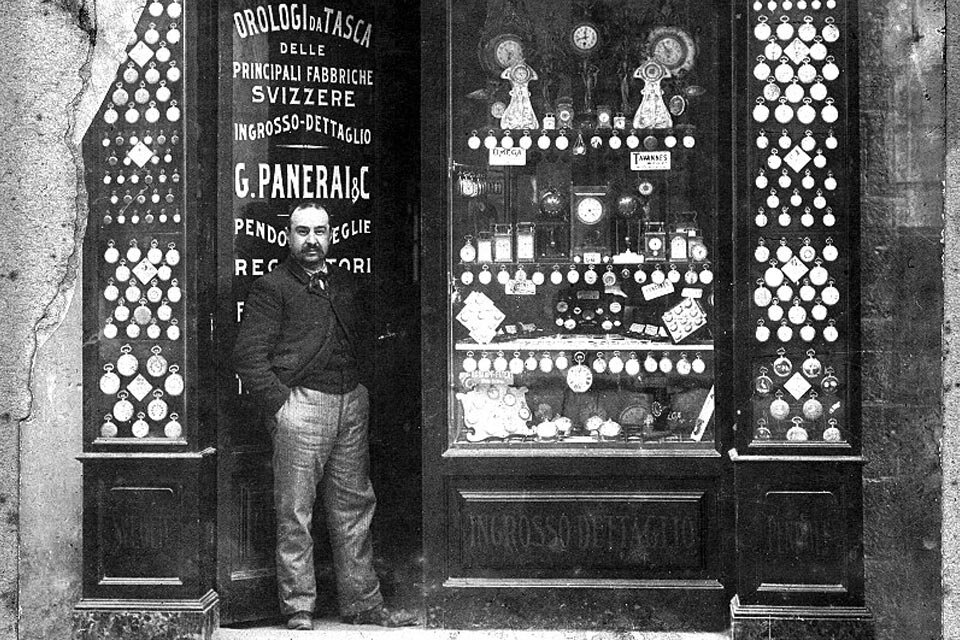
Giovanni Panerai outside his shop
When I first moved to Italy, my roommate constantly reminded me that parmesan isn’t cheese, it’s parmesan – something totally different. I’ve always struggled to understand this concept, that is until I met my first Paneristi. He was very eager to remind that he wasn’t ‘wearing a watch’ but a Panerai (“No. No. Questo non è un orologio, è un Panerai”). At the time I didn’t distinguish him as a Panersiti; they’re good at camouflaging themselves, but eventually I came to understand this distinction, or at least I thought I did. The concept of “Made in Italy” is certainly unique, especially if you think of what it represents in contrast to “Made in China”. But how does it translate to the world of horology? Is Panerai really so special or is “Made in Italy” just a nationalized marketing scheme? Well, I’ll say this for now: unlike a Maserati, a Panerai runs better than it looks.
Panerai was founded in 1860 in Florence, Italy by Giovanni Panerai. Originally, Panerai was essentially a retailer and mechanical workshop, making a variety of instruments. Giovanni’s grandson Guido expanded the shop and launched a new company called ‘G. Panerai e Figlio’ (G. Panerai and Son), which became official suppliers to the Regia Marina (the formally Royal Italian Navy). This also marked the birth of the Radiomir in 1916. Radiomir was a radium-based paste developed by Panerai for luminosity, its high visibility and adhesive properties making it an excellent choice for dial markers. The first Radiomir prototypes appeared in 1936 and were assembled by Rolex. Rolex continued assembling Panerai watches until 1956, when Panerai made its first manufacture models. However, at the advent of WWII, the Regia Marina’s requirements changed, and an even more rugged timepiece was needed. This resulted in the ‘Radiomir 1940’, which specifically used the same piece of steel for the case and lugs, making it even more water resistant. Although referred to as the Radiomir 1940 even today (and by Panerai itself), that watch was actually a Rolex Panerai ref. 3646. What Radiomir 1940 really refers to (soldered lugs, single piece of steel case) is a Rolex Panerai ref. 6152, released in 1952. After the war, in 1949, Panerai trademarked the name Luminor. Luminor, in the 1960s, would become the name of the Tritium-based lume that would replace Radiomir. They also supposedly started conducting experiments with Luminor/Tritium in 1949. The following year, the first prototype with the famous ‘Luminor’ crown guard was developed, these prototypes were designed in a similar rugged fashion as the ‘Radiomir 1940’ for the Regia Marina before them. The crown guard was patented in 1955 and fitted to a Rolex Panerai ref. 6152/1. Despite being referred to as having been developed for the Luminor (again, even by Panerai), the first of the famous crown guards appears on Radiomir models. Since then, the reissues of the Regia Marina Radiomir produced at the begining of WWII have been referred to as the Radiomir 1940 and the crown guard models released in the 1950s have been referred to the Luminor/Luminor 1950 - erroneously, supposedly for marketing purposes.
Nonetheless, these four models: the Radiomir, the Radiomir 1940, the Luminor, and the Luminor 1950, make up the bulk of Panerai’s collection, even today. Although there has been significant developments since those early days – specifically in 1972 with the death of Giuseppe Panerai.
But what’s the special sauce that has made Panerai such a maverick? Well, I’d say it comes down to four factors: their hyper focus on a few models, their military tool watch history, over a century of family ownership, and their unique, iconic, easily recognizable design.
Let’s unpack.

Panerai Radiomir
Panerai, like Rolex, and even Omega for that matter, make almost the same models as the ones they started out with. Think about it. The Radiomir, the Radiomir 1940, the Luminor, the Luminor 1950 – very little has changed! The Oyster Perpetual, the Submariner, the Speedmaster, the Constellation – many iterations but essentially the same models and the same watches. I think this helps collectors and enthusiasts feel an enhanced connection with the brand and its history. Moreover, it helps it feel as if the brand is older, and therefore more authentic and collectible. If you release a new model every year, people forget about what that model means to them. But if your grandpa, your dad, and you all have a birth-year Submariner…well you’ve basically gone into the business of buying Rolexes. This is the same for Panerai, albeit in a bit more of an Italian way.
Second, there’s the fact that Panerai watches are essentially THE original military dive watches, you simply cannot buy that PR. Especially considering the market for MilSubs, it’s like making the first watch worn on Everest…or the official watch for NASA astronauts…
The next reason is a bit obvious, but there are some cultural nuances that are important: Italy is a highly fragmented country, and just like its internal geopolitics, its economy is also highly fragmented. There are thousands of small business all operating in the exact same sectors, simply covering different geographical and cultural regions (acquisition spree anyone?), most of which are family-owned and operated. Given the strong cultural importance of family ties and succession, especially in business, the fact that Panerai fits perfectly into this mold, and more so is a historic and iconic Italian brand, makes Panerai’s brand image inside and outside Italy one that is distinctly and definitively Italian. For non-Italians I imagine it’s even more striking, meanwhile Italians are fiercely proud of the brand.
Finally, there’s the design, no one makes watches like Panerai…well actually there are a few companies…but apart from the copycats and ‘homages’, Panerai design is Panerai design. When you see it, you immediately know what it is – no logo needed. This is significant for two reasons: first it makes Panerai a stand-alone, independent brand, at least in our minds. Ever asked yourself why so many companies use Mercedes hands when we all know they’re associated with Rolex? Or why brands keep releasing homages instead of making new models? Panerai would never find itself in a discussion regarding originality and over time this has created a cult following, uber important for the consumer brands of today. In fact, they do the opposite of pumping out homages; having kept essentially the same models since its inception. The second reason is that Panerai’s unique design exemplifies Italian craftmanship or “Made in Italy”. Imagine old Giovanni Panerai sitting in his little shop in Florence tinkering away at some watch movements; it sounds like archetypal Italian imagery but it’s Panerai’s REAL story. The fact that they spend millions of dollars and tons of manpower on research only speaks to the refinement typically associated with Italian craftwork – the handmade, artisanal quality that we appreciate across so many product categories. Panerai is authentically Italian, they’re also authentic watchmakers.
So, to bring the circle back around, Panerai is distinctive from other watches – just like parmigiano is distinctive from other cheeses. Among well-known watch brands, Panerai is the only major Italian player. As such, everything about it is slightly differentiated from any other big watch brand as they strive to maintain their Italian identity. As consumers we see Panerai in a different light than the Swiss brands, and even differently than Japanese luxury brands like Grand Seiko or Credor. Panerai watches themselves have a unique mix of luxury and utility and people truly do stand out when they choose to sport a Panerai over a Submariner; it sends a message. All of these factors make Panerai special in the watch market, the same way parmigiano is unlike any other cheese. You’re not just going to pick up a cow and make a new version of parmigiano the same way you can’t put Arabic numerals at 3,6,9, and 12 o’clock, throw on a bulky crown guard and square-ish case, and call it original design. Not happening. As such, Panerai is to horology as parmigiano is to cheese. Two products in a category that don’t exactly fit in that category.
By: Andres Ibarguen
Editor’s note: In a previous version of this article we reported various aspects of Panerai’s history incorrectly. We’d like to thank Panerai expert Jose Pereztroika for helping us correct these mistakes.