
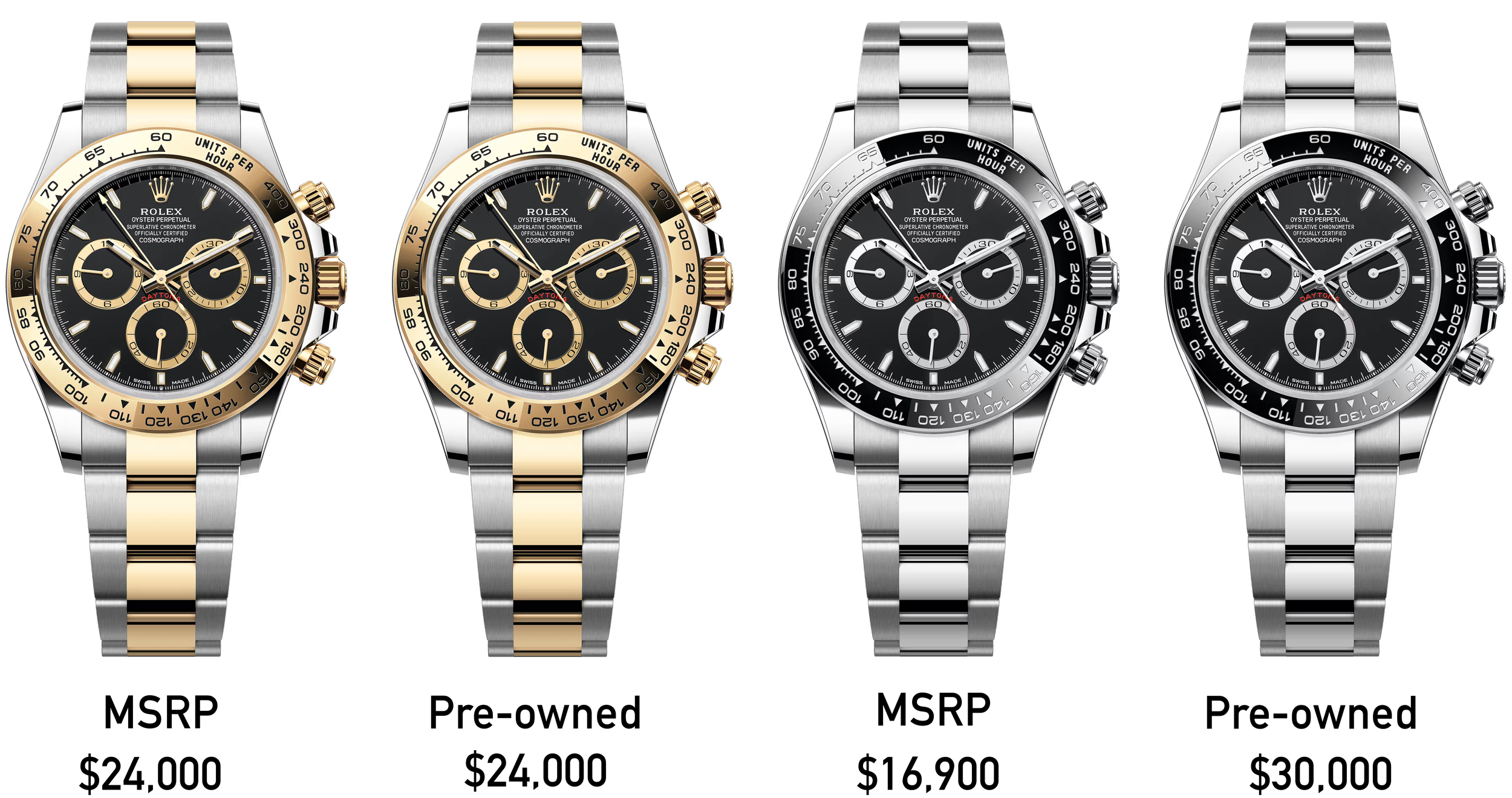
Retail and resale. (Photo credit: Rolex)
Recent rumors of a Rolex GMT-Master II Pepsi discontinuation, which sent prices up by several thousand dollars in a matter of days, are a stark reminder of the two distinct paths to pricing chez Rolex. One is set by the brand through official retail prices, typically based on production costs, positioning and material value. The other is set solely by buyers and sellers, in a market where supply and demand dictate value.
That second path operates completely independently of retail pricing and material cost. In one example, a stainless steel Daytona retails for $16,900 but trades near $30,000 preowned. Its Rolesor version retails $24,000 but resells for roughly the same price, despite its higher intrinsic value. A Rolesor Daytona commands no premium, while a steel Daytona’s MSRP increase would have almost no effect on its secondary value.
Few industries are like Rolex, where watches with entirely different pricing dynamics can sit just feet from each other at official retailers. Prices in one display case are set by Rolex; in the other, by supply and demand, regardless of intrinsic value. At the whim of the brand, production can stop even if a model is in high demand. Conversely, the brand can reintroduce a line, putting pressure on prices for models thought to be discontinued. This process will play out again next month, as it does each year, when Rolex reveals its new catalog.
Now that Rolex benefits from secondary-market price swings through its wholly owned Bucherer’s CPO program, it stands to gain by playing the market. The brand could release a new Pepsi this year without discontinuation. But it may be better off discontinuing the model, then reintroducing it two years later to capitalize on the hype created by both moves, something it did with the yellow-gold Daytona with a green dial.
Thank you to Sébastien Page for the idea for the story. Follow him here.