
The Story of the Seiko Caliber 8T23
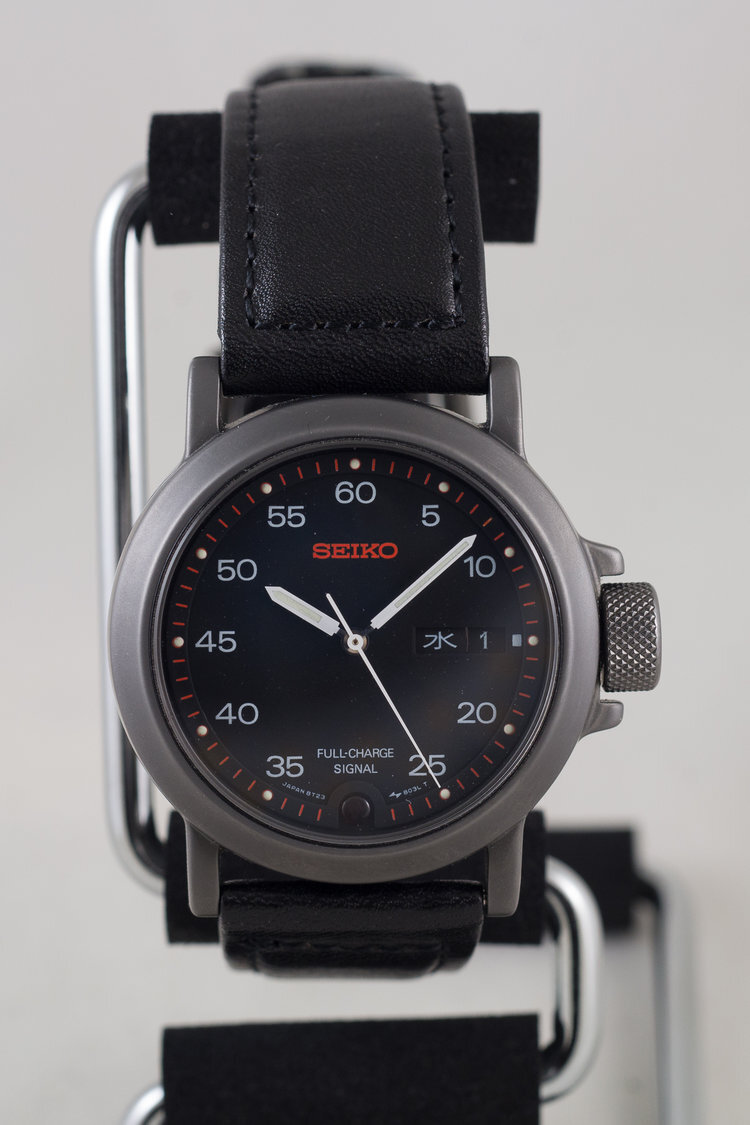
Seiko ref. SBAD003 featuring the Cal. 8T23 / Credit: Plus9Time
The world of horology is always full of surprises, we’ve all seen the Kama Sutra watches on Instagram along with the array of ultra-complications available today. But what if we told you that at one point someone decided to combine one of the ancient hallmarks of horology, the manually wound crown, with…one of horology’s least savory products…quartz.
In the early 1980s, almost two decades after the initial launch of the Astron, Seiko started experimenting with their watch batteries, leading to the development of the Caliber 8T23, the world’s first manual winding quartz movement. The idea of winding quartz does not at all come from a bad place, the calamity caused by quartz in the 1970s created tons of mercury batteries in need of disposal, the environmental impact of which was starting to weigh on watch manufacturers. In theory, today alkaline batteries are fine to dispose of normally, whereas the mercury batteries of the 1970s and 80s exhibited toxic effects.
The first two models featuring the Seiko Caliber 8T23 were the SBAD003 and SBAD001, both launching in 1986. Given the watch’s unique disposition, it also had some interesting features…It had an oversize crown to facilitate the winding of the watch, a red LED light at 6 o’clock that glowed when the watch was fully charged, and a 75-hour power reserve. However, the main downside of the watch was that it took 3 minutes of winding to fully charge the capacitor; not so convenient in hindsight. As a result, the Caliber 8T23 was unfortunately not a very successful endeavor for Seiko. The movement didn’t make it to its second year of production, with Seiko pulling it off the shelf just after the 1-year mark.
To make up for its failure, Seiko released their kinetic technology, the Automatic Generating System, in 1988; a winding system that has stayed in play for over 30 years and is now featured in dozens of Seiko watches. Despite the failure of the winding quartz movement, the positive take away is that it led to the development of Seiko’s kinetic technology – something that was definitely worth the wait.