
A History of Vintage Girard-Perregaux Quartz Watches

Girard-Perregaux Cal. 350 / Credit: Hodinkee
Some people are staunchly anti-quartz, ‘horological purists’, as they may call themselves, dedicated purely to mechanical horology. This article is not for those people. This is for people who appreciate watchmaking no matter the source of power. Those who do not discriminate between quartz and mechanical movements. This is the story of a Girard-Perregaux movement that dominated the quartz market decades ago: the Girard-Perregaux Caliber 350.
People remember the Beta 21 and when Hamilton introduced the Electric 500 in 1957,but the Girard-Perregaux Cal. 350 is an often-forgotten step in the development of quartz/electric watch movements. A movement that introduced key technological developments to the market.
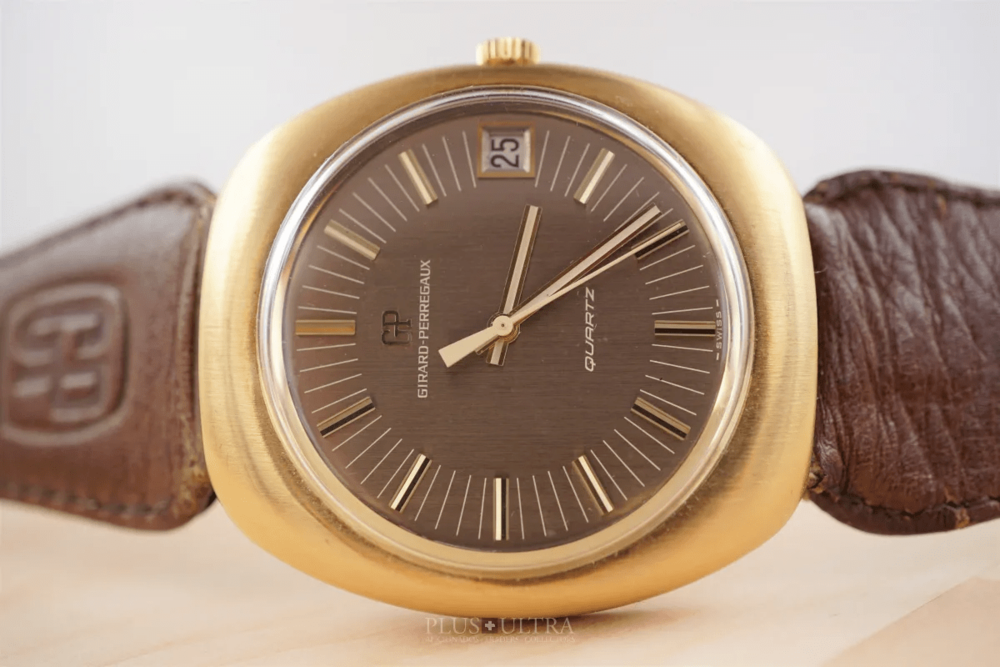
NOS 1972 Girard-Perregaux Cal. 350
Accuracy and battery life were major issues that the Girard-Perregaux Cal. 350 improved upon from its inception. The Bulova Accutron partly solved the accuracy issue, as Bulova’s tuning fork movements were far more accurate than any other watch for years, but the GP solved both. Girard-Perregaux released their new movement shortly after the Seiko Astron, in 1971. The Girard-Perregaux Cal. 350 beat at a rate of 32,768Hz, which dwarfed the comparable rate for a mechanical movement at the time – despite being the standard for quartz watches today. Moreover, the accuracy of the Girard-Perregaux was unheard of, less than 0.2 seconds per day! The watches were large, with bulky classic 1970s cases, and came in steel, gold-plated, or 18k gold cases.
Girard-Perregaux was extremely successful with the Caliber 350, allowing brands like Jaeger-LeCoultre to use it as well and having watches with the movement certified by the Neuchâtel Observatory, winning in 1971 and 1972 against their Swiss and Japanese counterparts!
Ultimately, the Caliber 350 from Girard-Perregaux is a reminder of the impact of many lesser-known quartz calibers. Next time you see a 1970s quartz GP going for next to nothing…buy it!
By: Andres Ibarguen