

By next week, the Ecole d’Horlogerie de Genève, the esteemed watch school that will mark two hundred years next year, will officially have moved to a new building in Plan-les-Ouates, the same Geneva suburb that is home to one of four Rolex manufactures.
The purchase and development of the new six-story, 22,000-square-meter building was financed by the Hans Wilsdorf Foundation, owner of Rolex S.A., for a total of 125 million Swiss francs, one of Rolex's biggest investments in the future of watchmaking.
Meanwhile, in the heart of Geneva, 31 homeless people have found shelter in a hotel’s renovated annex, which opened earlier this month.
The former four-star hotel, La Cour des Augustins, and its annex had been purchased by the Hans Wilsdorf Foundation, which then handed the keys over to the Collectif d’associations pour l’urgence sociale, or CausE, a group of non-profits that include the Salvation Army, le Bateau Genève, Caritas Genève, la Roseraie, le Centre social protestant and Première ligne, according to its website.
There was no press release, no event; no Rolex-wielding celebrity standing in front of the cameras.

Though the annex opened on Oct. 1st, the 32-million-franc hotel is still undergoing renovations. It’s on track to receive by the end of next year dozens more who will be allowed to stay for a maximum of 60 days, according to CausE.
How La fondation Hans Wilsdorf really started is unclear. In 1945, soon after the passing of his wife, a childless Mr. Wilsdorf created the foundation to which he would cede complete ownership of Rolex. In the foundation’s statutes, Mr. Wilsdorf listed potential beneficiaries, including some considered quaint by today's standards: “Cultivated and deserving women should receive discreet help,” he wrote.
Still, after almost every point, Mr. Wilsdorf noted “à Genève” or “genevois” even though he himself was an immigrant and had to cede, in 1926, an estate he had recently acquired to the canton by parliamentary decree.
To this day, the very discreet foundation, which is administered by an eight-member board of directors, remains the sole owner of Rolex. From Rolex via Wilsdorf, “a river of money flows to Geneva,” once wrote the Geneva daily, La Tribune de Genève. Indeed, besides the foundation's discreet donations, Rolex is the single largest taxpayer in the Canton of Geneva.
For someone like me who writes about Rolex, the beneficiaries are hard to track down, as few of them are in the watch business: In 2019, Wilsdorf saved the Geneva cinema Plaza, classified as a historical monument, with the ambition to create a cultural and film center, a sum in the high double-digit millions. It also financed half of the Geneva State Archives for 50 million francs. In 2020, it helped establish the Aventinus Foundation to support local “independent, diversified and high-quality press and media.”
The green-lighting last week of a new building near the School of Economics and Management was great news for the University of Geneva. The building, which plans to provide no fewer than 1,355 logements, including 300 for students, will take four years to complete.
It's a sure bet that almost none of the students, faculty or staff will know the Hans Wilsdorf Foundation paid for the construction project, topping 200 million Swiss francs. There will be no plaque and no sponsorship. No renaming of the school or stadium as we do in America.
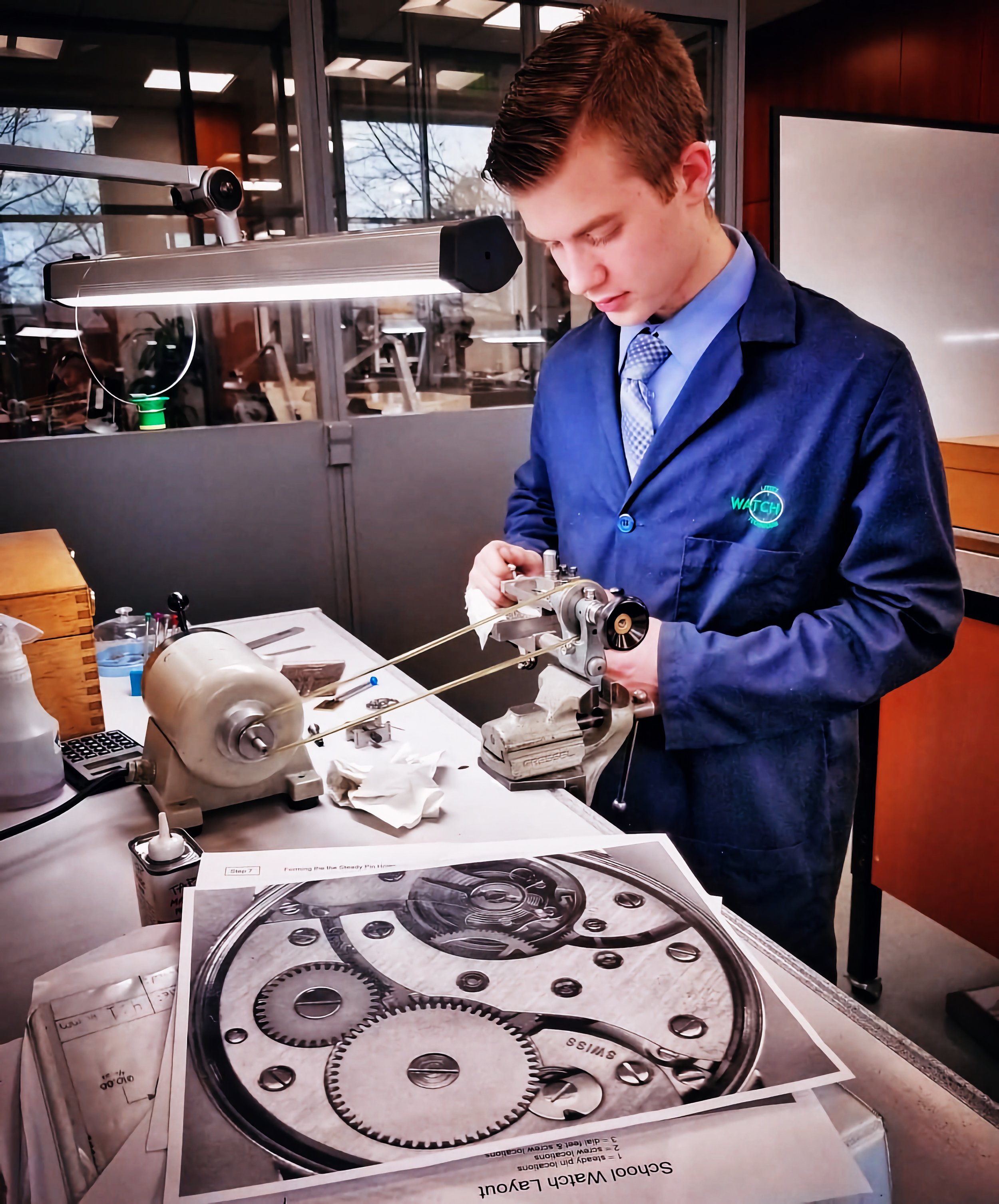
Photo credit: Lititz Watch Technicum
In my research, I found Rolex built and continues to support a school here in the U.S., in the heart of quiet Pennsylvania Dutch country. While the school has been running for over two decades — a new freshman class started last month — the school’s website is down, and it “no longer advertises to students,” according to Rolex.
Established in 2001 in Lititz, Penn., the watchmaking school only selects 100 applications each year. About 40 of those candidates are invited to an eight-hour test and interview process. Only 14 will don the blue lab coats of first-year students. Rolex said it also supports two other courses in the U.S., at North Seattle College and Oklahoma State University, both using the Lititz curriculum.
In the past year, from July 1st 2022 to June 30, 2023, the Hans Wilsdorf Foundation supported 5,700 projects, most of them in healthcare and personal financial aid, according to the latest data made available by the foundation. Though many of those donations remained in Geneva, some have no geographical limitations, especially when it comes to the environment and animal rights. The future of education and training seems to weigh heavily on the foundation’s mind with almost a third of the donations. After all, without highly trained watchmakers, Rolex can't exist.
Rolex is right to be concerned with the future of the craft: studies show watchmaking is a profession in decline. To make matters worse, the demand for vintage and pre-owned watches has fueled the shortage of qualified watchmakers to inspect, repair and certify watches, something that can't be automated. (Rolex launched a Certified Pre-Owned program last December which inspects every used watch before sale.)

Source: Fondation Hans Wilsdorf
The Fédération de l’Horlogerie, based in Paris, said that just 684 students graduated in 2022 from the two-year watchmaking programs in the country. By 2026, an estimated 4,000 new watchmakers will be needed in Switzerland alone just to cover the increased demand for workers and the loss of retirees, according to the Employers’ Convention of the Swiss Watch Industry.
And, yet, the demand for Rolex watches is still “enormous” as one Rolex Public Relations specialist in Geneva told me. In less than six years, Rolex will open a new production site in Bulle, Switzerland, its fifth manufacture. It will require 2,000 new employees.