
History of the Glycine Airman
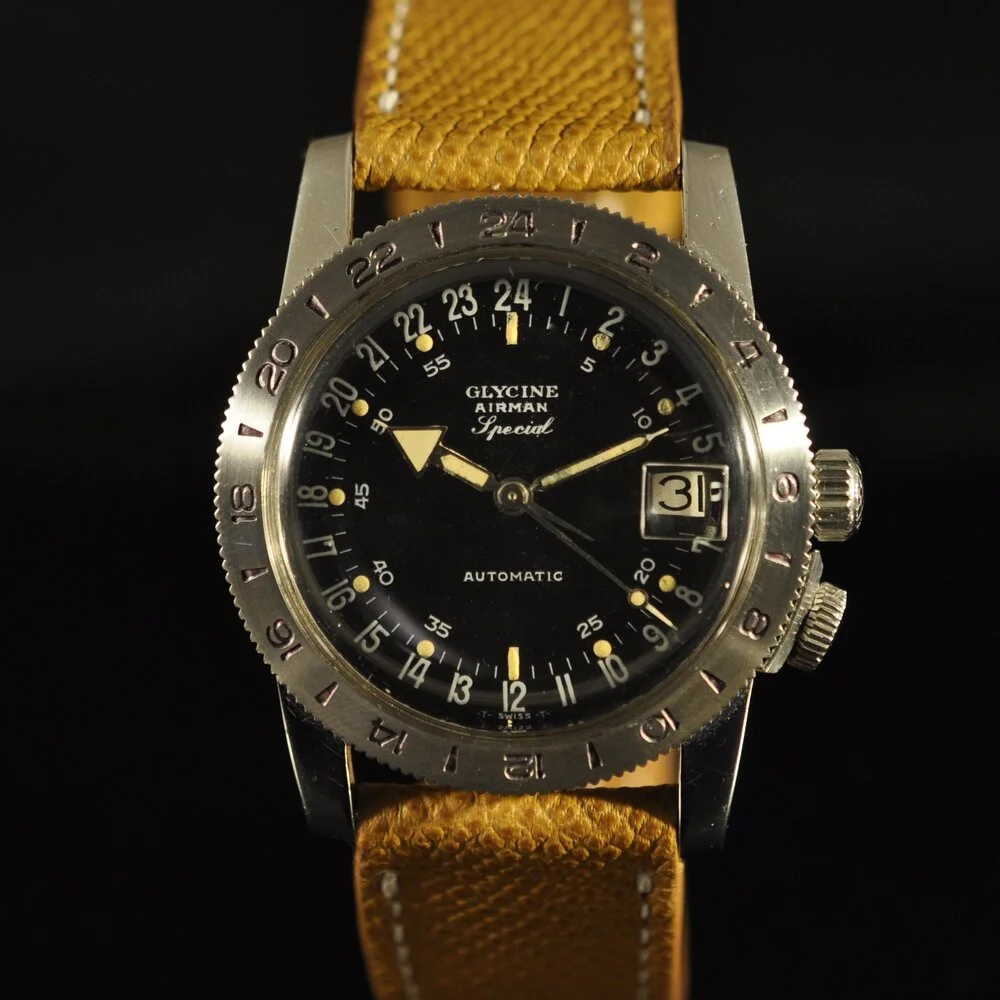
Glycine Airman Special / Credit: Romain Rea
While Glycine is often overlooked by collectors today, they did have great success in the mid-20th century, competing with the likes of Rolex and Omega to dominate the tool watch sector. One of those tool watches, the Glycine Airman, went head-to-head with the Rolex GMT-Master in the 1950s.
The Original Glycine Airman
At the time of the Glycine Airman’s release the need for a particular kind of pilot watch was ever-increasing. Pilots wanted features like a 24-hour bezel, a waterproof case, and a self-winding movement. In came the Glycine Airman, which was released in 1953 to a strong reception. The first Glycine Airmans had ‘AM’ and ‘PM’ written on the dial and featured a double crown. Uniquely, the Airman had an early example of a locking mechanism to allow alternative time zones to be tracked. These vintage Glycine Airmans were powered by a 23 jewel, automatic Felsa movement, that was later changed for A. Schild movements in the 1960s. For the American market, the Glycine Airman Special was released, which instead had a 17 jewel Felsa movement.

1969 Glycine Airman SST / Credit: Craft & Tailored
Throughout the 1960s and ‘70s, the Airman went through different transitions, with funky case shapes in the 1960s and quartz movements in the late 1970s. Notably, in 1968, Glycine released the first Airman chronograph, with the Glycine Airman SST Chronograph. SST stood for ‘SuperSonic Transport’, and was named after the Boeing SST, the first American super sonic plane project. Unfortunately, the project by Boeing was scrapped by 1971, and the Glycine Airman SST Chronograph also didn’t last long, as its Valjoux 72 now competed with automatic chronographs.
Today, the Glycine Airman is still in rotation, and after surviving the Quartz Crisis with some awkward quartz models in the 1970s, has come a long way since it was first released in the 1950s.
By: Andres Ibarguen