
Today we had an enlightening conversation with Daniel Hug, Head of Brand and Heritage at Longines, where we discussed how branding and heritage mix, the importance of balance and relevance in branding, and Daniel shared with us some important new discoveries in relation to historic Longines chronographs…

Daniel Hug
Andres Ibarguen: Thanks for speaking with us today, Daniel! As Longines’ Head of Brand and Heritage, what initially attracted you to the role? How did you find yourself in such an interesting position?
Daniel Hug: I was covering the Swiss watch industry for more than 20 years, working as a business and economics journalist for newspapers. During this time, I had the chance to visit more or less all of the important watch factories in Switzerland and to talk to the movers and shakers of the industry. I found the history of Longines particularly interesting, because they were at the same time innovators, helping many pioneers to make their dream come true, as well as official timers of the most prestigious sporting events. Their watches were always more about substance than social status.
AI: Is there any one aspect of Longines’ heritage that you would say stands out in its long history?
DH: The deep and long history in the field of chronographs is impressive: the very first wrist chronographs were produced as early as 1911 and delivered to Russia. These instruments were equipped by a Longines movement, like its successor model, the caliber 13.33Z. This chronograph had been on the wrist of Amelia Earhart when she crossed the Atlantic as the first female pilot solo in 1932. At the same time, Longines has a unique history in professional timekeeping. In 1914, Longines already manufactured a stopwatch capable of measuring 1/10th of a second, with a high frequency movement underneath the dial. Two years later, in 1916, Longines launched an even faster beating watch capable of measuring 1/100th of a second. For the emerging aviation industry and its pilots, Longines built the first wrist chronograph with two pushers and the flyback function in 1925. This watch was basically the blueprint for the modern chronograph. Then, in 1931, Longines presented the Lindbergh Hour Angle watch, the first watch in the world with a graduated rotating bezel. Two years later, we find pilot wristwatches made by Longines that can indicate two time zones, independently, on the same dial. The clever watchmakers in Saint-Imier invented so many things that are useful even today.

1911 Longines Cal. 19.73N chronograph sent to Russia, the earliest Longines wrist chronograph known; previously many believed the Cal. 13.33Z movements to have been the first for wrist chronograph circa 1913 – this proves that the first Longines wrist chronographs were actually fitted with the Cal. 19.73N that were previously used only in pocket watches, and produced as early as 1911

1928 Longines flyback chronograph with the 1925 modified Cal. 13.33Z flyback movement
AI: Brand and heritage are two very important and often intermixed aspects of any watchmaker, how do you look to use Longines’ heritage for branding purposes?
DH: Good question! Our history consists of millions of bits and bytes, of watches and components. But only a few of them have a meaning today. You have to scan the history to identify the aesthetical codes of Longines or to observe the unique approach to solve a technical problem. I keep my eyes always open to register what separates Longines from hundreds of other watch brands. After this exercise you get some inspiration for the concept and design of watches – with the aim of giving the brand more identity. We have an excellent team who is in charge of product development – and we collaborate very closely.
AI: And how do you manage the balance between using both Longines’ past and present for branding today?
DH: We want to highlight our heritage that is still of relevance today. We do not aim to reproduce a vintage model to 100%, but to take it as an inspirational source and present it in a more contemporary design, respecting the aesthetic codes that define the Longines’ style.

1916 Longines Cal. 19.73N, 1/100th stopwatch
AI: Now, while we may be passionate watch lovers, the rest of the world is not as enthusiastic about horology as us…do you think wider social or cultural relevance is a challenge going forward for watch brands?
DH: I notice how many people wear a smartwatch on their wrist. But after a while these electronic gadgets have become really generic. They have a lifespan of only some years, up to the next update. Our watches are fundamentally different: we have an ‘atelier heritage’, the capacity to restore and revise Longines watches that are even more than 100 years old. This is thanks to their knowledge and their huge stock of spare parts. A Longines watch with its high quality mechanical movement has a lifespan of around 100 years, if it is serviced correctly. But I agree with you that not everyone in our society is aware of that. As soon as people are looking for a product to celebrate an important milestone in their life, they tend to focus on enduring and sustainable mechanical watches rather than on smartwatches that tend to be obsolete in a short time and lose their value rapidly.
AI: What would you say is the biggest challenge in terms of branding that watchmakers like Longines face going into the 2020s?
DH: Branding is all about infusing identity and personality. But you have to be careful: you need to choose a brand that is of relevance to your clients. Branding incorporates and displays the values of your brand: when we were revisiting our heritage in aviation, we consciously were choosing two female and two male pioneering pilots. This represents our brand values.
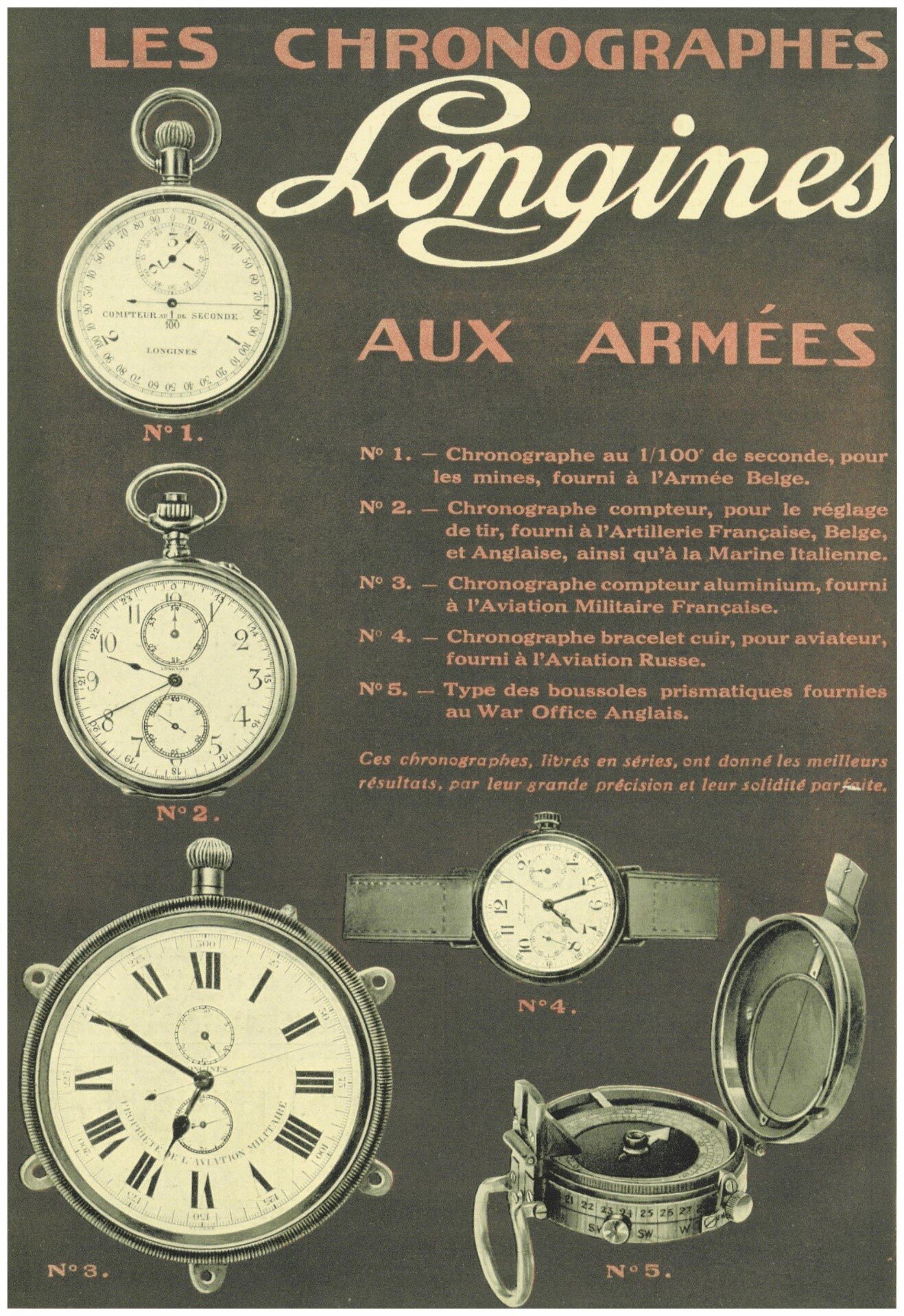
1916 Longines ad
AI: What are the differences that exist between branding for watch companies versus branding for other kinds of products?
DH: If you work with watches, it is something very personal, even intimate. You wear your watch on you skin, it serves as a companion for every day. A watch is a personal style signifier, especially for men but for women as well. I think you have to be very careful if you want to meet the taste and branding expectations of your customers.
AI: You previously mentioned that you had some new information to share regarding Longines’ history and we’d, of course, be thrilled to know more. What are these new discoveries?
DH: I previously mentioned the discovery of the first wrist chronographs as early as 1911. Further research showed us that Longines manufactured the first two-pusher chronograph with the flyback function in 1925. We now have, in our museum, two examples of those early chronographs that served as a blueprint for the modern chronograph of today.
In early 1968, Longines launched the first diver’s watch with a high frequency movement: the Ultra-Chron Diver, with a guaranteed accuracy of one minute a month or two seconds a day. Far more accurate than today’s COSC chronometers!

1968 Longines Ultra-Chron Diver featuring the high frequency Caliber 431
AI: Are there any vintage Longines models that you have a particular affinity for?
DH: At the moment I wear on my wrist an Ultra-Chron Diver from 1968 with its very accurate high frequency movement ticking inside.
AI: And finally, as we go forward into the 2020s, how do you think Longines and other watch brands can best position themselves to leverage their storied pasts?
DH: The key words for Longines are: stay relevant. In what we are doing, in what we are communicating, in what we are presenting to the public. Using history makes sense as long as you are capable of telling something that is still relevant today. Take off all the dust, and highlight timepieces and special features that are still meaningful nowadays.
Thank you for sharing with us, Daniel.