
The Accidental Creation of One of the Most Important Watches Ever Made

The original Vacheron Constantin ref. 3620 dial and the re-dial
The World of Vacheron Constantin Genève Mystery

The World of Vacheron Constantin Genève by Carole Lambelet and Lorette Coen
In 1992, The World of Vacheron Constantin Genève was released, this was a book which featured an assortment of wristwatches and pocket watches made by the prestigious Swiss watch maker Vacheron Constantin. Within this book featured a tonneau shaped wristwatch, which many had never seen before, which included the date (1936), and the reference number (3620), which Vacheron Constantin’s Heritage Department assigned to the photo.
Upon closer inspection, this was no regular timepiece – a calendar indication at 6 o’clock, a retrograde date, and a minute repeating trigger placed on the right side of the case - this was in fact the most important wristwatch created by Vacheron Constantin in the 20th century. For the next two decades, collectors and enthusiasts began the search for this coveted watch.
Fast forward to 2011, the head of sales at Phillips, Alex Ghotbi was the first to stumble upon some concrete proof of the ref. 3620’s existence. He had been contacted by an anonymous source, with pictures validating their claims, who then disappeared after the ensuing explosion of excitement among the watch world overwhelmed the owner.Years later, Ghotbi was then able to re-establish contact with the descendent of the original owner, and a meeting was arranged. Phillips’ Senior Watch Consultant, Aurel Bacs, and Alex Ghotbi were to travel to Spain.
Thankfully, Vacheron Constantin is one of the few watch manufacturers capable of retrieving precise information about every single watch it has ever produced. The extensive archives are safely stored in a room beneath the manufacturer’s ground floor. Therefore, the entire story of the reference 3620, including the identity of the original owner, the total cost, and other information could be retrieved.
The Creation of the Vacheron Constantin Reference 3620 - One of the Most Expensive Watches in the World During the 1930s

Documents between Brooking, a Madrid-based retailer, and Vacheron Constantin, December 1935 / Credit: Hodinkee
Brooking, a Madrid-based retailer, reached out to Vacheron Constantin in December 1935 looking to create a unique piece for a client. The client was Spanish businessman Francisco Martinez Llano, who wanted to create a wristwatch with complex functions typically found in Vacheron Constantin’s pocket watches.
Being based in Chile, this caused communication between the three parties to be quite slow. The distance between Llano and Brooking, the Madrid-based retailer, meant that Llano couldn’t see other wristwatches readily available. Instead, he received hand-drawn sketches of three concepts, with notes explaining the different calendar and minute repeating functions.

Design concepts for the Vacheron Constantin ref. 3620 / Credit: SJX Watches
Llano initially was okay with just a simple minute repeater model. But as correspondence continued with Brooking, he had a growing desire to include additional complex functions. He inquired about a perpetual calendar minute repeater, before placing his final order on a 10-lignes minute repeater with day, and retrograde date.
His final order was read as follows: “A large yellow gold tonneau-shaped case, a crown at twelve, a minute repeater with the lowest possible notes, a repeater trigger on the right side of the case, day, retrograde date, and the clients’ initials in blue enamel on the caseback.” He also wished to be sent two dials, one with radium numerals, another with enameled black Breguet numerals, and six interchangeable leather straps.
The cost of the entire setup was 3,750 Swiss Francs, which made it one of the most expensive wristwatches sold during that time in the 1930s.
Llano did not set out to purchase a multi-complication wristwatch, nor did he realize how insanely difficult it was to create a wristwatch to meet his demands. Vacheron Constantin now had to figure out how to miniaturize the complicated mechanisms inside their pocket watches. This watch was in fact one of three watches that included both calendar functions and a minute repeating mechanism during that era.
Three Watches That Included Both Calendar Functions and Minute Repeating Mechanisms in 1939
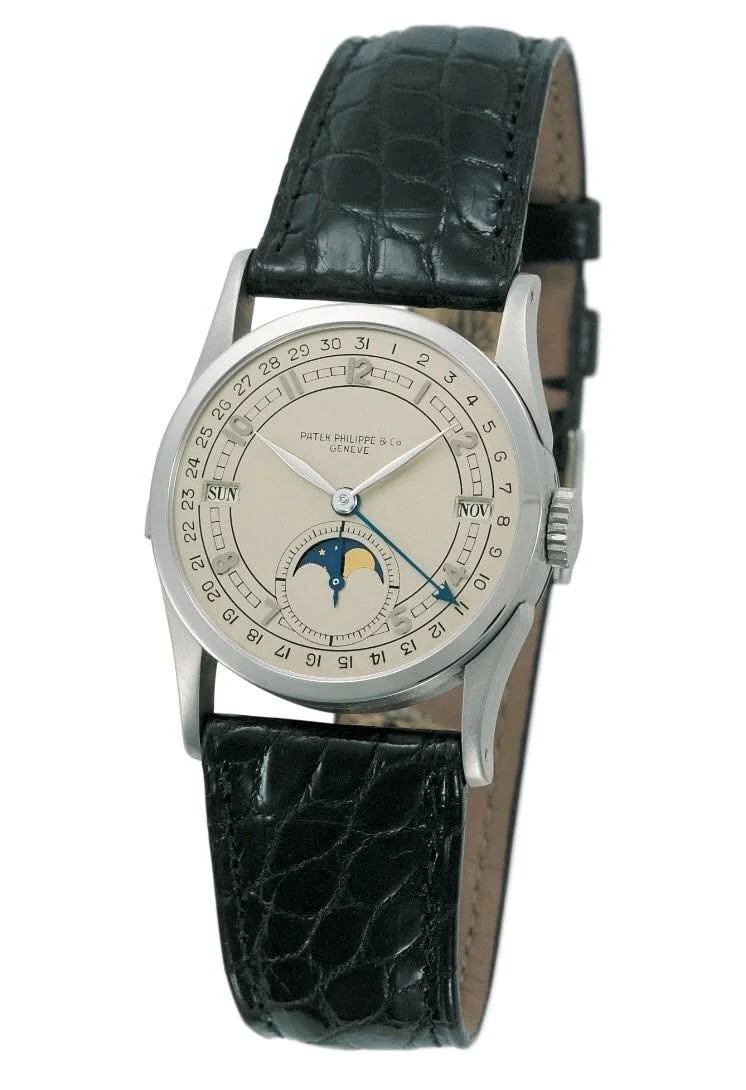
The Patek Philippe Calatrava no. 198340, circa 1939 / Credit: Antiquorum
Patek Philippe was a well-known complications maker, and produced a watch that included both calendar functions and a minute repeating mechanism in 1939. This perpetual calendar minute repeater included day, date, and month all shown on the dial. The watch is now proudly displayed within the Patek Philippe Museum, likely to never be sold ever again.

The James Schulz platinum tonneau-shaped minute repeating perpetual calendar monopusher chronograph wristwatch / Credit: Christies
The James Schultz was a platinum minute repeater with perpetual calendar and single button chronograph. It was named after an American Businessman who ordered the watch in the late 1920s, who had much different intentions than Mr. Francisco Martinez Llano’s Vacheron Constantin. He had in fact set out to create the world’s most complicated wristwatch, which now resides in a private collection.

The Vacheron Constantin ref. 3620 / Credit: Phillips
The final timepiece is the Vacheron Constantin reference 3620. This timepiece boasts the minute repeater and a calendar with retrograde date, differentiated further than the above two, as they don’t include both the aforementioned functions.
The Vallée de Joux

The Audemars Piguet Museum in the Vallée de Joux / Credit: Forbes
Despite embarking on different lives altogether, all three watches were made in the Vallée de Joux. The best minute repeating watches at that time, no matter to whom or where they were to be sold, were made by small suppliers in the Vallée de Joux. Minute repeaters were the Vallée’s speciality.
Vacheron Constantin then used a combination of efforts to create this timepiece: repeating mechanism was to be created by Nicole, calendar to Victorin Piguet, and the dial to Stern Frères. Each of these workshops worked independently to fulfill its obligations, providing feedback to Vacheron Constantin along the way, in which they kept extensive records of the communications.
The Vacheron Constantin ref. 3620 Took Four Years to Complete

The Vacheron Constantin ref. 3620 / Credit: Vacheron Constantin
Vacheron Constantin took four years to assemble the various components made by its independent suppliers, in which they delivered the watch in January 1940, just over four years from the initial outreach in December 1935.
Germany would then begin its major offensive on Western Europe, and Llano would enjoy his timepiece for the next seven years before his death in 1947. The watch was then vaulted for the next 60 years until once again opened by the family. Upon viewing the timepiece after 60 years vaulted, the dial showed significant aging, and the movement needing a full restoration.
The Restoration Process of the Vacheron Constantin ref. 3620

The Vacheron Constantin ref. 3620 dial variations
Using tools from the 1940s, and recovering as many original components as possible, Vacheron Constantin was able to restore the movement. The dial, however, was to be left untouched and in original condition. Instead, Vacheron Constantin was asked to make an exact replica to present it as it would have been received by Francisco Martinez Llano in 1940.
Using other dials created by Vacheron Constantin during that same era, and studying them profusely, many factors were considered on the creation of the new dial. The case was also to be left in original condition. The watch still features an enameled monogram of Francisco Martinez Llano on its case back.
Often referred to by his friends and family as “Don Pancho”, Don set out to create a unique timepiece with humble beginnings, only to create one of the most important watches ever made.
The watch was auctioned in 2019 at a Phillips Geneva Watch Auction, it sold for CHF 740,000.
By: Eric Mulder