
HISTORY OF THE ENICAR SHERPA COLLECTION
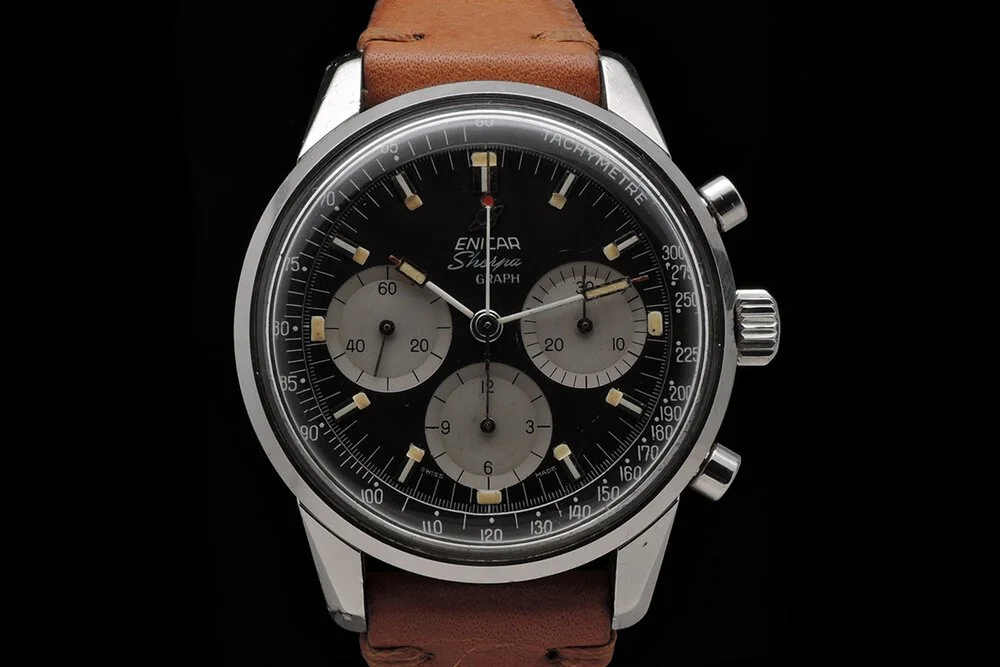
Enicar Sherpa-Graph MKIII / Credit: Ancienne
An obscure rival of the Rolex Explorer and formerly held in the same regard as Rolex and Omega, the Enicar Sherpa is still a formidable collection. Manufactured by the Racine family’s Enicar to compete with other sports watches in the 1950s, today it is beloved in the vintage watch market and even has new models. So, how did this Sherpa find its way to the Alps from the Himalayas?
Much like other watch brands at the time, Enicar started sponsoring outdoor sportsmen for marketing purposes in the 1950s. One of their watches, the Seapearl, released in 1955, was used by Albert Eggler’s group on the ascents of Lhotse and Everest in May 1956, only the second successful Everest expedition. Enicar, like Rolex, got a lot of publicity; Eggler even mentioned Enicar in his account of the adventure. So, seeing the opportunity, Enicar seized the day by calling their new sports watches ‘Sherpa’, in honour of the 22 Sherpas that participated in the expedition. This also led to the creation of the Sherpa Dive watches from the original Seapearl, and eventually to their famous Super Compressor watches, a name trademarked by Ervin Piquerez S.A., the manufacture.
Over 100 models of the Sherpa were released over the next few decades, among them many collectible pieces. There is: the Sherpa GMT, the World Time, the Diver 600, the Sherpa-Graph (which notably shared the Valjoux 72 movement with the Rolex Daytona), and many more. Unfortunately, Enicar went under in 1987 and had the brand name used by counterfeiters to market fake watches. The bright side of all this being that authentic vintage Enicar is all the rarer and all the more desirable. The Enicar brand eventually found a home with its old Chinese distributors in 1988, and has since been operating as 'Enicar of Switzerland'.
By: Andres Ibarguen