
An Overview of the Types of Chronographs
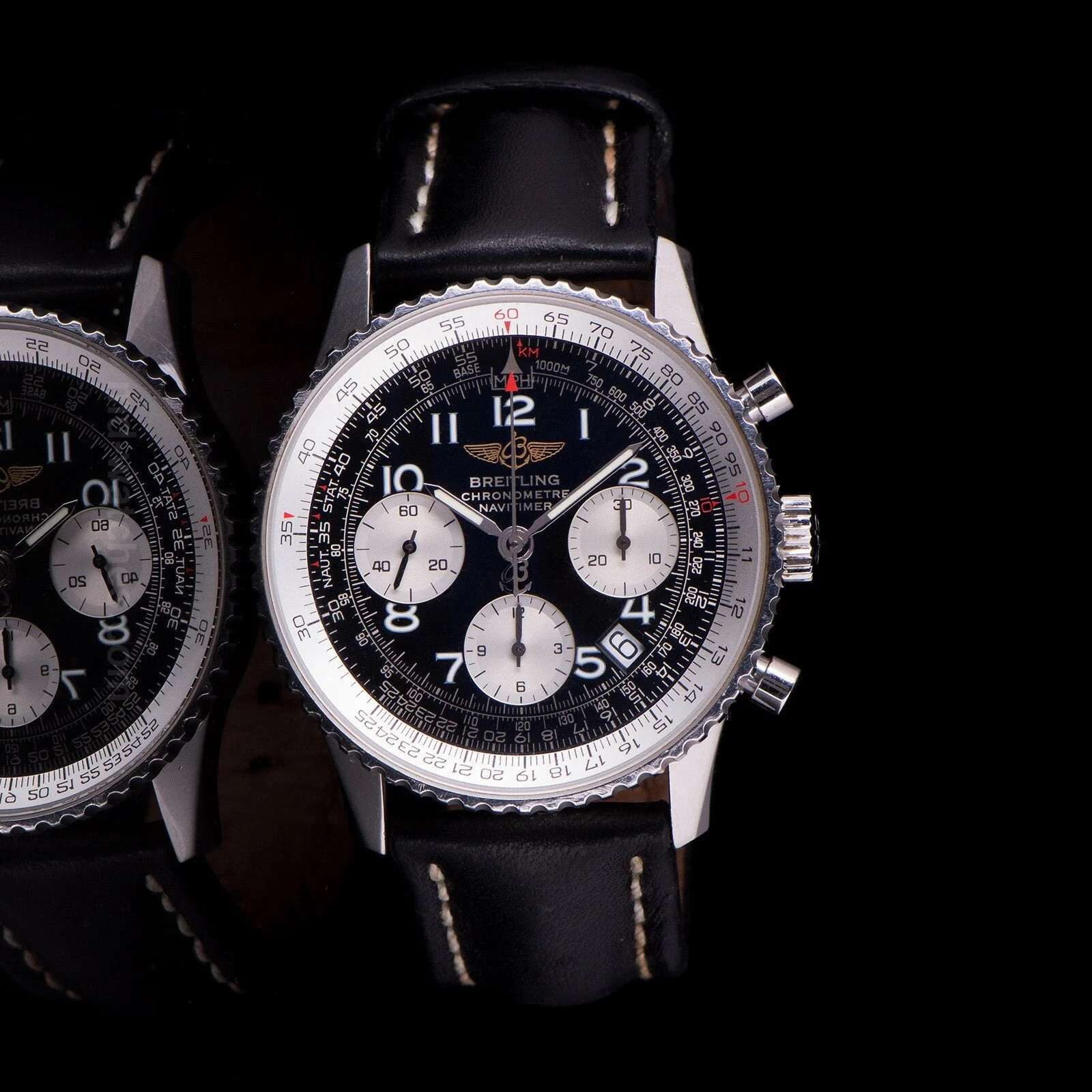
Breitling Navitimer Chronograph ref. A23322 / Credit: MDWatches
Invented in 1816 by Louis Moinet, the first chronograph was a simple pocket watch, with three sub-dials and a single hand, capable of measuring time accurate to 1/60th of a second. Since those early days, the chronograph has developed into one of the most popular watch functions on the market, today with a plethora of variations; from telemeter scales to monopushers, there’s a lot to unpack.
Starting with the different types of scales, there’s the tachymeter, telemeter, pulsometer, and respirometer. The tachymeter is used to calculate speed based on known distance. One would start the chronograph when they see a plane fly overhead and stop it when they see it touch down, the scale allowing you to easily interpret its the speed. The telemeter instead measures distance based on sound. This was especially useful for soldiers, who used it to understand how far enemy artillery was by starting the chronograph when they heard the artillery fire and stopping it when they heard the impact. Less common are the pulsometer and respirometer, which are applicable usually to those in the medical profession; the pulsometer is used to measure pulse, while the respirometer is used to measure respiratory rate.
Another type of chronograph is the rattrapante, which allows two elapsed events to be recorded simultaneously using two chronograph hands in the same sub-dial. Once the upper hand is already going, the user can start the second, lower hand, thereby recording two elapsed events at once. Then there’s the flyback chronograph, invented in 1932 by Breitling, and popular in high-end watches; its function is to reset the chronograph without restarting it. It’s useful for measuring things under pressure, like for example, a relay race. Finally, there’s monopusher chronographs, which use the same button to start, stop, and reset the chronograph, meaning everything has to be done in sequence – not quite as ‘modern’ of an invention as some of the others.