
The Christiaan Hugyens Story
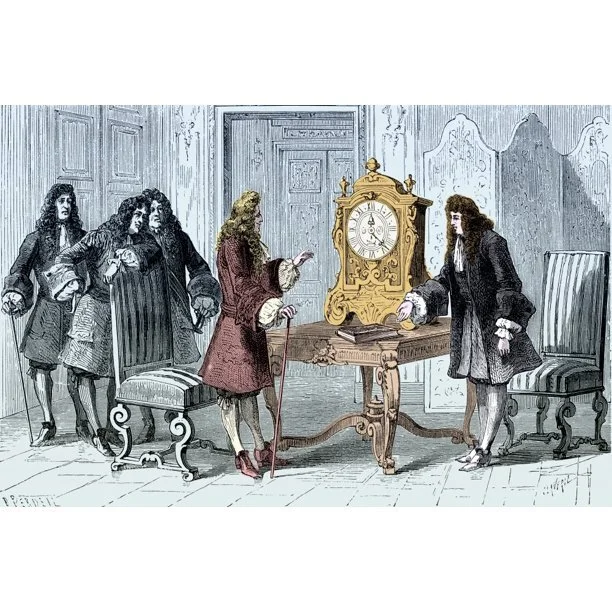
Huygens presenting a pendulum clock to Louis XIV
There is many heros in the history of horology, famous watchmakers, designers, executives, and others – some that we’ve discussed and many that we have yet to. However, if we go back about 400 years, we arrive to the time of a man who can be considered the original horology hero, Christaan Huygens.
Christaan Huygens was a Dutch scientist, born in the Hague in 1629. Huygens was from a well-respected family and his father, who was a diplomat among other things, would receive friends like Descartes, who noticed Christaan’s penchant for geometry early on. Huygens studied and Leiden Universität in 1645 and subsequently spent a significant portion of his life in Paris.
Where we become interested in Huygens is in the 1650s, when, through his studies of astronomy and the measurement of time, he started experimenting with a pendulum to regulate clocks. Huygens designed the first ever pendulum clock and then hired a clockmaker in the Hague (Salomon Coster) to help make the first pendulum clock, which Huygens also patented in 1657. His new clock proved to be much more accurate than the table clocks of the time. This revelation eventually led to pendulum clocks dominating the table clock sector for hundreds of years afterwards, Christaan Huygens also published his learnings in his work, Horologium in 1658. An interesting thing to note is that this did not yet solve the issue of navigation that marine chronometers could, as the rocking of the ship would disrupt the motion of the pendulum.

Christiaan Huygens working on a pendulum in his workshop / Credit: Smithsonian
Huygens’ further contribution to horology came in 1673, when he published Horologium Oscillatorium. In this book, he described both clock design but also went into detail regarding pendulums. As such the book is both important from the perspective of horology and mechanics.
Horology was never lost on Huygens, who made more than one balance spring watch, particularly in the 1670s. Huygens was said to have invented the first spiral balance spring in 1675 but this was (and is) disputed by fellow scientist Robert Hooke – and remains somewhat contentious to this day.
Huygens passed away in 1695, and despite having dedicated his life to mathematics, astronomy, physics, and other studies; today he is largely remembered for his work in the development of the pendulum clock and the balance spring. Achievements for which he is often viewed as the father (or grandfather) of mechanical watchmaking.