
The Rolex GMT Story
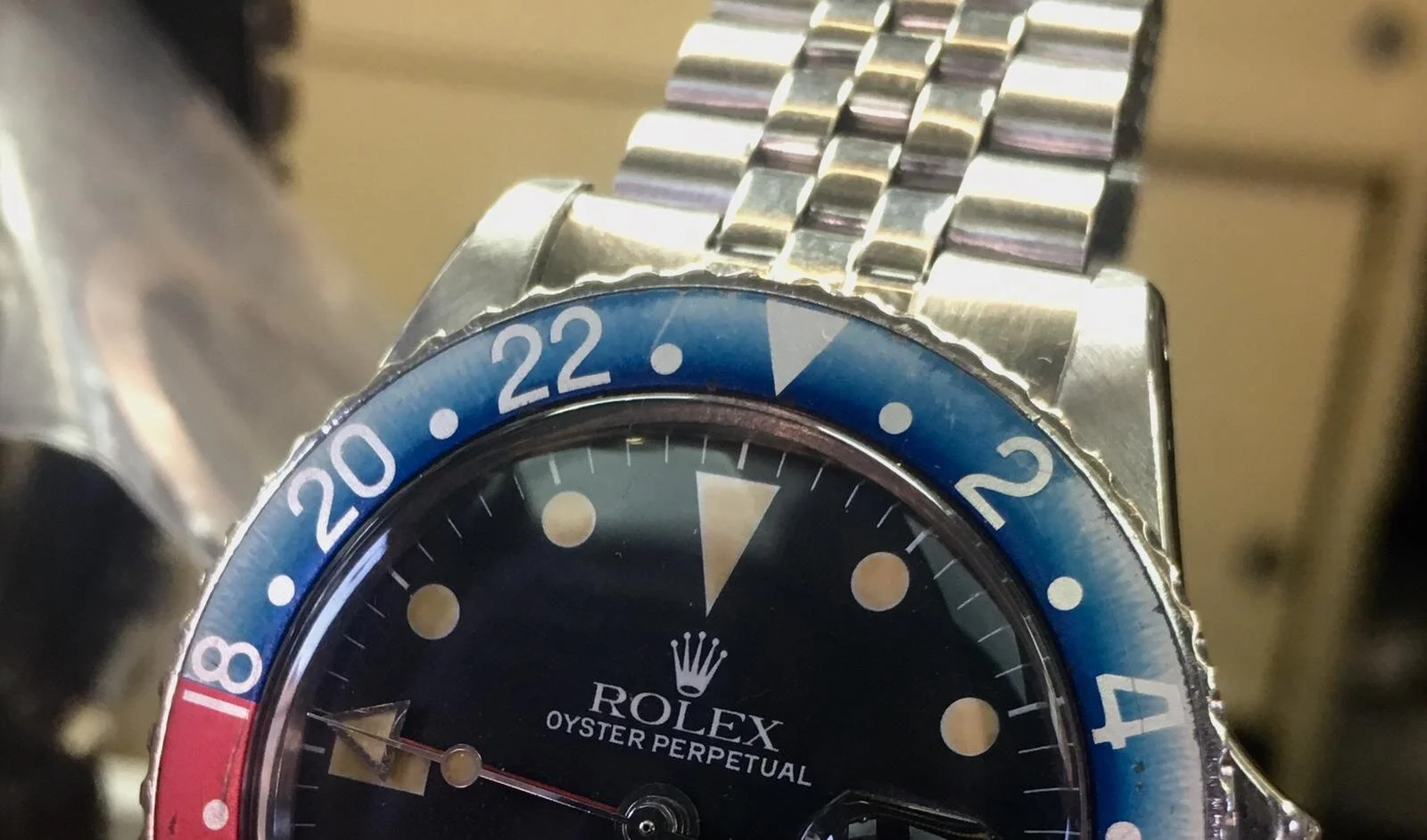
Rolex GMT-Master ref. 16750
Sometimes you’ve got to take a step back and wonder why everyone loves a particular watch. Sure, a lot of people might have a shallow reason, people are sheep after all. But in general, there must be something exceptional about a timepiece that becomes immensely popular. And that’s exactly the case with the Rolex GMT-Master.
The story of the Rolex GMT-Master goes back to the mid-20th century, when transatlantic flights were just beginning and pilots were starting to see the utility in a watch that displayed two time zones. Pan Am actually approached Rolex and requested they make them such a watch. A ‘real’ pilot watch. The first Rolex GMT, the ref. 6542, was released in 1954 and made to be the legible and easy to use in flight. The ref. 6542 was said to be a Rolex Turn-O-Graph (ref. 6202) with a modified movement (the Caliber 1036) and bezel. It was produced until 1959 and went from bakelite bezel to aluminum bezel in 1956. At the time, the Rolex GMT even competed with the Glycine Airman, which also showed two time zones and was released in 1953.
The most popular vintage Rolex GMT, and one of the more popular vintage Rolexes, was the Rolex GMT ref. 1675, released in 1959 to replace to ref. 6542. The ref. 1675 was the first Rolex available on both the Jubilee and Oyster bracelets and hosted a Rolex Caliber 1565. It was also a very long-lived Rolex model, produced until 1980.
In modern times there have been a whole slew of GMT references, from the ref. 116710LN to the ‘Batman’ ref. 126710BNLR. The Rolex GMT-Master became extremely popular, and continues to be popular with the GMT-Master II. It’s come a long way from being all the rage among Pan Am pilots in the 1950s and ‘60s, and although I’d bet most of owners today don’t fly planes, I’m sure can they still value the versatility of the watch and the utility of the two time zones from the ground.