
The History of the Self-Winding Watch
We previously established that Breguet gifted his first Perpétuelle in 1780. However, Richard Watkins’ “The Origins of Self-Winding Watches 1773-1779” argues that Breguet actually completed an earlier version of his mechanism, using a barrel remontoir, in 1777 – in theory making this the first self-winding watch. The ambiguity continues, in 1778 the French Academy of Sciences reported that Hubert Sarton invented a timepiece with a self-winding rotor mechanism; he is believed to have invented it in 1777 and to have begun selling them in Liège in 1778 – potentially beating Breguet by some months.
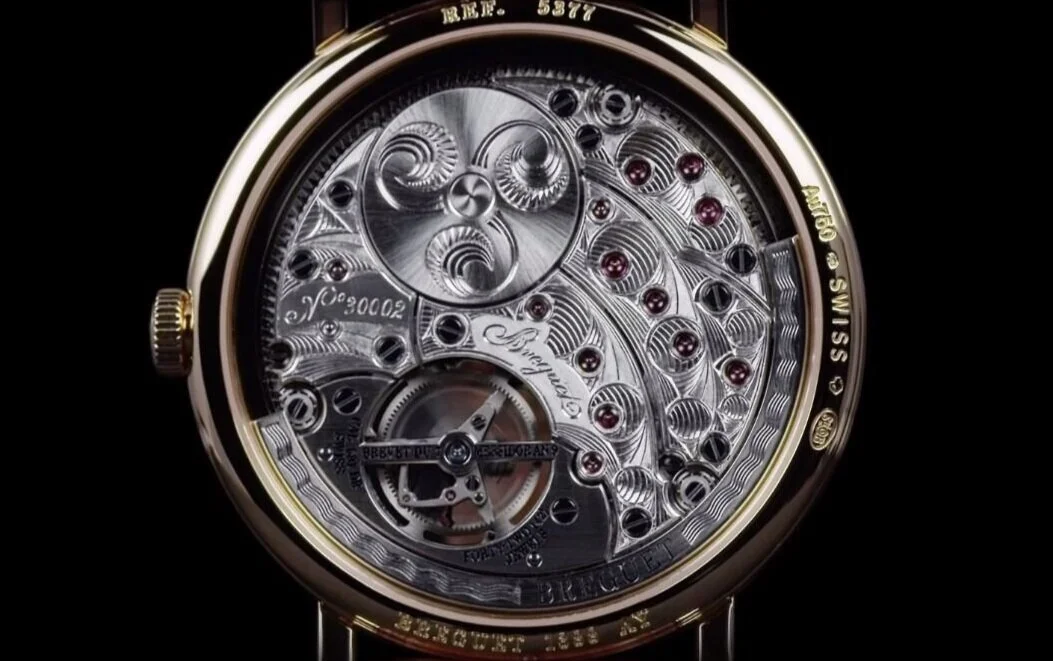
Breguet Extra-Plat Tourbillon ref. 5377
Furthermore, an additional account by Alfred Chapuis and Eugène Jacquet in their 1952 book “La Montre Automatique Ancienne, un Siècle et Demi d’Histoire 1770-1931”, claims that a 1777 report from the Geneva Society of Arts recorded Abraham-Louis Perrelet as having invented a rotor movement that could be fully self-wound during a 15-minute walk – which again, could refute the previous claims and make Perrelet the inventor.
Although there has yet to be consent as to who really invented the self-winding movement, it is ultimately Breguet, Sarton, and Perrelet who are usually involved in discussions surrounding its origins.
However, there is an earlier account, the first ever, that comes from a German-language newspaper, presumably in 1773 (or 1775 – in Leipzig, Munich, or Vienna), that mentions someone by the name of Joseph Tlustos as having invented a watch that "does not need to be wound". If true, Tlustos would beat all other claims by at least a few years.
There is a lot of ambiguity the deeper one goes into watchmaking history, but at the end of the day it’s stories like these that make watch collecting such a thrill.