
These Brands Are Popular for Vintage Women’s Watches
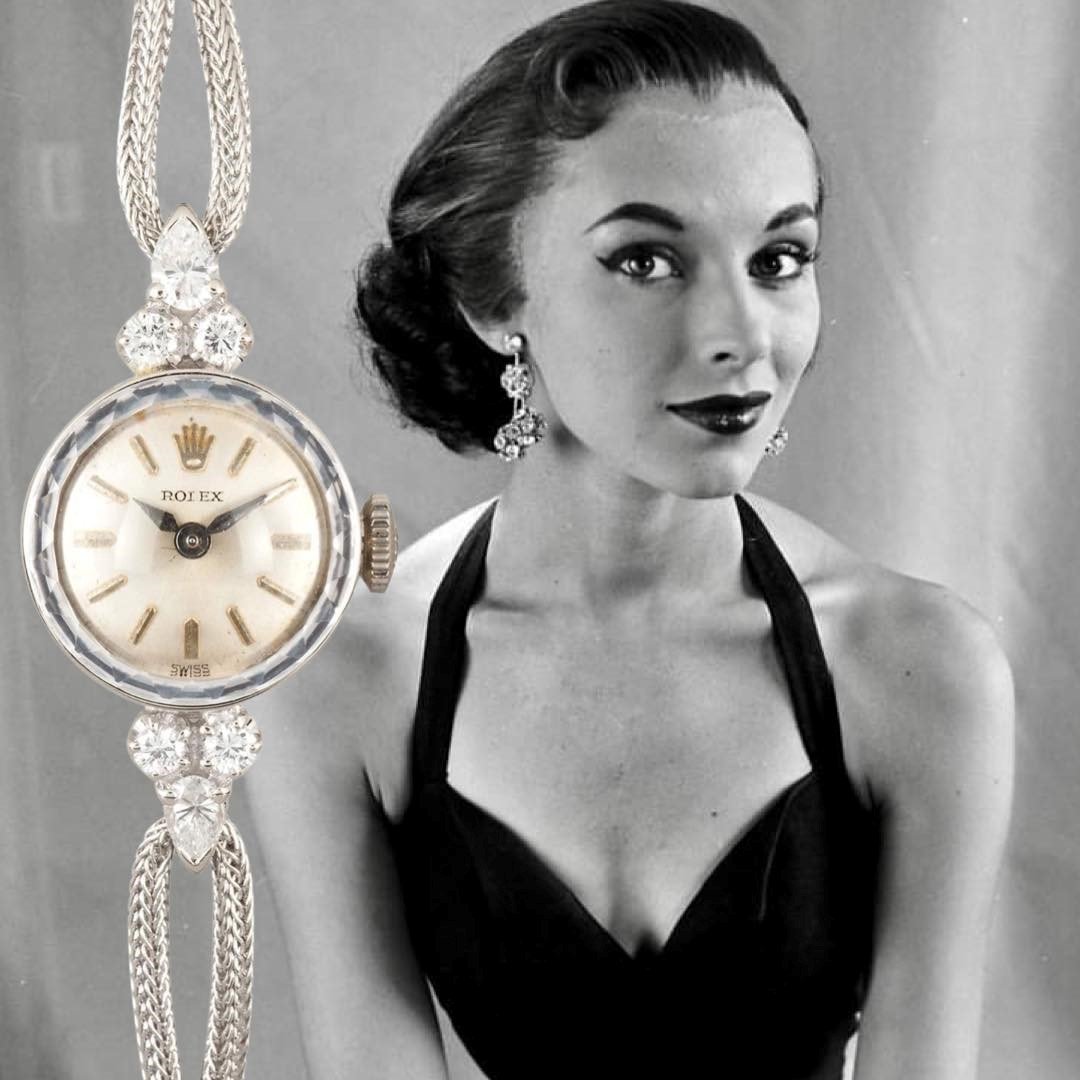
Vikki Dougan and a ladies’ Rolex diamond cocktail watch from the 1940s
Omega Ladies’ Vintage Watches

Vintage Omega De Ville Ladies’ Cocktail Watch / Credit: Bob’s Watches
Omega’s inception was in 1848, when Louis Brandt set up an operation to assemble watches in La-Chaux-de-Fonds, Switzerland. By 1903, the company became ‘Louis Brandt et Frere – Omega Watch & Co.’ The term Omega comes from the twenty fourth and last letter of the Greek Alphabet. The name is derived from the 19-ligne caliber which the Brandt brothers released in 1894, and named ‘Omega’. This movement was a major step forward for the company, as not only was the movement extremely accurate, but it could also be replaced without any modifications by watchmakers. The movement set a new standard for watchmaking worldwide.
By the early 1900s, Omega was producing about 100,000 watches per year, making them one of the largest watch manufacturers of the time.
In 1955, Omega released the Ladymatic. This was the brand’s first automatic ladies’ wristwatch and was a clear success right from the initial release. This movement became the world’s smallest rotor equipped automatic caliber to obtain a special certificate with special mention. It would then be utilized on many vintage ladies’ Omega watches throughout the 1960s.
Omega has always kept a degree of timelessness, elegance, and sophistication with their vintage women’s watches. The model shown above is the Omega Deville in 14k yellow gold watch with a silver dial. The diameter comes in around 25 mm, with the smaller sizing typical for vintage cocktail timepieces.
The Omega De Ville made its debut in 1960, when it was housed inside the Omega Seamaster collection. It then started appearing on the dial by 1963. Omega then released the ‘De Ville’ as its own line in 1967, where it now showcases the brand’s more elegant dress watches.
The Omega Constellation is a more accessible line of Omega ladies’ watches and is very popular for women and men to this day.
Vintage Lady Hamilton Watches
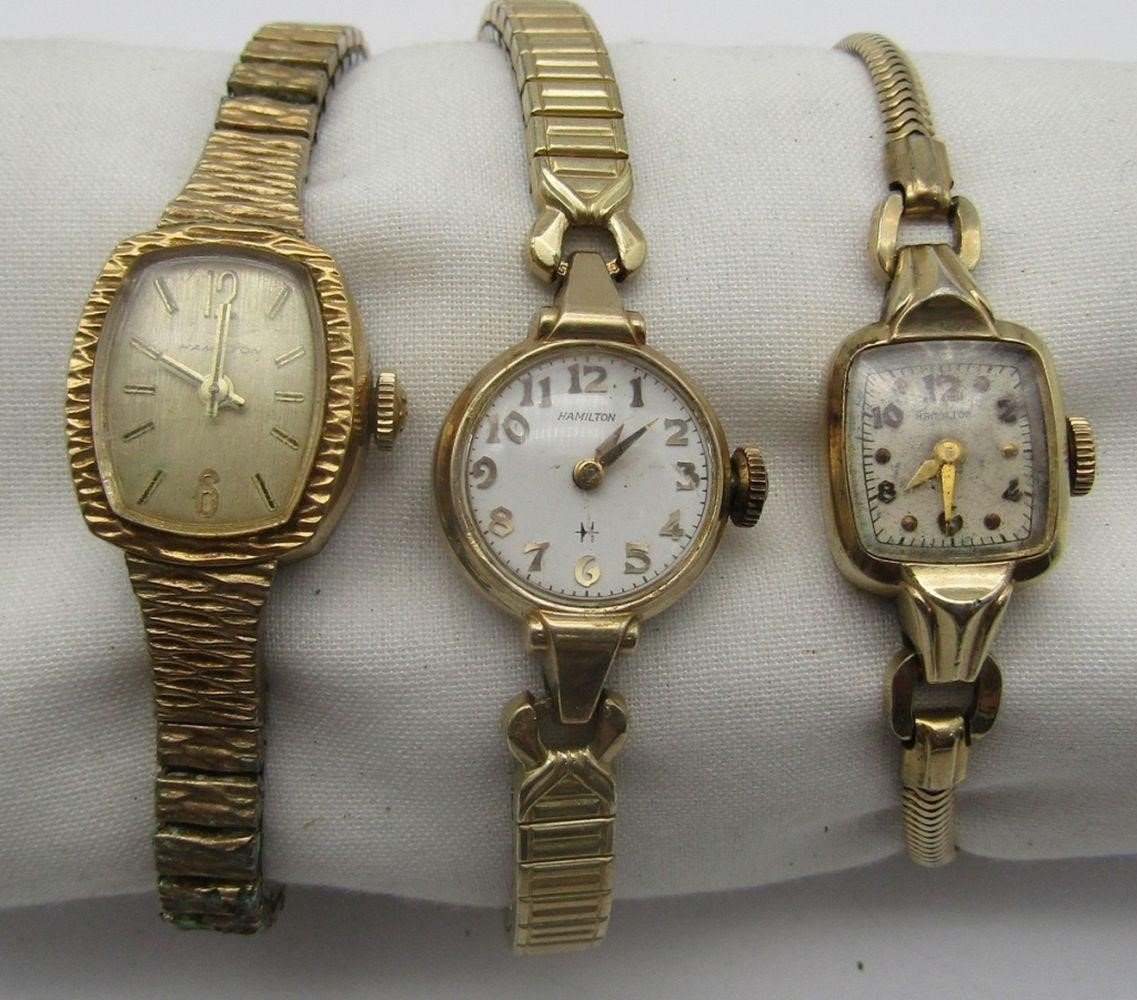
Assortment of vintage women’s Hamilton watches / Credit: Invaluable user
Hamilton was founded in Pennsylvania where they began manufacturing pocket watches in 1892. From inception, the companies’ values have always been quality and accuracy, which to this day has helped Hamilton remain a world-renowned brand.
Hamilton became well-known during the early days of American railroads. As railroad infrastructure expanded, Hamilton provided accurate timepieces which helped reduce train accidents due to the inaccurate time synchronization on the tracks.
As an official supplier to the United States Army during World War I, Hamilton equipped many soldiers with timepieces for the war. It was during this time that they started to shift manufacturing efforts from pocket watches to wristwatches as well.
Hamilton’s first wristwatches were actually released as ladies’ pendant watches, starting around 1915. These were the Hamilton 986 detachable pendant watches, and were produced until the early 1920s, until being replaced by the 986A.
Throughout the years that followed, Hamilton has been synonymous with the fields of aviation and warfare. But they also steadily produced the ‘everyday’ men’s and women’s wristwatches throughout the years as well. Well into the 20th century, Hamilton also garnered a name as the movie watch – appearing in over 500 films throughout the years and having close ties to Hollywood.

Three versions of the vintage-inspired Hamilton ladies’ wristwatch that Rooney Mara wears in the film Nightmare Alley / Credit: New York Times
Hamilton was then acquired by the Swatch group in 1974, and moved their headquarters to Switzerland. While now displaying a proud ‘Swiss Made’ label, Hamilton will always have its roots in American culture and history. Hamilton continues to produce men’s and women’s wristwatches to this day.
1940 Vintage Rolex Ladies’ Watches

A ladies’ Rolex diamond cocktail watch from the 1940s / Credit: Bob’s Watches
The history of ladies’ Rolex watches dates back to 1905, when Rolex was founded by a young Hans Wilsdorf. Even from the company's earliest days, Rolex produced wristwatches for women, but were often more so ornamental jewellery, with a timepiece mechanism added in. During these times, men would often stick to using their masculine pocket watches.
Once men started to wear timepieces on their wrist, they were typically made in sizes reserved for women of today. Barely ever over 32 mm in diameter – quite the difference to todays standards, as some models are even over 45 mm in diameter.
Throughout the 1920s and ‘30s, Rolex released many timepieces for women, typically with Art Deco design. It was during this time, with the success of the Oyster case and automatic winding Perpetual movement, Rolex started concentrating their efforts on the male market. Although there is a number of quite small Oyster Perpetual models from this time, some as small as 24 mm. Rolex released the Lady Datejust in 1957, benefitting from all the features of the Datejust, but with 10 mm shaved off the profile.
In 1992, the Rolex Yacht-Master and Pearlmaster were released. The Rolex Pearlmaster was entirely targeted at women, and the smallest watch was 29 mm. The Yacht-Master was either a 35 mm or 40mm, and the Pearlmaster also had a 34 mm option. In 1998, the smallest Oyster Perpetual watches increased to 26 mm. And in 2015, Rolex released 5 new variants to the Rolex Oyster Perpetual – 26 mm, 31 mm, 34 mm, 36 mm, and 39 mm. Each size except the 39 mm is displayed on the women’s section of Rolex’s website. That same year, a 39 mm Rolex Pearlmaster was released, which is more than the widely accepted size appropriate for a woman’s wristwatch. The Rolex Lady Datejust then increased from 26 mm to 28 mm.
Interestingly enough, Rolex women’s watches are continuing the trend of men’s that we have seen throughout the years, and are slowly increasing in size. As with most things in the watch market, where Rolex leads others will follow, so you can expect this from brands throughout. Rolex still continues to produce women’s watches to this day, but the production is significantly less than the male timepieces. The women’s timepieces today are typically smaller versions of the well-known models, the Rolex Datejust, the Rolex Yachtmaster, and the Rolex Oyster Perpetual being examples. The only model made exclusively for women is the Rolex Pearlmaster.
Gruen Ladies’ Vintage Watches

1937 Gruen Banff 14k Art Deco Ladies’ Watch / Credit: Empress
In 1908, Gruen introduced both men’s and women’s wristwatches to the American market. Women’s timepieces sold well, but the male population did not, and hence provided poor sales overall. Despite this, Gruen had supreme confidence in the wristwatch and was one of the earliest companies to really see the potential of the wristwatch.
Throughout the ‘20s, ‘30s, and ‘40s, Gruen continued releasing innovative timepieces for the everyday person, military, and other tool watch markets. This included many beautiful vintage Gruen women’s wristwatches. The model shown above is the Gruen Banff, highly reminiscent of the late ‘30s. This Art Deco-inspired vintage Gruen women’s wristwatch is part of their luxurious Precision series. These were particularly popular as cocktail timepieces for women.
In the 1940s, Gruen released the Pan American Pilot for both men and women. It was during this time that the Gruen Curvex was also extremely popular. Both men and women at the time, as it was a large societal trend, were enjoying rectangular timepieces that ‘curved’ to the shape of your wrist.
Unfortunately, health troubles in the 1940s and 50s led to key members of the Gruen family to pass away. By 1953, the Gruen family had sold their shares in the company. That same year, the president at the time, Benjamin Katz, was forced into early retirement after a scandal. Coincidentally, this was also the year that Gruen boasted the highest amount of revenue ever.
Due to this changeover in management and loss of family involvement, Gruen lost its vision. By 1958, they had fired a significant amount of their staff, were selling off properties, and were facing severe legal problems. To make matters worse, they were heavily indebted and couldn’t secure additional financing. Under new ownership, Gruen moved to New York, where they would produce watches for another 15 years. Apparently of no interest to the new owners, all pre-1958 records were destroyed. According to the Cincinnati Business Record, this segment of Gruen was officially bankrupt in 1976.
Unfortunately for Gruen connoisseurs, we now have mostly vintage Gruen’s women’s wristwatches available for purchase. But despite this fact, you can still find amazing vintage pieces for good prices today.
Longines Ladies’ Vintage Watches
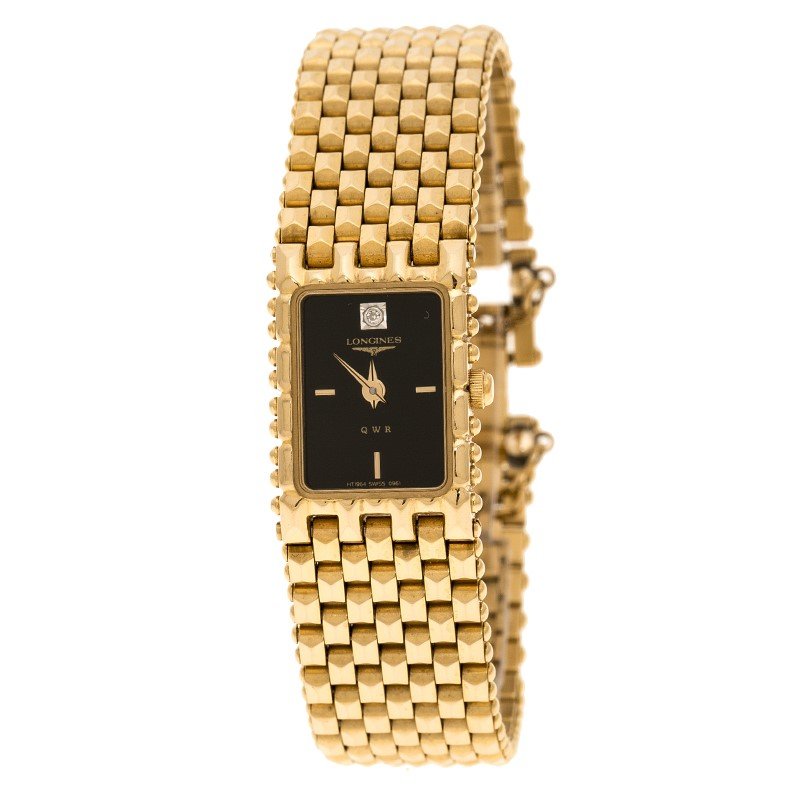
Longines black gold-plated QWR HT 1964-0961 / Credit: The Luxury Closet
Longines was first established in 1832 by August Agassiz and his two partners in Switzerland. By 1846, it was starting to become a global success, due to his connections in the United States in particular.
The first Longines mechanical ladies’ pendant watch was released in 1903. A couple years later, in 1905, Longines released the first wristwatch for men, which would be instrumental in helping their male customers move away from pocket watches.
Longines has produced many ladies’ timepieces throughout the years, and boasts an extremely large number of female brand ambassadors. These include, but are not limited to, Stefanie Graf – a former tennis pro, Kate Winslet – Titanic actor, Aishwarya Rai Bachchan – Miss World 1994, and Chi Ling Lin – a graceful Chinese actress. Swiss Gymnast Giulia Steingruber, Swiss show jumper Jane Richard, Swiss Skier Mikaela Shiffrin, and gymnast Yana Kudryavtseva, all promote Longines.
In 2009, after seeing that recent developments were not accommodating for the smaller feminine wrist, Longines released the PrimaLuna collection, devoted entirely to women.
Vintage Gucci Watches for Women

Gucci interchangeable bezel bangle watch circa 1980s, one of the archetypal vintage Gucci watches / Credit: Catawiki user
Guccio Gucci, founded the House of Gucci in Florence in 1906. Guccio proved to be an extraordinary craftsman, and started producing luxury goods in the 1920s. A boutique was then opened up in Rome in 1938. By 1953, the first store had opened up in New York, and by the 1960s they were expanding throughout all major cities globally, London, Paris, Tokyo being a few destinations.
Gucci initially was an equestrian and luggage shop, before expanding their products in the 1930s. This expansion led them to continue to produce leather goods, alongside: premium knitwear, silk goods, shoes, and handbags. In 1953, After Guccio passed away, his three sons took over and again further expanded their product line to include fine jewellery and luxury watches. The next few decades is when a majority of the famous vintage Gucci watches were created for both men and women.
After family feuding and mismanagement of Gucci’s image and resources throughout the 1980s, Gucci was on the edge of bankruptcy by the 1990s. To gain back some market share, and with new management, they re-entered the watch market in the late 1990s, and started production again in 1997.
That same year, Gucci acquired the operating assets of Severin Montres Group, a leading manufacturer of timepieces, and curated their first watches. In the next few years, Gucci would continue their buying spree to companies such as Yves Saint Laurent Couture, Sanofi Beaute, and a majority stake in Sergio Rossi. The plan to further dominate this market was amplified in 2000, when it acquired Boucheron International Group. They would then secure the rights to sell Yves Saint Laurent Couture watches.
These developments were pushing Gucci towards their ultimate goal of becoming a leader in the worldwide watch market. These acquisitions, along with their initial releases, helped Gucci develop a strong base within the luxury goods market, and the fashion watch market. From the beginning, Gucci has focused on fashion watches to win over the hearts of the youth. Gucci’s revenues now place them in the top 25 Swiss watch brands in the world.
Vintage Bulgari Watches for Women

Elizabeth Taylor on the set of Cleopatra in 1962, wearing a Bulgari Serpenti
Last on the list of vintage women’s watches worth money is Bulgari. Bulgari has one of the most classic vintage ladies watches on the market – the Bulgari Serpenti.
Bulgari has its origins in Greece. The name ‘Bvlgari’, comes from the name of its founder, Sotirios Boulgaris. While travelling around for many years, Sotirios finally landed in Italy in 1884. This is where he founded Bulgari as a jewellery house.
The Serpenti designs date back to the 1940s, with the original design made by Sotirios Boulgaris himself. During this period, Bulgari started to use a technique called ‘Tubogas’ to create their Serpenti designs. It was similar to the Ancient Roman jewellery design, as it would wrap around the wrist or neck of the wearer.
Vintage Bulgari women’s watches actually date all the way back to the 1920s. It was during this period that they produced jewellery inspired Art Deco wristwatches which were often diamond encrusted. During the 1920s, domed calibré-cut colored gemstones were also used to construct floral motifs for vintage Bulgari women’s watches.
Throughout the decades, into 1970, Bulgari would create a lady’s version for most of their male timepieces. The Bulgari Parentesi watch was designed by Giannia Bulgari during the 1970s, to demonstrate that successful jewellery design can be created by simple graphic patterns. These were watches with well defined shapes that did not need excess ornamentation. This was similar to Gerald Genta, using basic forms to create his legendary watch designs. The watches turned out to be one of the most popular jewellery and watch designs by Bulgari throughout the 1980s.
Unconventional materials were added to Bulgari’s vintage women’s watches throughout the years, often resulting in highly creative designs which pushed the boundaries of luxury timepieces.
By: Eric Mulder
Read more:
“Omega.” Haute Horlogerie, https://www.hautehorlogerie.org/en/watches-and-culture/partner-brands/history/h/omega/.
“1894 Omega is Born.” Omega Watches, https://www.omegawatches.com/en-us/chronicle/1894-omega-is-born.
“1955: Ladymatic.” Omega Watches, https://www.omegawatches.com/chronicle/1955-the-first-ladymatic.
“1967 the De Ville is Born.” Omega Watches, https://www.omegawatches.com/chronicle/1967-the-de-ville-is-born.
“Hamilton History.” Hamilton Watch, https://www.hamiltonwatch.com/en-ca/timeline.html.
“1916 Ladies 986 Bracelet Watch - Overhaul.” Hamilton Chronicles, September 10th, 2014, http://www.hamiltonchronicles.com/2014/09/1926-ladies-986-bracelet-watch-overhaul.html.
“Rolex Watches History.” Rolex, https://www.rolex.com/en-us/about-rolex-watches/.
“History of Ladies Rolex Watches.” Becker Time, December 17th, 2020, https://beckertime.com/blog/history-of-ladies-rolex-watches/.
“Gruen History.” The Watch Guy, http://www.thewatchguy.com/pages/GRUEN.html.
“History.” Longines, https://www.longines.com/company/history/19th/1832.
“History of Gucci Watches.” Street Directory, https://www.streetdirectory.com/travel_guide/61781/modelling/history_of_gucci_watches.html.
“AN INTRODUCTION TO GUCCI WATCHES.” Horologii, December 14th, 2021, https://www.horologii.com/watch-news/an-introduction-to-gucci-watches/.
Ibarguen, Andres F. “The History of the Bulgari Serpenti.” Montres Publiques, December 2nd, 2021, https://montrespubliques.com/new-1minute-reads/the-history-of-the-bulgari-serpenti.
Tsai, Ping. “A Look at the Bulgari Ladies' Watch Story.” Watchprosite, January 2011, https://www.watchprosite.com/bulgari/a-look-at-the-bulgari-ladies-watch-story/1051.686508.4397103/.