
“It Takes a Licking and Keeps on Ticking.”

World Heavyweight Boxing Champion Rocky Marciano in a vintage Timex advertisement from 1954
Timex was established in 1854 as the Waterbury Clock Company, which began in Connecticut’s Naugatuck Valley. During World War II, the Waterbury Clock Company became the U.S. Time Corporation. Several years later, in 1950, they released the Timex wristwatch. Then, in the 1950s and 1960s, Timex became an iconic American product through a long-running advertising campaign which subjected their timepieces to ‘torture tests’.
Retailers initially resisted the new timepieces because of the measly 50 percent markup, while other companies would offer 100 percent markups. U.S. Time Corporation then started to become creative, resorting to various retail channels to showcase their timepieces. This included drugstores, department stores, and cigar stands that would display these pieces being submerged in water or smashed with a hammer.
By the early 1950s, the company had started advertising in magazines with an emphasis on durability, shock-resistance, and waterproofing. Beginning around 1952, Timex began their famous ‘torture test’ advertising campaigns. This included being attached to Mickey Mantle’s baseball bat during practice, being strapped to the hooves of racehorses, and attached to turtles as they swam through water.
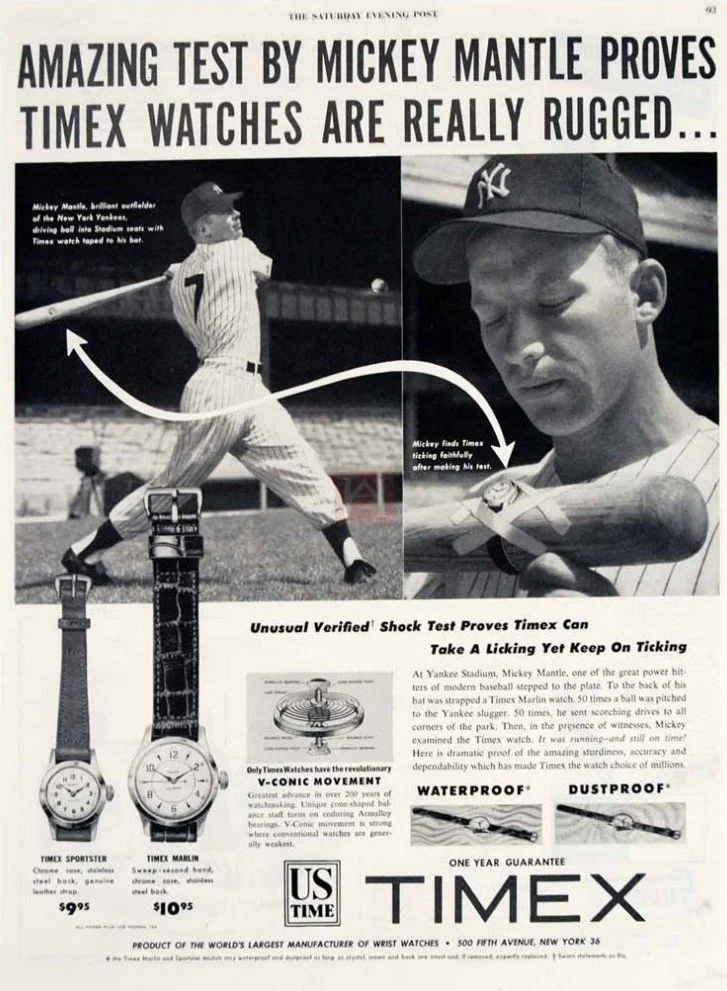
A 1953 Timex advertisement featuring Mickey Mantle
In 1956, after numerous campaigns run in newspapers and magazines, Timex turned to television advertising. The American company teamed up with John Cameron Swayze, a former NBC news anchor, who became the face of a multiple live torture tests broadcasted over television. The watches were put through paint mixers, beat with jackhammers, stuffed into washing machines, attached to the bow of a boat, and were even included in an 87-foot cliff dive in Acapulco, Mexico.
It was during these marketing demonstrations that they would reiterate the famous line, “It takes a licking and keeps on ticking.” Timex was further reinforcing to their target market that their timepieces were affordable, emphasizing their robustness. These genius advertising campaigns were instrumental to Timex becoming a household name.
Timex continued their celebrity endorsement campaigns into the 1960s, doing torture test commercials alongside Jerry Lewis and Dean Martin, to name a few. By now, Timex watches were so popular that every third watch sold in America was a Timex.
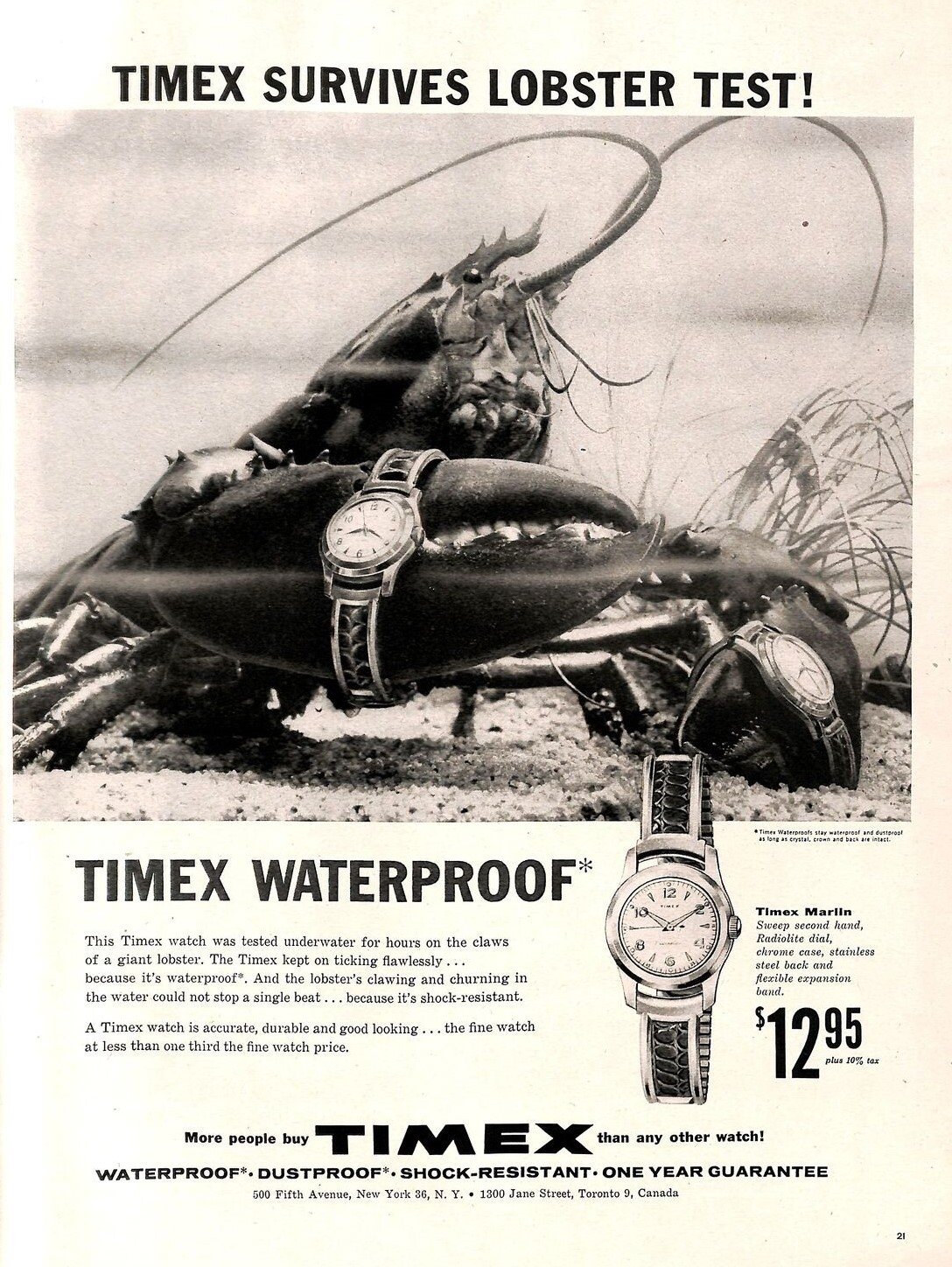
A Timex advertisement showing one of their watches being tested underwater on the claws of a giant lobster
By all accounts, the 1950s were an advertiser's dream decade. The postwar boom was well underway and Americans again viewed the world through a lens of prosperity. They were now buying homes, cars, and an abundance of other products. This consumeristic boom was coupled with the fact that television was now in more homes than ever, something advertisers like Timex were able to capitalize on. This was the height of the American Dream and advertisers were urging consumers to buy, buy, buy.
Forget the diamond encrusted Patek Philippes, this is how real watch hype originated.
By: Eric Mulder
Read more:
Doyle, Jack. “…Keeps on Ticking, 1950s-1990s.” PopHistoryDig.com, August 17, 2009, https://www.pophistorydig.com/topics/tag/timex-torture-test/.
“The Torture Test: Timex Proves ‘It Takes a Licking’ … for Over 60 Years.” 4A's Foundation, https://www.aaaa.org/timeline-event/torture-test-timex-proves-takes-licking-sixty-years/?cn-reloaded=1.
“The Timex Story.” Timex, https://www.timex.ca/the-timex-story/.
“What Caused the Advertising Industry Boom in the 1950s?.” Chron., September 4th, 2020, https://smallbusiness.chron.com/caused-advertising-industry-boom-1950s-69115.html.