
How Trench Warfare Led to the Mainstream Adoption of Wristwatches
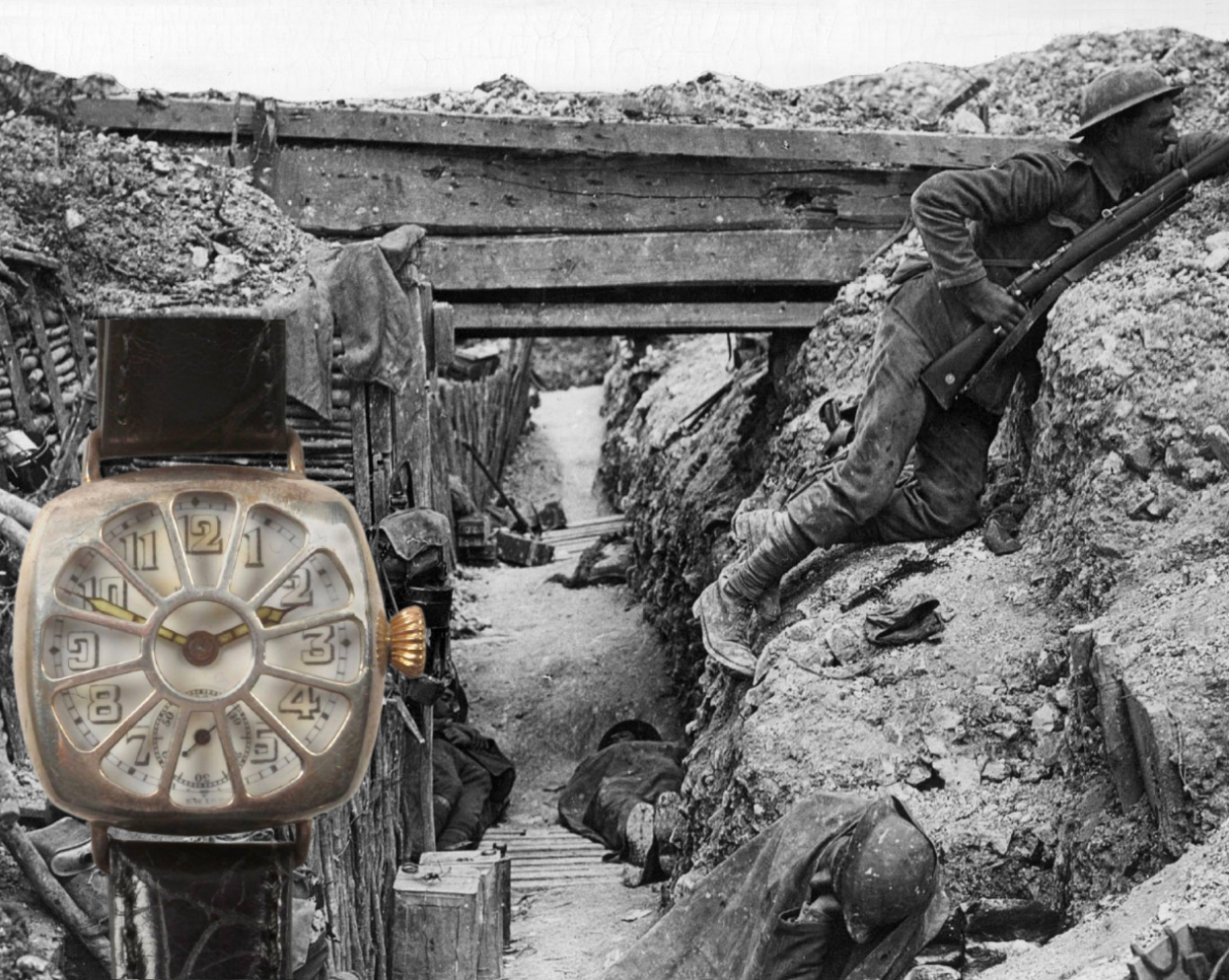
Trench warfare during WWI and the typical trench watch
The First World War, from 1914-1918, is undoubtedly one of the most influential military conflicts in shaping the modern world, and the world of horology.
There is documentary evidence to prove that Breguet designed the first contemporary wristwatch ever known, the Breguet watch number 2639, for the Queen of Naples in 1810. The Queen of Naples, otherwise known as Caroline Bonaparte, was the younger sister of Napoleon Bonaparte – the de facto leader of the French Republic as First Consul from 1799-1804.
There are countless examples throughout the 19th century of wristwatches being developed, but there was one major theme throughout this century when it came to wristwatches – they were made for women, more so for jewellery than for practicality.
Going into the 1900s, men were continuing to rely on pocket watches to keep time, although there were a few instances prior where wristwatches were being used for military advantage. The first notable record of men wearing wristwatches dates to 1880, when Kaiser Wilhelm I of Germany ordered 2,000 for his navy. Wristwatches were also utilized in the Second Boer War (1899-1902) and the Spanish-American War (1898).
The Second Boer War was fought between British and South African troops trying to end British rule in the region. The British had developed timed, coordinated attacks against the South African forces. They were able to do this by soldering metal lugs onto their pocket watches and attaching thick leather straps to hold these timepieces on their wrist. The British ultimately won this war, and brands started to pick up on the functionality of the wristwatch. Mainstream opinion was not changed, however. Wristwatches were still seen as ‘feminine’ and referred to as “wristlets” in the late 19th century. The pocket watch was seen as the reliable, masculine accessory, and men who wore wristwatches could be ostracized.
Once World War I began in 1914, American soldiers were extremely surprised to find that many of their European counterparts were wearing wristwatches on the battlefield. By 1916, about a quarter of all soldiers were wearing wristwatches.
Not surprisingly, many soldiers had quickly realized that the practicalities of modern warfare demanded upgrades – and this included their coveted pocket watches. The fast-paced environment of the Great War demanded that time be ascertained readily, and scavenging through your pockets in the chaos of the trenches would not be sufficient.

World War I era wristwatches / Credit: Bloomberg
Although it wasn’t only the fast-paced atmosphere of the war itself, the environment in which the soldiers found themselves in, that led to this change. The pocket watches were just too impractical in the field of battle, with noise often drowning out orders, timing signals replaced an audible call. The use of pocket watches was also difficult while crawling through no man’s land or having to free up a hand to check while in the trenches.
Soldiers were beginning to synchronize watches before jumping out of the trenches and hurtling towards enemy territory. A military tactic called a creeping artillery barrage also made the use of effective timepieces crucial. As you can imagine, the timed synchronization between artillery gunners and infantry would need to be precise, to the second, as the consequences could otherwise be fatal.

The Battle of Verdun in 1916, French casualties during this battle amounted to 400,000, while the Germans sustained 350,000
Now that the pocket watch was on the wrist, it was time to undergo some new design considerations. The watches were beginning to be equipped with thick metal grills over their glass faces, to protect them from shattering. Soldiers would need to protect their timepieces while entering and exiting the trench, as the crystals would typically get damaged. It would be protected by a hinged cage, similar to a pocket watch, however you would still be able to view the numerals inside.
These wristwatches were becoming as important to military uniforms as the rifles themselves. During the Pancho Villa Expedition (1916-1917), where General John Pershing ordered 6,000 American troops into Mexico to capture Villawristwatches were a key resource. Just about every store within the El Paso district was now supplying these coveted timepieces. The demand only increased when America entered the Great War on December 7th, 1917. Manufacturers, such as Omega and Longines, started to mass produce these trench watches, which were marketed for military use.
That same year, in 1917, the wristwatch was so essential in combat that the British War Department began issuing wristwatches to the combatants. Hence, the wristwatch was now an official part of the modern soldier’s uniform.

Waltham wristwatch advertisement from the First World War / Credit: Vintage Watch Straps
As you can see, marketers and manufacturers were quick to jump on this quick change in public perception. Feminine wristlets were now a Christmas gift that any man would be proud to wear – as these watches were used as a tool in the most trying of conditions. The watches themselves continued to be developed throughout the Great War. This was due to the extremely harsh conditions on the battlefield. Tougher crystals, luminous dials. During this period, pilots also started using wristwatches as they proved much more practical for combat.
On November 11th, 1918, after Germany signed an armistice agreement with the Allies, World War I officially came to an end. This meant that American troops would be returning home and bringing their timepieces with them. Less than a decade prior, men would fear wearing a wristwatch because of the risk of ostracization. Following the war, it was now public perception that men could wear wristwatches without shame. If it were not for World War I, what would have been the spark that popularized wristwatches?
By: Eric Mulder

Australian ANZACS wearing wristwatches in World War I
Read more:
“The First Wristwatch.” Breguet, https://www.breguet.com/en/history/inventions/first-wristwatch.
“Napoleon Bonaparte.” Google Arts & Culture, https://artsandculture.google.com/entity/napoleon-bonaparte/m0j5b8?hl=en.
“THE HISTORY OF AVIATION WATCHES.” Bremont, June 2nd, 2017, https://www.bremont.com/blogs/blogbook/the-history-of-aviation-watches.
“The Second Boer War and “Wristlets”.” Time Sticking, https://www.timesticking.com/the-second-boer-war-and-wristlets/.
“World War 1 and the establishment of the wristwatch.” Watch and Bullion, January 10th, 2018, https://watchandbullion.com/ww1_wristwatch.
“Pancho Villa attacks Columbus, New Mexico.” History, November 16th, 2009, https://www.history.com/this-day-in-history/pancho-villa-attacks-columbus-new-mexico.