

The Cold War is a very unique and interesting conflict, especially with respect to the previous global conflict that had engulfed world superpowers; World War Two. This conflict is generally seen as having started in 1947, when Bernard Baruch first used the term in Columbia, South Carolina State House.
What was so unique about the Cold War was its very nature, this was not a battle fought and won through direct military conflict like World War Two. This was a battle that played out largely in the minds and hearts of citizens, a battle between two different political ideologies – communism and capitalism. Moreover, this was a conflict that spread across the world – actually including several other smaller wars like the Vietnam War or the Angolan Civil War. To be more specific, the Cold War was largely a war of information, although it did include several military conflicts.
The Cold War was also an extremely long conflict, ending officially on December 31st, 1991 with the end of the Soviet Union. Previously, the Berlin Wall had come down in 1989.
The leaders throughout the decades of the Cold War were eminently important to the resolution of the war, what we want to do today is go through the roles of some of the most important political and military figures of the day…with a focus on what was on their wrist while they were keeping the world from nuclear holocaust.

Truman, Churchill, and Stalin / Credit: US Army
Starting with our side of the world, North America, Harry Truman was the first Cold War President - serving from 1945 to 1953. This was a particularly important time in the Cold War as the Soviets had installed puppet governments in many Eastern Bloc states while the United States gained influence in Western Europe with the Marshall Plan.
Truman became Vice President on January 20th, 1945 but was shocked to ascend to the presidency in April when Roosevelt died suddenly. In fact, it was Truman who oversaw the bombing Hiroshima and Nagasaki in August of the same year.

Truman’s Vulcain Cricket / Credit: Harry S. Truman Presidential Library

Truman’s Vulcain Cricket’s caseback inscription/ Credit: Harry S. Truman Presidential Library
Horologically speaking, Truman is connected the Vulcain Cricket, which he received as a gift in 1953 from the White House News Photographers Association. He was the first US President to receive this watch. Interestingly, the Vulcain Cricket was given to several presidents including Dwight Eisenhower, Bill Clinton, Ronald Reagan, Jimmy Carter, and more. It became tradition to present the President with a Vulcain Cricket - which became known as the ‘President’s Watch’.
This Vulcain Cricket tradition that began in 1953 was continued by the Paajanen family into the 2010s. This is a family of jeweler’s from Helsinki who continued to send or present different American leaders with Vulcain Crickets even until recently. The Vulcain Cricket was chosen for this special role as it was so the first mass-produced alarm wristwatch, released in 1947. The perfect watch for a businessperson or world leader who needed reminders of different appointments. Although, according to Vulcain, Truman’s alarm was often mistaken for a bomb by the Secret Service, a mistake that wasn’t repeated for the successive wearers of the timepiece.
Now, Truman may have started the Cricket tradition, but Eisenhower - who succeeded Truman as a Cold War President in 1953 and also wore the Cricket frequently, owned a Rolex Perpetual Datejust ref. 6305. This was a timepiece that was presented to ‘General’ Eisenhower by Rolex, who was a general before becoming President in 1953. It was auctioned by RR Auctions back in 2014 but did not meet its reserve price (high bid of $475,000).
Most recently, Donald Trump received a Vulcain Cricket when he became President in 2016.

Time International Magazine December 31st, 1990 cover page – Gorbachev and his Vulcain Cricket

Mikhail Gorbachev wearing the Omega Constellation Manhattan
The Vulcain Cricket, however, was not limited to only to the American political class; Mikhail Gorbachev famously appeared on the cover of the December 31st, 1990 issue of Time magazine clearly wearing a Vulcain Cricket, ironically one year before he was out of a job! Along with the Vulcain, Gorbachev has also been pictured wearing a gold Omega Constellation Manhattan, both pictured above. His successor, Boris Yeltsin, has been pictured wearing a steel Rolex, along with Erich Honecker - leader of the German Democratic Republic - who has also been pictured wearing a Rolex.
Now, while not directly related to Russian President’s personal collections, Poljot started a line of watches dedicated to the Russian Presidents called ‘President of Russia’ back in 1993. There are editions made for all recent Russian Presidents...which means you’ll most likely find the ‘Putin’ versions if you’re looking for one. It goes back to when Boris Yeltsin was in office, as the first Russian President and the first to have one dedicated to him.
Moving slightly south we come to another important country in the Cold War – Cuba.
Fidel Castro came to power in Cuba in 1959 after defeating his rival, Batista’s, army. Surely the most recognized event related to Cuba of the Cold War was the Cuban Missile Crisis of 1962. This was overseen on the American side by John F. Kennedy, who was also responsible for the failed Bay of Pigs invasion. To put it briefly, when the Americans became aware of Soviet ballistic missiles in Cuba, capable of hitting the East Coast, it began a tense standoff between the two nations. Both teetering on the edge of all out war. The Cubans were very closely allied with the Soviets, who shared their communist ideology. Cubans were also notoriously involved in the Angolan Civil War, sending troops to back the Communist MPLA against UNITA.
Castro is a fairly well-known watch ‘collector’, recognized for a photograph in which he was seen wearing two Rolexes on the same wrist. He was known to have owned at least four Rolexes, including two Rolex GMT-Masters ref. 6542 and ref. 1675, a ref. 6536 Submariner, and a Rolex Datejust. Che Guevara is another Cuban leader known to wear a Rolex, a ‘Pepsi’ GMT ref. 1675.

Che Guevara wearing his ‘Pepsi’ ref. 1675 while lighting a cigar / Credit: South China Morning Post
Now, there is, of course, a great irony in these Cuban political leaders wearing very expensive timepieces while being the faces of the communist revolution. The same could be said for Gorbachev, although that came at a later point in time. It is, however, worthwhile to note that Rolex was not seen as the same level of ‘luxury’ watch as it is today...Nonetheless, what is believed to be Guevara’s friend’s GMT 1675 sold for 112,500 CHF in an Antiquorum auction back in 2019. According to Antiquorum, the watch belonged to Che’s right-hand Carlos Coello Tuma. Upon their execution in Bolivia in 1967, both Che’s and Tuma’s Rolex GMTs were recovered, although it is unclear what happened to Che’s. Both of these, however, would’ve been gifts from Fidel Castro.
Turning back to the Americans, we have John F. Kennedy, the iconic American president, who also played an important role in the Cold War – as mentioned above with the Missile Crisis and failed Bay of Pigs invasion. Now, JFK is known to have worn many different timepieces, including an Art Deco Bulova that was a homage to the 1937 Hamilton Emerson and an Omega ‘Tank’. However, there is also the Rolex gifted to him by Marilyn Monroe for his birthday in 1962. This Rolex sold for $120,000 USD in a 2005 Alexander Autographs auction, it was inscribed, "Jack, with love as always from, Marilyn May 29th 1962" and also included a written poem. One can imagine that a timepiece like that would only have increased in value over the last sixteen years. The last watch we’ll mention as being on the wrist of any Cold War leader, as President Kennedy was assassinated about just over a year later.
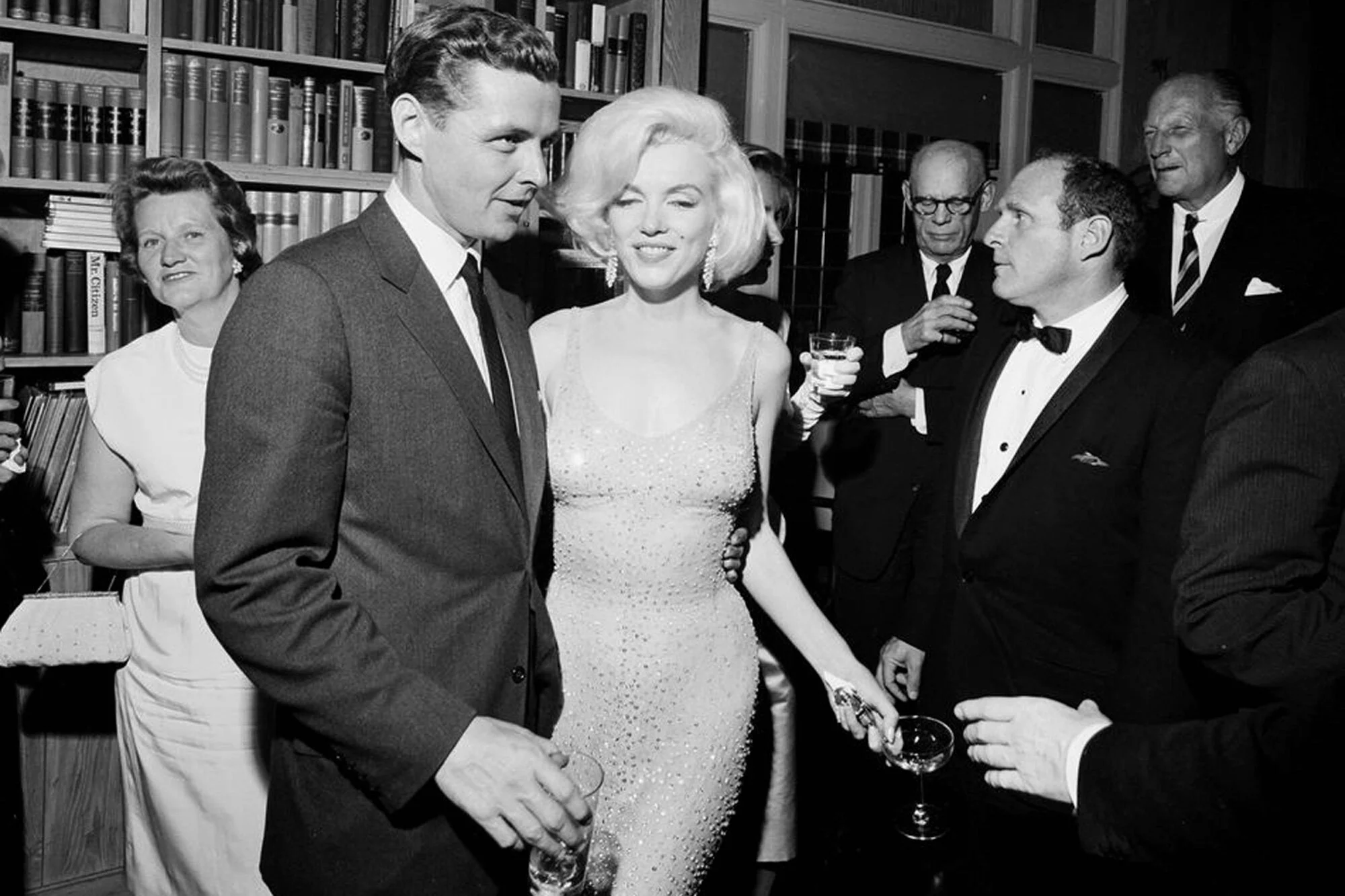
Steve Smith and Marilyn Monroe at JFK’s 1962 birthday party where Marilyn presented him with the Rolex / Credit: Associated Press
It is somewhat strange to, in discussing the Cold War, focus on the sometimes very expensive timepieces of a few political leaders. Russian, Cuban, East German, and American leaders to be exact. It does give an idea of the distinction between what was happening in the lives of those leaders versus what was happening to the ‘regular folk’. There is a great contrast between the lives of men like John F. Kennedy and Fidel Castro, versus those of the people they were meant to serve. Watches serve to highlight this but also give an idea of the ‘spirit’ behind the different nations intertwined in this decades-long conflict, from the Far East to Washington, D.C. Although, as usual, Rolex seems to be a common denominator.
By: Andres Ibarguen
Read more:
The Editors of Encyclopaedia Britannica. “Cold War.” Encyclopedia Britannica, https://www.britannica.com/event/Cold-War.
The Editors of Encyclopaedia Britannica. “The Collapse of the Soviet Union.” Encyclopedia Britannica, https://www.britannica.com/event/the-collapse-of-the-Soviet-Union.
Steinberg, Alfred. “Harry S. Truman.” Encyclopedia Britannica, https://www.britannica.com/biography/Harry-S-Truman.
Colston, Penelope. “The Allure of the President’s Watch.” The New York Times, November 3rd, 2020, https://www.nytimes.com/2020/11/03/fashion/the-presidents-watch-vulcain-cricket.html.
Heim, Gabriel. “The watch of Presidents.” National Museum, March, 2018, https://blog.nationalmuseum.ch/en/2018/03/the-watch-of-presidents/.
Gretler, Corinne. “Trump to Get Inaugural Timepiece From Ailing Swiss Watchmaker.” Bloomberg, December 8th, 2016, https://www.bloomberg.com/news/articles/2016-12-08/trump-to-get-inaugural-timepiece-from-ailing-swiss-watchmaker.
“Dwight D. Eisenhower’s Rolex Watch.” RR Auction, https://www.rrauction.com/Dwight-D-Eisenhowers-Rolex-Watch.html.
“Poljot President of Russia.” Polmax 3133, http://www.polmax3133.com/gallery0201.html.
The Editors of Encyclopaedia Britannica. “Fidel Castro.” Encyclopedia Britannica, https://www.britannica.com/biography/Fidel-Castro.
The Editors of Encyclopaedia Britannica. “Cuban missile crisis.” Encyclopedia Britannica, https://www.britannica.com/event/Cuban-missile-crisis.
Gervase Clarence-Smith, William. “Angola.” Encyclopedia Britannica, https://www.britannica.com/place/Angola/Independence-and-civil-war.
Gabella, Marco. “The Unlikely Watch Collectors: Rolex Edition.” Watchonista, March 27th, 2020. https://www.watchonista.com/articles/history/unlikely-watch-collectors-rolex-edition.
Fung, Ginn. “All you need to know about iconic Rolex ‘Pepsi’ GMT-Master II.” South China Morning Post, April 18th, 2018, https://www.scmp.com/magazines/style/watches/article/2141918/all-you-need-know-about-iconic-rolex-pepsi-gmt-master-ii.
“Lot 247.” Antiquorum, https://catalog.antiquorum.swiss/en/lots/rolex-ref-1675-gmt-master-lot-324-247.
Sale for Monroe 'gift to Kennedy'.” BBC, October 19th, 2005, http://news.bbc.co.uk/2/hi/entertainment/4357142.stm.