

We previously discussed the mid-century rivalry between Vulcain's Cricket and Jaeger-LeCoultre's Memovox, both credited with popularizing the alarm function at the time. Today, instead, we ask a different question, what came before?
Well, the origins of alarm clocks hearken back to Plato and his famous water clocks in the 4th century BCE. Their use has always been clear; humans need to be reminded of things to do, like in Plato's case, waking up early. More recently, in 1847, Antoine Redier patented the first adjustable mechanical alarm clock – previous attempts were not adjustable and could only ring at a single, specified time. As an example, take the American Levi Hutchins, who invented an alarm clock in 1787 that would ring exclusively at 4am – in time to wake him up. The alarm wristwatch, however, has its roots in the first mass-produced alarm pocket watch, its movement patented by Dürrstein & Co. in 1899. This movement set the precedent for the future development of alarm wristwatches, in particular the second crown at 2 o’clock, used to set the alarm; and the hammer mechanism, used to strike an internal membrane to ring the alarm. Then, in 1904, Eterna used Dürrstein’s movement to develop a patented uni-directional internal bezel, for setting the pocket watch’s alarm. This internal bezel joined the independent alarm hand previously developed by Dürrstein in becoming the predominant designs for alarm wristwatches.
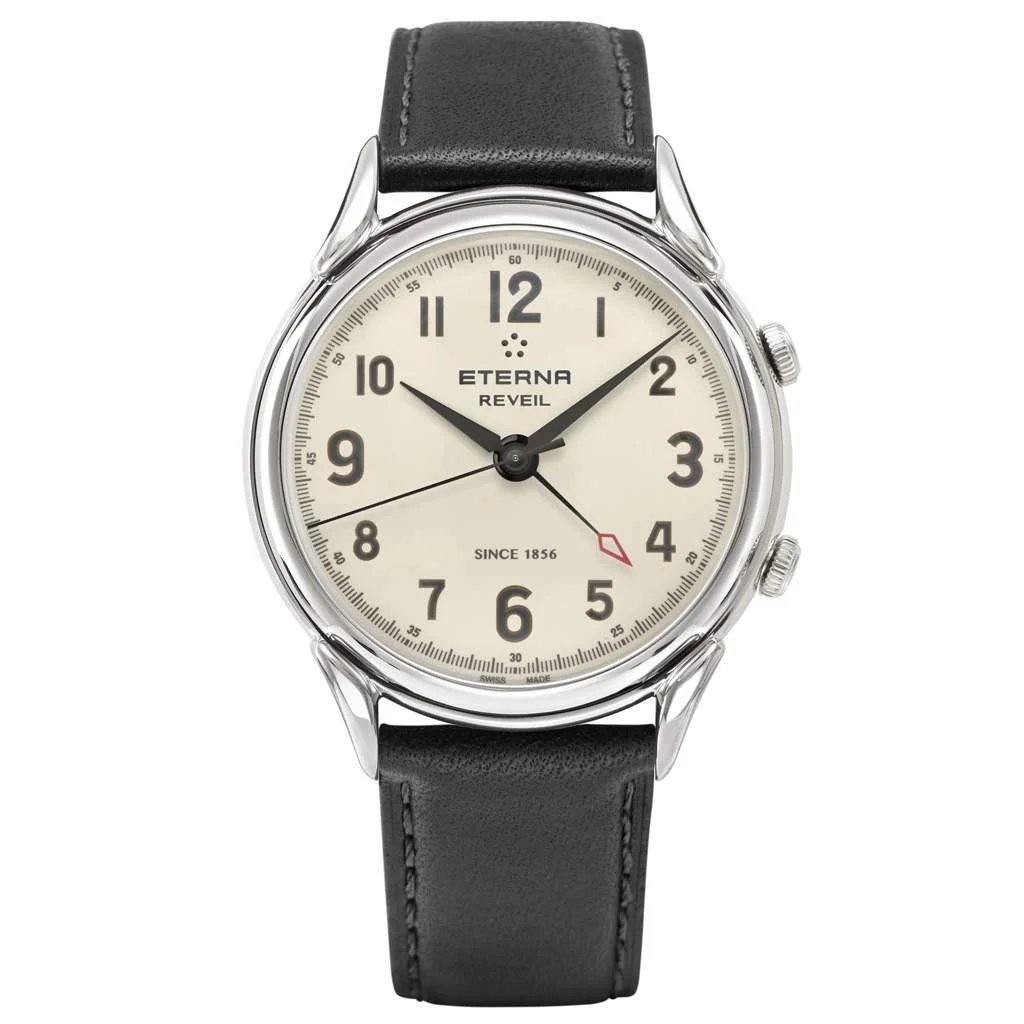
Eterna 1948 for Him Réveil / Credit: GPHG
Eterna finally patented the alarm wristwatch, now with a bi-directional internal bezel, in 1908, releasing it after years of development in 1914. Theirs was based on the original Dürrstein movement, but much smaller to accommodate the case sizes of the time.
Ultimately, this should serve as a reminder of Eterna’s true position in the watch industry. Not only their historical connection to ETA, but the invention of the alarm wristwatch, the Eterna-matic, and the legendary Kontiki! It is truly an undervalued brand today, with a history on par with the best of them.
By: Andres Ibarguen