
Everything You Need to Know About Vintage Omega Watches Throughout the 1960s
Omega Watches in the Sixties

1967 vintage Omega Seamaster 300 ref. 165.024 / Credit: Hodinkee
The 1950s were all about modesty and minimalism, and the belief that less is more as it pertains to watch designs. The post market boom was well underway, and the ‘American Dream’ was in full effect. A new market for luxury watches emerged, and Rolex and Omega were dominating in this field. Sport watches also made their mainstream introduction, now proudly being sold alongside the typical dress watches that society had become accustomed too.
By the 1960s, the watch world accepted the sportier watches which were now undergoing massive design changes in a highly experimental period. If the fifties were black and white, the sixties were technicolor, and this was displayed through pushing the aesthetic design of watches, past what was previously acceptable.
In Britain, this decade was referred to as the ‘Swinging Sixties’ where it transformed from the bleak, conservative city, into a place of freedom and promise. By the early 1960s, teenagers were much, much different than their parents,who had spent their youth fighting World War II.
One of the largest, defining aspects of the 1960s, was the cultural shift in music. Although Rock ‘n’ Roll began in the 1950s, it wasn’t until the ‘60s when bands like The Beatles would start to revolutionize the music industry. It was during this time that artists would also start experimenting with new sounds, and highly innovative music was released. The revolution was well underway – and it was at least partly accompanied by the rise in recreational drug use, which became synonymous with the 1960s.
Massive technological shifts were also happening around the world. While watch companies were competing to create the world’s first automatic chronograph, countries were racing to put the first man on the moon. The many inventions of the 1960s shaped the modern technology landscape.
Omega Watches’ Milestones in the Sixties
John F. Kennedy and His Omega Slimline Watch (1960)

John F. Kennedy’s Omega Slimline watch gifted by Grant Stockdale circa 1960
Heading into the 1960 presidential election in America, John F. Kennedy received an Omega Slimline watch from his friend Grant Stockdale. Following his victory, he wore the watch during his inauguration on January 20th, 1961.
Astronaut Wally Schirra and His Omega Speedmaster Chronograph (1962)

May 1962 – Wally Schirra preparing for a capsule checkout exercise wearing the Omega Speedmaster ref. CK-2998 / Credit: NASA
On October 3rd, 1962, Astronaut Wally Schirra wore an Omega Speedmaster chronograph on the Mercury Sigma 7 mission. Wally orbited the Earth six times while wearing the Speedmaster chronograph, two and a half years before it was officially qualified by NASA for all its spaceflights.
NASA Officially Qualifies the Omega Speedmaster for Spaceflight (1965)
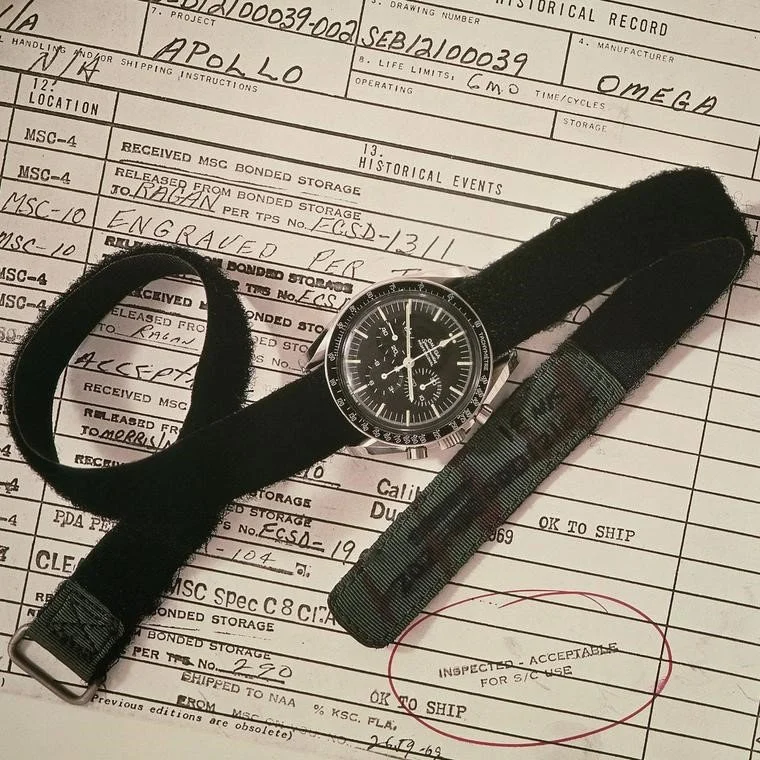
NASA qualifies the Omega Speedmaster for all manned space missions in 1965 / Credit: The Jewellery Editor
As part of the space program that was rapidly accelerating in the 1960s around the world, Omega was one of four watch companies eligible to submit their timepieces for NASA certification. The Omega Speedmaster was the only watch to pass the rigid requirements for all manned space missions and extravehicular activity. Over 50 years later, the Omega Speedmaster is still the only watch certified by NASA and the International Space Station for extravehicular activity.
The Omega De Ville Release (1967)

The Omega De Ville ref. 111.077 / Credit: Timepiece LTD
In 1967, the Omega De Ville became its own line after dropping ‘Seamaster’ from its name. The Omega De Ville initially made its debut in 1960, when it was housed inside the Omega Seamaster collection. It then started appearing on the dial by 1963.
The Omega Speedmaster Professional Worn on the First Mission to the Moon (1969)

Buzz Aldrin in the Apollo 11 Lunar Module wearing an Omega Speedmaster on July 20th, 1969. / Credit: NASA
On the 21st of July, 1969, Buzz Aldrin and Neil Armstrong made history when they became the first humans to walk on the moon. After this infamous spacewalk, during the Apollo 11 mission, the Speedmaster would forever be cemented as the ‘Moon Watch’. Following the first spacewalk, ten more astronauts would appear on the moon in the subsequent three years. Each of those astronauts would wear the Omega Speedmaster.
The Omega Speedmaster ref. BA145.022 gifted to Richard Nixon and Vice President Spiro Agnew (1969)

The Omega Speedmaster ref. BA145.022 inscribed for President Richard Nixon in 1969
To commemorate the moon landing, Omega created the Omega Speedmaster ref. BA145.022. This commemorative edition was made from 18k gold, featured a burgundy bezel, and had an inscription on the caseback that read: “to mark man’s conquest of space with time, through time, on time”.
This vintage Omega Speedmaster housed the Caliber 861, with only 1,014 models released from 1969 - 1973.The first was created for President Richard Nixon, followed by the second created for Vice President Spiro Agnew. Models 3-28 were given to NASA astronauts, 29-32 given to famous Swiss watch industry leaders, and the public were given the opportunity to purchase the remaining available timepieces. Unfortunately, due to the American government’s strict gifting protocol, the presidential watches had to be returned.
Important Vintage Omega Watches From the Sixties
The Omega De Ville Chronograph Cal. 860 (1969)

The Omega De Ville Chronograph Cal. 860 ref. 145.017 circa 1969 / Credit: Corr Classic Watches
The Omega De Ville was first launched as the Omega Seamaster De Ville, part of the Seamaster series, in 1960. By 1963, it was common to see only the “De Ville” on Omega dials, informally dropping the “Seamaster” until the Omega De Ville became its own line in 1967. Throughout the 1960s, the Omega De Ville was produced in a wide assortment of models.
It is important to note that in 1957, Omega released the famous ‘Trilogy’ of watches: the Omega Railmaster, Omega Seamaster, and Omega Speedmaster. This release was extremely popular and was pulling the brand into a sportier segment. The Omega De Ville can be thought of as the more elegant timepiece, much more representative of a 1950s minimalist dress watch. The Omega De Ville became one of the brand's most lucrative lines – still available for men and women to this day.
The Omega Cal. 860 was the two-register version of the Cal. 861, which had three sub-dials. The Caliber 861 was an updated Caliber 321 movement, used on Omega Speedmaster, De Ville, and Seamaster chronographs.
The Omega Speedmaster Mark II With Racing Dial (1969)

Vintage Omega Speedmaster Mark II Chrono ref. 145.014 / Credit: Omega Forum user TomVox
Looking to extend the brand’s line in 1969, the Omega Speedmaster Mark II signaled the first re-design of Omega’s Speedmaster chronograph. The Speedmaster Mark II chronograph now had a barrel shaped case, enhanced readability, and used the Omega Caliber 861 movement.
The Caliber 861 was the second movement used in the Speedmaster, first seen in 1968. Compared to the previous Caliber 321, it had a much simpler structure.The Mark II was also a great rebrand for the Omega Speedmaster series, going back to their sports and racing roots when it was first introduced in 1957
The Omega Seamaster 300 ref. 165.024 (1967)

Vintage Omega Seamaster 300 ref. 165.024 circa 1967 / Credit: Hodinkee
The Omega Seamaster was first released in 1948, and it was designed for “Town, Sea, and Country”. So, from inception, it wasn’t necessarily always a dive watch, but more so a gentleman’s watch, which was dust and moisture proof.
By 1957, Omega released the infamous Omega Seamaster 300 ref. CK2913, specifically designed for underwater use. Going to 1962, the second generation of the Seamaster 300 was ready to be released, which included the ref. 162.024 and 162.025 (date). The case was now 42 mm in diameter, increased from 38 mm, and the straight lugs were turned inwards. The reference 165.024 (pictured above) would house either the Cal. 550 or 552, while the reference 165.025 would house either the Cal. 563 or 565.
This is an important piece, because just as the Omega Speedmaster was gaining worldwide attention, the Omega Seamaster series was still duking it out with the likes of the Rolex Submariner, Blancpain Fifty Fathoms, Zodiac Sea Wolf, and Breitling SuperOcean in the 1960s.
By: Eric Mulder
Read more:
“NASA Tests and Qualifies the Speedmaster.” Omega Watches, https://www.omegawatches.com/chronicle/1965-nasa-tests-and-qualifies-the-speedmaster.
Mazzardo, Alessandro. “History of the Omega Speedmaster.” Time and Watches, January 4th, 2021, https://www.timeandwatches.com/p/history-of-omega-speedmaster.html.
Weppelink, Jorg. “Buying Guide: The Best Omega Watches From The 1960s.” Fratello Watches, https://www.fratellowatches.com/buying-guide-the-best-omega-watches-from-the-1960s/.
“1969 Omega Speedmaster Mark II.” Omega Watches, March 27th, 2021, https://www.omegawatches.com/planet-omega/60th-anniversary-speedmaster/mark-ii-1969.
“The 1960s Omega Seamaster 300 - A Hands-On History.” Stetz & Co., November 21st, 2017, https://www.stetzcowatches.com/2017/11/21/buying-vintage-seamaster-300-read-first/.

A vintage King Seiko Hi-Beat Chronometer 5626-7060 that was recently serviced, for sale on Toronto Vintage Watches.