
The Bakelite Story and Why We Love It

1957 Rolex GMT-Master ref. 6542 ‘Bakelite’ / Credit: AmsterdamVintageWatches
History of Bakelite
The watch industry is no stranger to using interesting materials. From peculiar alloys that make up the tiniest of components to full-on bronze cases whose popularity only seems to grow. One of such materials was Bakelite, and it was used for quite some time not only in the watch industry, but in almost every industry. It was popular on dive watches in the mid-20th century, but also pilot’s watches with rotating bezels.
Bakelite was invented in 1907 by scientist Leo Hendrik Baekeland. Baekeland was an American born in Ghent, Belgium in 1863. He received his doctorate at the age of 21 from the University of Ghent and taught there until he started his own company selling his invention called ‘Vetox’. Bakelite is the trademark for the synthetic resin known as phenol-formaldehyde – a hard and resistant synthetic plastic that is also shatterproof and resistant to acids and electricity. An excellent start to making robust watch bezels. It was the first thermosetting synthetic plastic meaning it was heat resistant and did not melt. Bakelite came up during the ‘Age of Plastics’ when many different plastics were invented that are still used today.
Leo Hendrik Baekeland first began looking for a replacement for shellac in 1905 and discovered ‘Bakelite’. He was already wealthy from selling Vetox and tried improving the hardness of wood by impregnating it with a synthetic resin similar to Bakelite. He eventually found the right formula and created Bakelite – named after himself, of course. He applied for the patent in 1907 and founded the General Bakelite Company in 1910. Bakelite was first used in home appliances and in the electric power industry in the early 20th century, specifically right after the First World War. It continued to be used for electronics parts for the next decades. Bakelite really became popular in the 1920s when new colours were introduced and used in kitchenware and furniture. It was seen as a distinctly American achievement and widely praised in the press. The first issue of Plastics Magazine even had it on its cover.

1931 Ericsson Bakelite phone
However, the patent for Bakelite expired in 1927 and the company started to face increased competition from companies offering similar materials in the early 1930s. Baekeland sold the trademark in 1939 to the Union Carbide and Carbon Corporation (now Union Carbide Corporation, which is today a subsidiary of The Dow Chemical Company). Then, Union Carbide sold the trademark in 1992 to Georgia-Pacific Corporation – a pulp and papers company based in Atlanta, Georgia – founded in 1927.
All kinds of objects were made with Bakelite including jewelry, telephones, musical instruments, and, of course, watches!
Which Vintage Watches Used Bakelite?

Rolex’s GMT recall notice
One of the most popular uses of a Bakelite that we’re concerned with is in watchmaking – or more specifically – watch bezels. And one of those most popular applications is, you guessed it, the Rolex GMT!
The first Rolex GMT was released in 1954 as the reference 6542. This classic pilot’s watch was equipped with a blue and red or ‘Pepsi’ Bakelite bezel. Rolex started using aluminum bezels in their watches only a couple years after the release of the Rolex GMT-Master ref. 6542 – this came after the US Atomic Energy Commission issued a recall on all of the Rolex GMT-Masters sold in the US with radium in the bezel, as it was deemed too radioactive. Apart from this, the Bakelite bezel also proved to be prone to cracking, so the decision to change to aluminum was all too easy. At the time, the standard Rolex GMT-Master ref. 6542 cost a mere $240…now models with Bakelite go for many multiples of that.
Now, Rolex is, of course, by no means the only brand to use a Bakelite bezel, Wittnauer used Bakelite bezels for vintage dive and sports watches, as did Elgin for their divers. In fact, many vintage dive watches from the 1960s and ‘70s used Bakelite bezels, including the Bulova Oceanographer and some early references of the Omega Seamaster 300. It was a very popular material for watchmaking as it was for several other industries.
Why We Love Bakelite Bezels
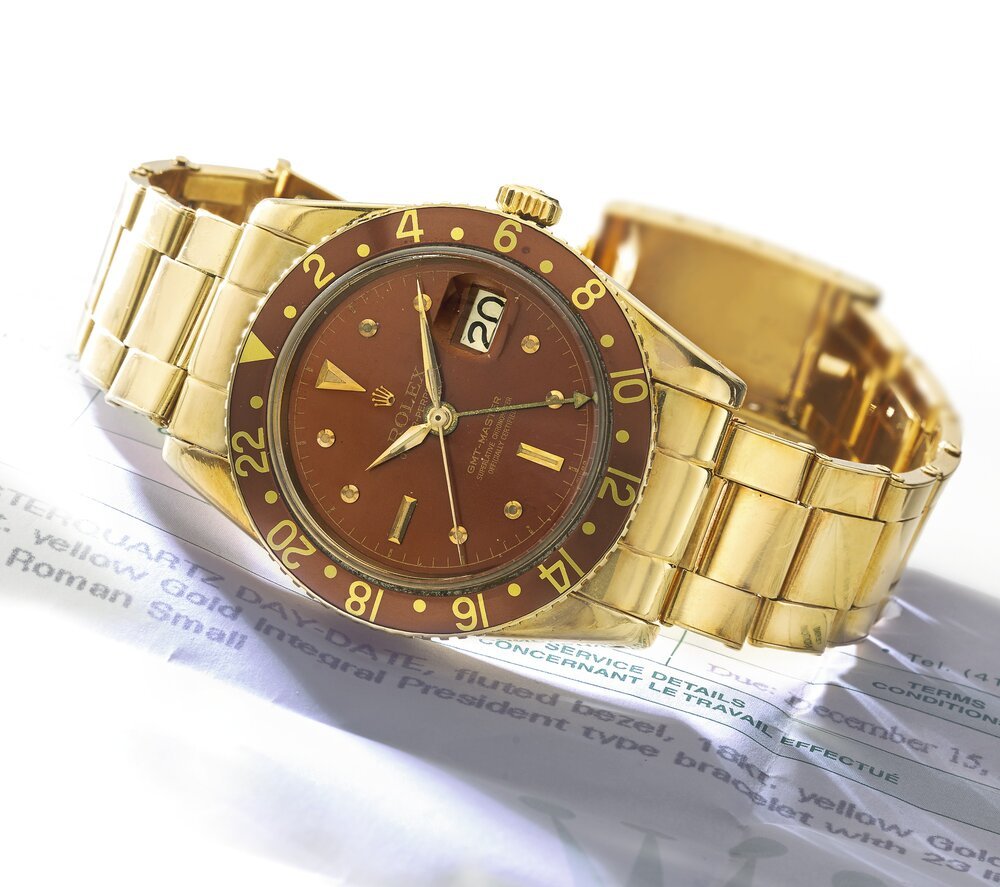
1958 Rolex GMT-Master ref. 6542 in yellow gold / Credit: Sotheby’s
Ultimately, at the time in which Bakelite was most popular, in the earlier part of the 20th century, it was in fact one of the best materials around for a watch bezel. This all changed, however, as material science improved and Bakelite fell behind. Its resistance to temperature changes is what made it a real breakthrough in the early 20th century, but other materials – specifically for watch bezels – proved more practical. First aluminum and today ceramic bezels are very popular.
As for Bakelite, today, if it is used in a watch at all it is mostly for ‘decorative’ or ‘nostalgic’ purposes – in homages. Bakelite still gets scratched fairly easily and so is usually combined as a sort of composite with something else. Notwithstanding, Bakelite is a very unique material, the way it makes colours stand out even after decades of wear is truly remarkable – and one of the main reasons I love to see Bakelite in watches. Moreover, it gives the feelings of a strange period in the early 20th century – kind of like when people thought the future would be full of flying saucers instead of self-driving cars.
Thus, although those cracked and crumbling Bakelite bezels you find at the flea market may not be so aesthetically pleasing, there’s a history behind the choice of material for vintage watch bezels that should certainly be appreciated.
By: Andres Ibarguen