
These Are the Vintage Watches You Should Start Collecting Now

Heuer Carrera ref. 2447SN, Patek Philippe Calatrava ref. 2526, and the Rolex Explorer II ref. 1655
Rolex Explorer II Reference 1655
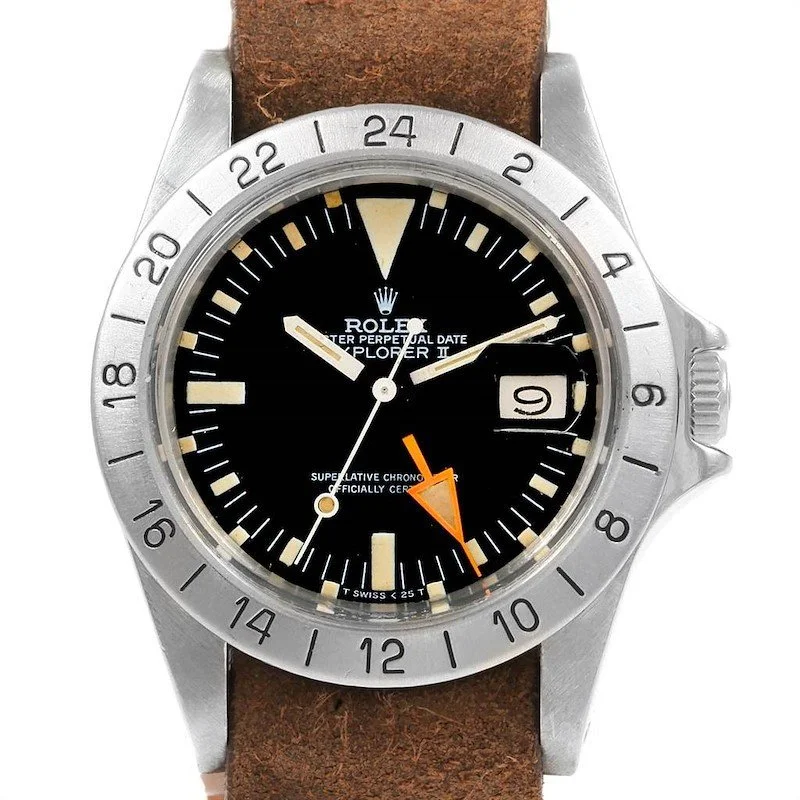
The Rolex Explorer II Steve McQueen ref. 1655, circa 1982 / Credit: Swiss Watch Expo
Going back to the 1930s, Rolex had been equipping mountaineers and sportsmen with their ‘Oyster’ case watches. While expanding upon the Oyster design, Rolex released a line of tool watches, with the Explorer being an example once it was released in 1953.
The Rolex Explorer II ref. 1655 was released in 1971. This included a metal bezel with a 24-hour clock and an addition of the second hour hand or GMT hand. The Rolex Explorer II had the same movement as the GMT-Master reference 1675 at that time, the Rolex Caliber 1575. The GMT had a rotating bezel, while the Rolex Explorer II used a fixed 24-hour scale indicator.
The introduction of the second hour hand helped tremendously inside cave systems, as it would help wearers know the remaining daylight hours left (AM/PM indicator). It was also chronometer rated and water resistant up to 100 metres. This was a rugged watch, capable of keeping up with even the toughest of expeditions.
Rolex has successfully tested Explorer II over a variety of different circumstances until the mid-1980s when it was discontinued. It equipped famous polar expeditions, mountaineering campaigns, and dangerous caving missions.
Grand Seiko ‘Star Light’ 5645-8000

Solid 18k yellow gold Grand Seiko ‘Star Light’ 5645-8000 from 1971 / Credit: Frogos Gallery
The Grand Seiko 56GS series includes a vast array of models, second only to the 61GS in terms of diversity. There are over 30 models within this series, while using only three different movements. Production of the 56GS started in 1970 and continued to 1974, when it was then discontinued.
The 5645A Grand Seiko was the date version, in which they also had the 5641A (no-date), and 5646A (day-date). The movement was to be set at 28,800 BPH. The 8000-case shown was available with both 5645 and 5646 movements. The high end of these 8000 cased ranges are the solid 18k gold models which were available for 390,000 Yen for the date version and 395,000 Yen for the day-date version. To put this in perspective, the 6138 models in the 1974 catalogue were only selling for around 20,000 Yen.
Heuer Carrera Reference 2447SN

Heuer Carrera ref. 2447SN, circa 1969 / Credit: Heuer World
The 2nd execution of Heuer Carreras were introduced in 1968, five years after the Heuer Carrera’s initial release. This release saw some details of the 1st execution expanded upon, mostly in the name of finer legibility. This second-generation Heuer Carrera also saw the introduction of many new dial designs.
The Heuer Carrera ref. 2447SN is not the rarest, but is the most desired of the range and it wouldn’t be too farfetched to call it the most aesthetic chronograph ever created. These Heuer Carrera ref. 2447SNs were powered by the Valjoux 72, which many claim is one of the finest manual winding chronographs ever created.
These timepieces have a distinctive white dial and tachy ring with contrasting black sub dials, known as the ‘Panda’ Carrera. It is the contrasting colors and steel hands which give the Carrera the classic look.
Jaeger-LeCoultre Reverso Grande Taille Reference 270.1.162

Jaeger-LeCoultre Reverso Grande Taille ref. 270.1.62, circa 2000 / Credit: Watch Club
In the early 20th century, at a time when the British still had a significant presence in India, many of their officers entertained themselves by playing polo. Upon their return to Europe, some of these British officers complained to César de Trey, a Swiss businessman and watch dealer, that their wristwatches keep breaking during matches, specifically the glass crystal covering the dial. To solve this problem, de Trey promptly engaged his associate Joseph-David LeCoultre and LeCoultre’s affiliate Edmond Jaeger (they had not yet founded Jaeger-LeCoultre), who subsequently contacted French engineer Alfred-Rene Chavot. Chavot, after some trial and error, eventually had the idea of creating a rectangular watch case that could be flipped onto a solid side to protect the dial. And thus, in releasing the first Reverso in 1931, the group succeeded in creating the first polo-friendly wristwatch and one of the world’s first sports watches.
The Jaeger-LeCoultre Reverso was originally produced with a Tavannes Caliber 64 (as at the time LeCoultre had no appropriately shaped movements available), until 1933 when they released the Caliber 410 (small seconds), the 411 (sweeping seconds), and the 412 (small seconds and date). In addition, the original had no signature on the dial.
The Jaeger-LeCoultre Reverso underwent a down period during the 1940s when consumer sentiment shifted back towards round watches. That was until the 1970s when an Italian watch dealer spotted some Reversos on a trip to the JLC manufacturer in Le Sentier. Convinced this was the correct time for a revival, JLC re-introduced various quartz Reversos throughout the 1980s with limited success. It wouldn’t be until the 1990s, when the Jaeger-LeCoultre Reverso ref. 270.1.162 was also introduced, when the Reverso would experience its full resurgence.
Omega Seamaster 300 Reference 165.024
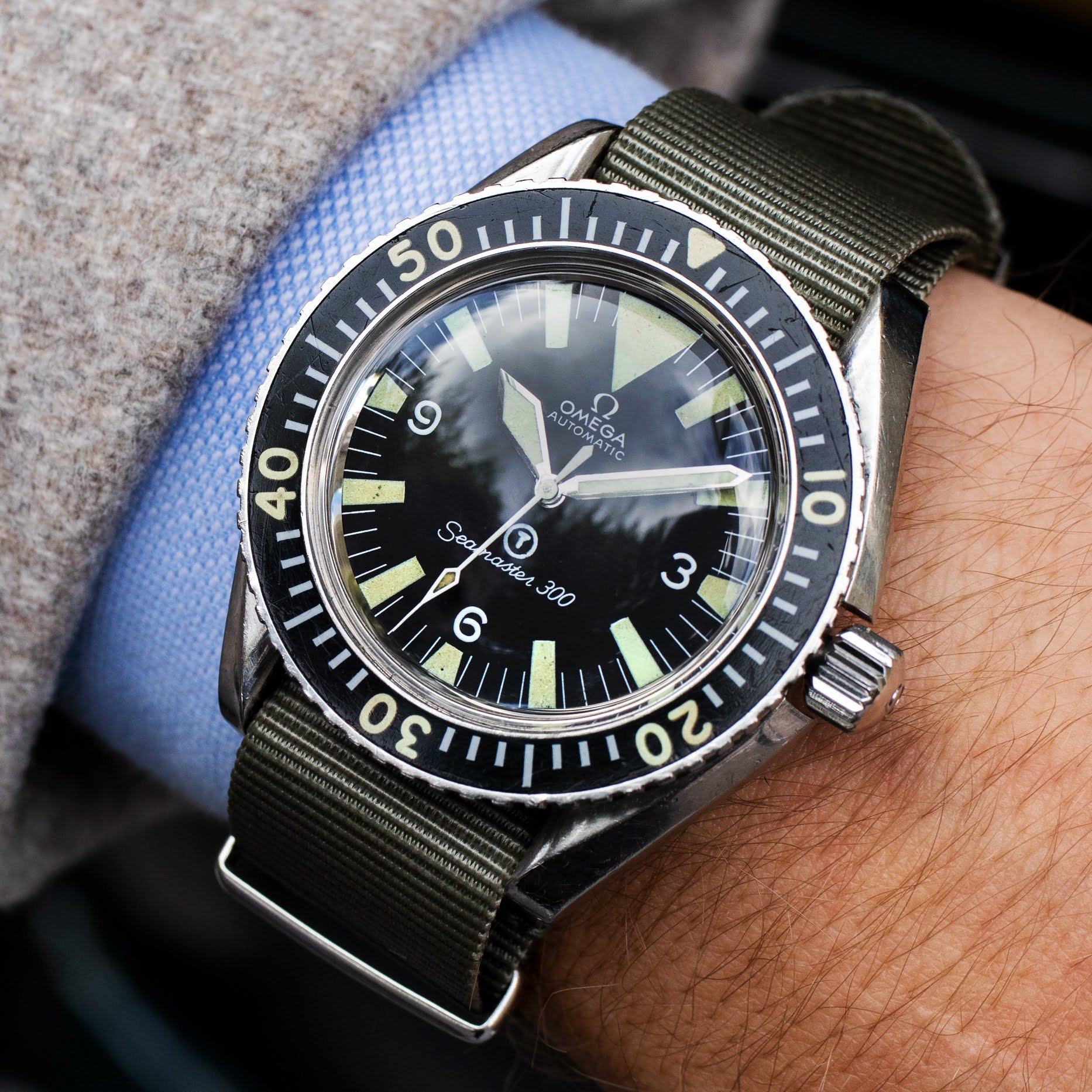
1958 Rolex GMT-Master ref. 6542 in yellow gold / Credit: Sotheby’s
The Omega Seamaster was known mostly for replacing the Rolex Submariner as James Bond’s go-to watch, it has had quite a riveting history. Moreover, an Omega Seamaster Planet Ocean Ultra Deep recently broke the world record for deepest dive watch by going 10,928 metres into Mariana’s Trench! So, there’s no doubt that the Seamaster is an icon, let’s explore why.
Omega released the Marine in 1932, kicking off their involvement in the dive watch sector. By the time the company’s 100th anniversary came around in 1948, it was already well known for making robust dive watches. It was also the official timekeeper for the 1948 London Olympic Games, as such, when Omega released the first Omega Seamaster that same year, it was well-received by the market. The first Omega Seamaster was based on designs for British military watches used during WWII, it distinguished itself by introducing the O-ring gasket to wristwatches for increased water resistance. Omega broke their first diving record in 1955 when Gordon McLean reached a depth of 62.5 metres in Australia. The company also tested the watch the following year by attaching it to the outside of Canadian Pacific Airways flight 302, that traversed the North Pole. As diving became more popular during the 1950s, dive watches naturally also did, and the Omega Seamaster found itself at the center of the argument, releasing the Omega Seamaster 300 as part of its 1957 trilogy and having the new model worn by famous divers like Jacques Cousteau in the early 1960s.
The Seamaster fell off as a result of the Quartz Attack and fashion trends during the 1970s and ‘80s but made a comeback in 1995 when it appeared as James Bond’s official watch in GoldenEye. It appeared in all the subsequent Bond films, from Pierce Brosnan to Daniel Craig, since the film series’ switch from Rolex. Ultimately, the Omega Seamaster has the honour of being, not only a pioneer in the field of dive watches, but also one of the few early dive watches still around today.
The Patek Philippe Reference 2526
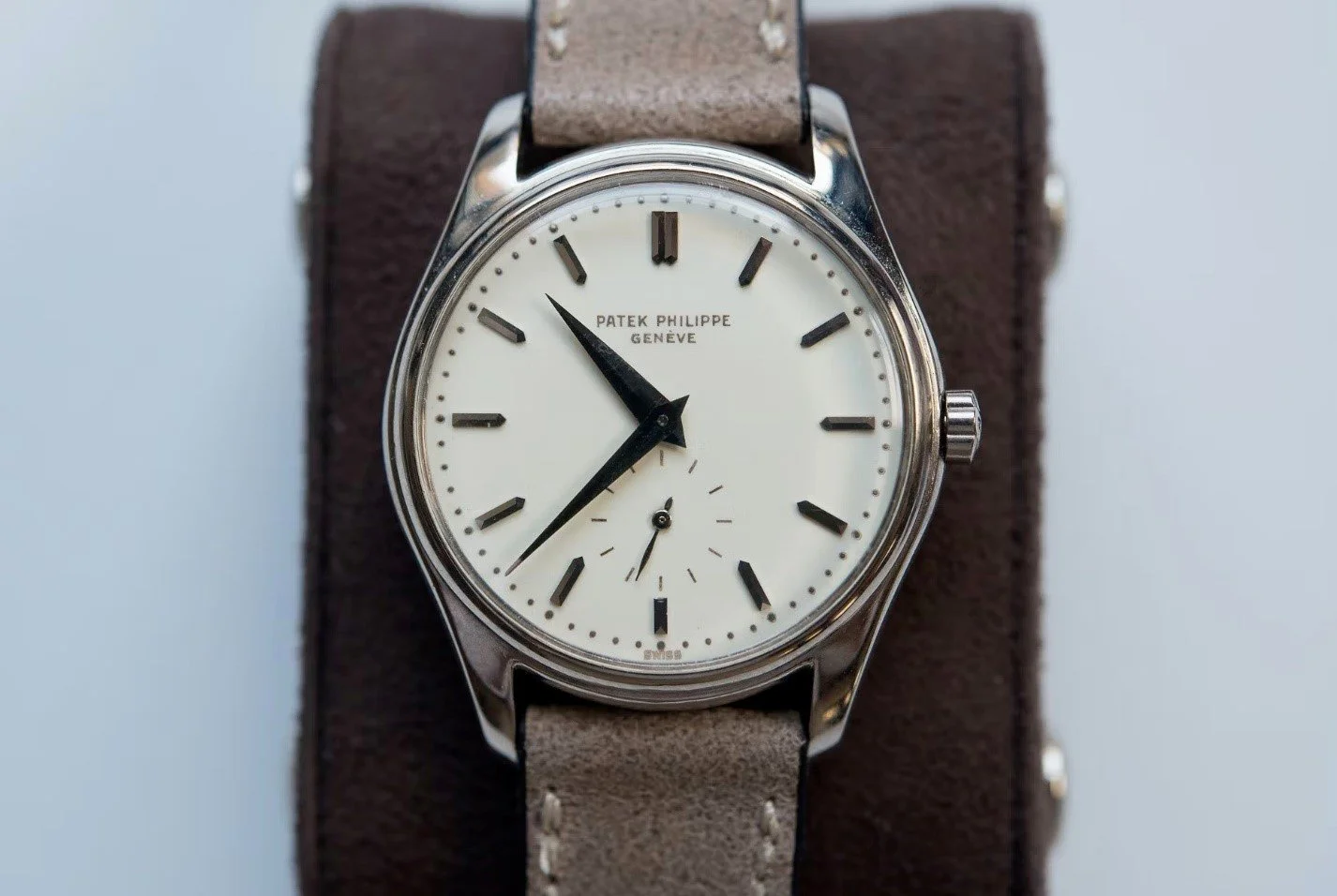
A white gold Patek Philippe Rref. 2526. / Credit: Hodinkee
The Patek Philippe ref. 2526 had a pioneering rotor. It came equipped with a bi-directional rotor which would spin and accumulate energy even from the faintest of movements. This helped it absorb enough energy to have a 40-hour power reserve. Although Patek was not the first to develop an automatic wristwatch, the automatic caliber 12’’’-600 is still recognized as one of the best automatic movements in the world, and it was first used in the Patek Philippe ref. 2526. The Patek Philippe reference 2526 was first released in 1953 and was discontinued in the 1960s, after a total of 7,000 timepieces were sold throughout its lifespan.
This Patek Philippe also came equipped with a thick enameled dial. These enamel dials had greater scratch resistance, they don’t fade with time, and can be cleaned easily. It was also the first time a highly iconic “PP” was cut into the crown.
The Patek Philippe reference 2526 was an instant success due to its design and innovations. Demand for thinner watches in the mid-1950s led to the development of the Patek Philippe ref. 2552, which was a thinner version of their first automatic watch.
By: Eric Mulder