
Exploring the Evolution of the Major Auctions and the Watches Sold in Them

Emperor Haile Selassie’s Patek Philippe ref. 2497 / Credit: Christie’s
Watch auctions, and auctions in general, can often become a contentious subject. Incentives and conflicts of interest. Originality and quality. Two aspects of the auction world that often cause this controversy. And yet, most are not aware of the origins of this ostentatious industry. Moreover, given the current performance of the watch auction market, positive, and the market’s track record of doing well throughout financial crises, exploring the history of this segment of the luxury goods industry is ever more alluring.
The Ancient History of Auctions
From the Henry Graves Supercomplication to the Patek Philippe Grandmaster Chime. Watches have been selling for millions of dollars for quite some time now. And although auctions have evolved as of late, with internet companies like Catawiki and others, the essence of the business has stayed true for thousands of years, since ancient Greece. Herodotus, author of The Histories, was the first to report the use of an auction in 500 B.C. At the time, auctions were organized to bid on young women who would then be married off. Under the Roman Empire, this evolved to include soldiers auctioning off their spoils of war in what were called ‘atrium auctionariums’ and regular citizens organizing estate sales and informal auctions for other goods.

The Slave Market in Rome by Gustave Boulanger
Throughout the existence of the Roman Empire and in the early Middle Ages, auctioning continued to grow as an activity, a notable instance of which being when the Praetorian Guard tried to auction off Rome in its entirely in 193 A.D., the Year of the Five Emperors, after Emperor Pertinax was killed. In this case, Didius Julianus outbid all others and successfully ‘acquired’ the Empire, although unfortunately for him, he was assassinated mere months later and Septimius Severus took the throne – initiating the Severan dynasty which lasted until 235 A.D.
Meanwhile, on the other side of the world, in what are today the regions of East and Southeast Asia, Buddhist monks would auction off goods to fund the construction of new temples. Moreover, the auctioning of women and livestock was reportedly in practice since ancient Mesopotamia, and it is also likely that other cultures engaged in a similar practice. To be honest, the basic concept of auctioning is very close to that of bartering so it’s hard to pinpoint exactly when it began.
The world of auctions that we know today really came to be in the 17th century, when the world’s first auction house was opened: the Stockholm Auktionsverk or Stockholm Auction House; opened in 1674. However, in North America, Europe, and the rest of the world, slaves had been traditionally sold at formal auctions for centuries (particularly in Africa where it was tradition to enslave the losing tribe/kingdom in a war). Today, the biggest auction houses, and the most recognized, are Sotheby’s and Christie’s – both founded in the 18th century – 1744 and 1766, respectively.

James Christie holds his first sale in his permanent saleroom in Pall Mall, London circa 1766 / Credit: Christie’s
Around this time, ‘candle auctions’ also became popular, whereby a candle would be lit and bidders would have until the candle went out to place bids. This was done to stop people from swooping in with last minute bids, knowing precisely when the auction would end.
That effectively brings us up to date as far as the world of auctions goes, but what about watch auctions? The kind of watches that are sold for extremely high prices in auction today were often made to order, like Henry Graves commissioning Patek Phillipe to make his Supercomplication, King Fuad I’s Vacheron Constantin, or Emperor Haile Selassie’s Patek ref. 2497. In more recent history, auction houses like Antiquorum, Phillips, and others, have focused on watches in competition with Christie’s and Sotheby’s. For example, the Patek Philippe Platinum World Time Ref. 1415 sold by Antiquorum in Geneva in 2002, set a world record when it sold for about $4 million USD. However, this was quickly upstaged in 2004 when a white gold Patek Philippe Calibre 89 sold for about $5 million USD. Patek has consistently found itself at the top of such lists, with another record set when a ref. 1527 sold for almost $6 million USD in 2010. Only to be upstaged by the Supercomplication’s 2014 price.
Since the early 2000s, as many of you may be familiar with, prices for watches in auction have skyrocketed. Last year alone was a record breaker, with the aforementioned Patek Philippe Grandmaster Chime ref. 6300A-010 selling for approximately $31 million USD. Eclipsing the Supercomplication’s previous record of $24 million USD. And as with the Great Recession in 2008, the auction sector has held fast throughout this latest round of financial turmoil. As evidenced by recent results in Geneva.

The most expensive watch ever sold – the Patek Philippe Grandmaster Chime ref. 6300A-010 / Credit: Barron’s
Despite these extreme highs, the auction, and watch auction world, has been no stranger to scandal. Notably, there was the price fixing scandal in the early 2000s that saw both Sotheby’s and Christie’s fined hundreds of millions of dollars, and Alfred Taubman, former owner and leader of Sotheby’s, being convicted of price fixing. Sotheby’s and Christie’s were found to have fixed prices starting in 1995 with their entire operation being uncovered only 6 years later (although Christie’s was found to have conspired on commission fees since 1993).
Scandals and Watch Auctions
On the other hand, auction houses have also been found and accused many times of selling fake or ‘franken’ watches and passing them off as a rarer piece than is true, or as all completely original, sometimes costing collectors hundreds of thousands or millions of dollars. This perception has been magnified recently with scandals involving leading auction houses in Europe selling either fake or modified vintage Rolexes, and being exposed for doing so by researchers like Perezscope. Notably there’s the somewhat recent Rolex Daytona scandal involving Phillips, where a watch disguised as a Rolex ‘Solo’ ref. 6240 that was actually a ref. 6239, was sold in Hong Kong. These incidents and many others like it have led collectors to no longer view auction houses as reliable sources of information, as they may have at one time, and even less so reliable sources of vintage timepieces. Although, to Phillips’ credit, the situation was resolved with the buyer, as is often the case when these discrepancies are uncovered.
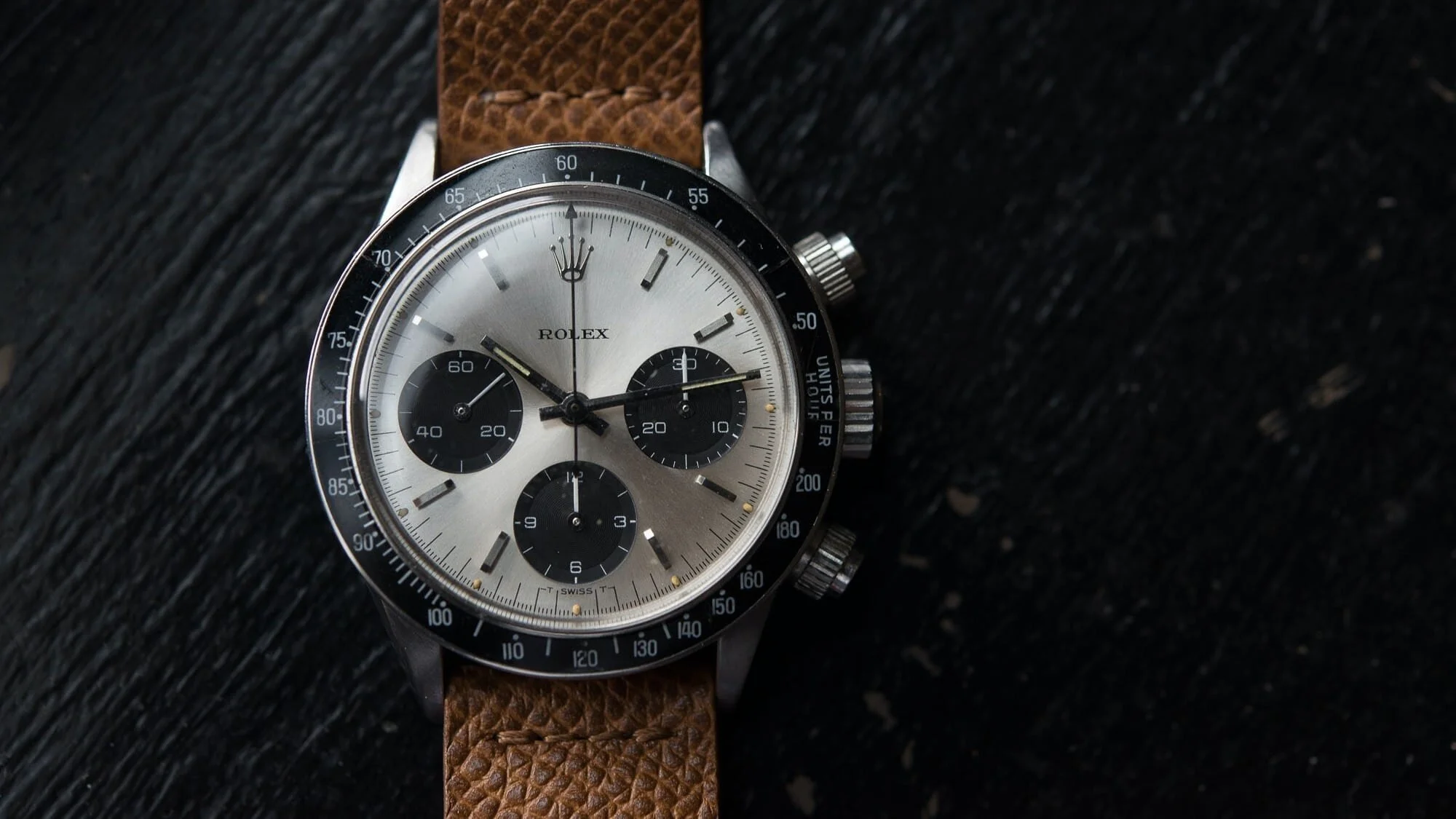
The Rolex Daytona which was part of a scandal involving Phillips / Credit: Hodinkee
Ultimately, despite the role of auction houses in the watch industry, no matter where you buy a watch from there’s a couple things to keep in mind: always buy the seller and no one truly knows everything about vintage watches, references numbers etc. Much of the history is undocumented or unverified and so to blindly trust what someone says would likely be a mistake. Oftentimes people specialize on certain brands, types, or periods of watchmaking but will have limited knowledge of what lies outside their expertise. Many more experienced collectors will have stories to share of making mistakes in regards to who to trust. But ultimately that is precisely the subject at hand: trust and individual research is the only way to go about buying vintage watches.
By: Andres Ibarguen