

In the early 1950s, the mighty Swiss watchmaker Jaeger-LeCoultre, debuted a new kind of automatic watch. Famed for its movement designs and innovative case shapes since the 19th century, Jaeger-LeCoultre aimed to make a highly accurate and reliable watch that improved on their line of ‘Powerwind’ automatic movements introduced in the late 1940s. Fitting the aspirational marketing and style of the time, they called it the Jaeger-LeCoultre ‘Futurematic’.
This radical watch was also very futuristic, in three ways. Firstly, you can see there is no crown on either side of the case. The crown to set the time is on the rear of the case. The automatic bumper rotor that winds the mainspring is larger than usual as the movement does away with a winding crown and mechanism. This extra space gives room for a larger balance wheel making the watch more accurate. When setting the watch there is a hacking mechanism that stops the balance wheel, making it possible to set the time to the second.
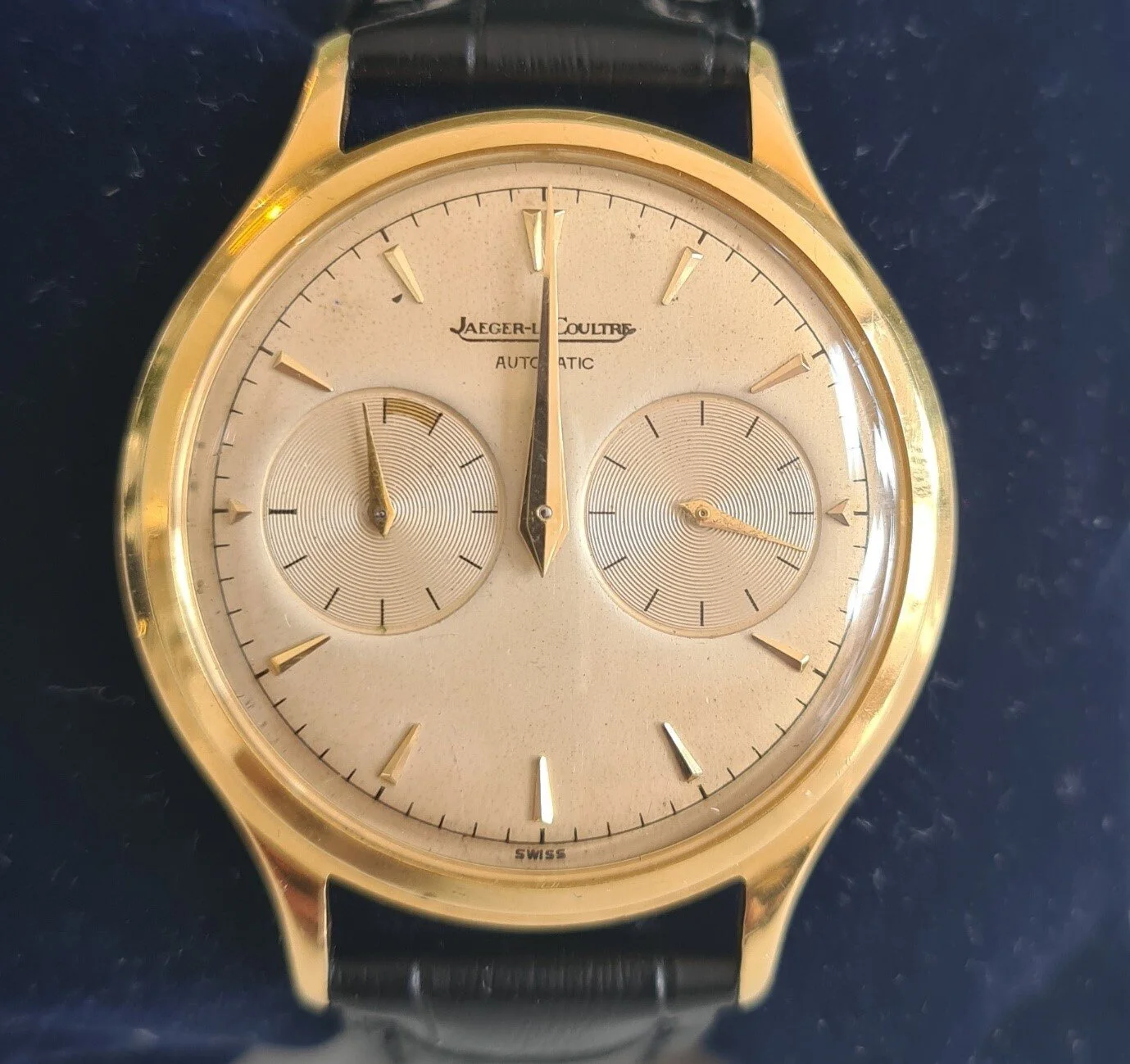
The author’s Jaeger-LeCoultre Futurematic in 18kt gold, sold into the French market circa 1955
Secondly, the winding mechanism has two other unique features. One locks the rotor from moving when the power reserve of 40 hours is reached, which reduces wear on the rotor. The rotor is also mounted above and below the movement. This is very unusual, but beneficial because it balances out wear on the pivots. The mainspring, which stores the power for the watch, is designed in such a way that even when the watch has stopped running it will preserve six hours of power. This is so that when the watch is next picked up it will start again.
Finally, only the crown is on the case back, making the Jaeger-LeCoultre Futurematic symmetrical in appearance. JLC played on this theme with two main design styles. The first, can be seen above, with two extra-large sub-dials showing the seconds on the right and the power reserve on the left. The other is found in later models and is sought after by collectors for its fun porthole design. Both allow for innovation in terms of dial design and symmetrical features.
With these features, Jaeger sold this watch as “The World’s First Fully Automatic Wristwatch”.
These watches were sold throughout the 1950s, available in steel, gold-filled, and solid gold cases of differing qualities depending on the market. The two main calibers are the JLC Cal. 497 and the JLC Cal. 817 for the ‘porthole’ models. Both calibers were improved slightly over the years with better shock protection, becoming the Cal. P827 and Cal. P837, respectively. It is suspected that this watch was too complicated to produce and sell profitability, leading to the production ending in the late 1950s.
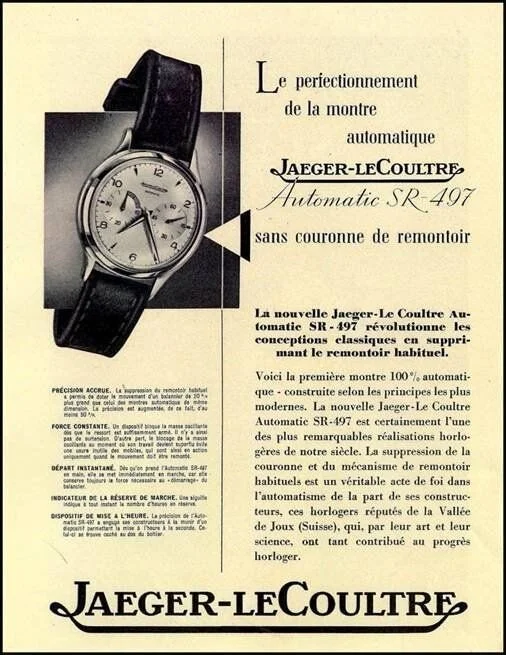
A French advertisement describing the benefits of the Jaeger-LeCoultre Futurematic / Credit: WatchProSite user Amanico
For today’s collectors, they come up every so often and range in price between $1,500 to over $6,000, depending on condition. There are a range of dial variations and lug designs for collectors to explore, and some beautiful uses of the porthole in the later models. For lovers of Jaeger-LeCoultre or those interested in the history of automatic movements, the Futurematic is a timepiece well worth looking out for.
By: Hamish Robertson/The Watch Collector’s Club
The Watch Collectors’ Club is a club for everyone who likes watches. Based in London, they run fun and informative events both online and in-person.
Read more:
Blomman. “Jaeger-LeCoultre: Futurematic on the French market.” Blomman Watch Report, July 10th, 2021. https://blommanwatchreport.com/2021/07/10/jaeger-lecoultre-futurematic-on-the-french-market/.