
The Superocean Was Breitling’s First Dive Watch, Released in 1957
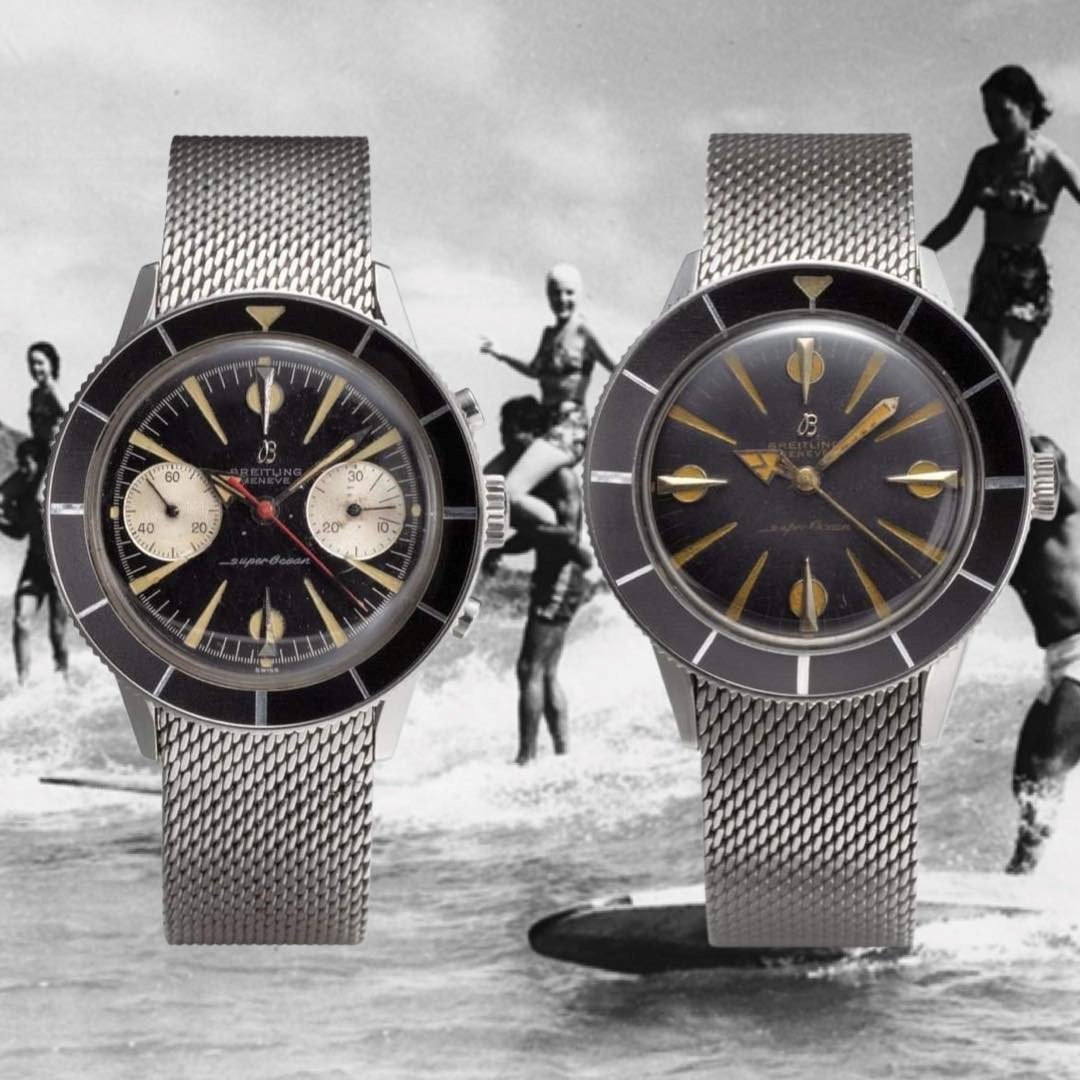
The 1957 Breitling Superocean ref. 807 featuring the Venus Cal. 150 and the 1957 Breitling Superocean ref. 1004 featuring the Felsa Cal. B125
Heading into the 1950s, Breitling was already famous for its aviation timepieces, gaining popularity among pilots since the initial release of their aviator chronograph in 1936. But Breitling also has a rich history in the maritime sports and diving sector, which we will explore today.
In the late 1940s and 1950s, dive watches became extremely popular. Omega released the Seamaster in 1948, while Rolex released the Submariner, Blancpain the Fifty Fathoms, and Zodiac the Seawolf in 1953. This demand coincided with the boom of nautical sports such as surfing, underwater diving, and professional oceanic exploration. By 1957, Breitling was ready to start dominating the seas just as it had done with the skies. They released a time-only diver, the ref. 1004, and a chronograph diving watch, the ref. 807. Each of these watches were marketed towards a different type of consumer, one a more casual beach goer and the other for a more seasoned professional.
Upon release, they both notably had 200-meter water resistance and massively oversized triangular hour markers, which gives the Breitling Superocean its highly recognizable design. The rotating bezel also had a rather unorthodox look – further adding to the Superocean’s unique appeal, which was released at 39 mm in diameter.
By the 1960s, Breitling was ready to start expanding upon its popular Superocean series. This led to the development of the ‘Slow-Motion’ Superocean. Willy Breitling, the president of Breitling at the time, had wanted to increase the technical prowess of the dive watch collection. So, they expanded upon the chronograph series that allowed for easy and safe reading of the diving duration, especially while divers were at significant depths. The minute recorder is typically too small and gets difficult to read when underneath the water. So, Breitling developed a caliber where the main chronograph hand would indicate the diving duration, which made one revolution per hour instead of per minute.
Unfortunately, this also made it difficult to figure out if the chronograph hand was working properly, as it was now slow-motion when looking down briefly. So, they innovated further – adding a running indicator at 6 o’clock. When the chronograph is working properly underwater, the indicator will resemble a yellow disc. Once the chronograph is on hold, it becomes black with a yellow dot. And finally, when the chronograph is reset and stopped, it will just be an all-black dot. When officially launched in 1964, the new slow-motion chronograph was well received among the diving community, who appreciated the large 43 mm case without the hard-to-read sub-dials.

The 1965 Breitling Superocean ‘Slow-Motion’ ref. 2005 and the 1970 Breitling Superocean Chrono-Matic ref. 2105
In 1969, in partnership with Heuer-Leonidas and Buren Hamilton, Breitling launched the caliber which would power the Chrono-Matic. The Caliber 11 was one of the world’s first automatic chronograph movements, competing directly with Seiko’s famous 6139 movement and Zenith’s legendary El Primero movement. Using this innovative new movement, Breitling released the Superocean Automatic ref. 2105 with a large 48 mm case. The aesthetic of their new Chrono-Matic Superocean was highly emblematic of late ‘60s/early ‘70s watch design – bold, bright, and experimental.
Now, arriving in 1983, Breitling was to once again push its Superocean series to its limits. They released the Breitling Superocean ‘Deep Sea’ ref. 81190, which could now reach depths of 1000 meters, about 800 meters deeper than their original release 26 years prior.

The 1983 Breitling Superocean ‘Deep Sea’ ref. 81190
This exceptional depth rating was made possible through a patented helium escapement caseback. This caseback acts like a valve which enables helium to be released, crucial in allowing the watch to go to significant depths.
Today, the Breitling Superocean is still popular among diving and watch enthusiasts alike. A remarkable story starting all the way back to 1957, when Breitling released this collection alongside the original dive watches from the early 1950s, a watch that was part of the race to the first automatic chronograph in the late 1960s, and that has added a lot of technical ingenuity to the field of diving and marine sports. It’s not hard to see how, in many ways, the Breitling Superocean series defines the classic dive watch.
By: Eric Mulder

A modern-day example of the Breitling Superocean Automatic 42 / Credit: Breitling
Read more:
“Aviation watches.” Breitling, https://www.breitling.com/us-en/find-your-breitling/aviation-watches/.
“Superocean.” Breitling, https://www.breitling.com/us-en/heritage/superocean/.

A vintage Vulcain automatic dress watch. For sale on Toronto Vintage Watches.