
Pforzheim Is an Ancient Watchmaking Hub Located in Southwest Germany
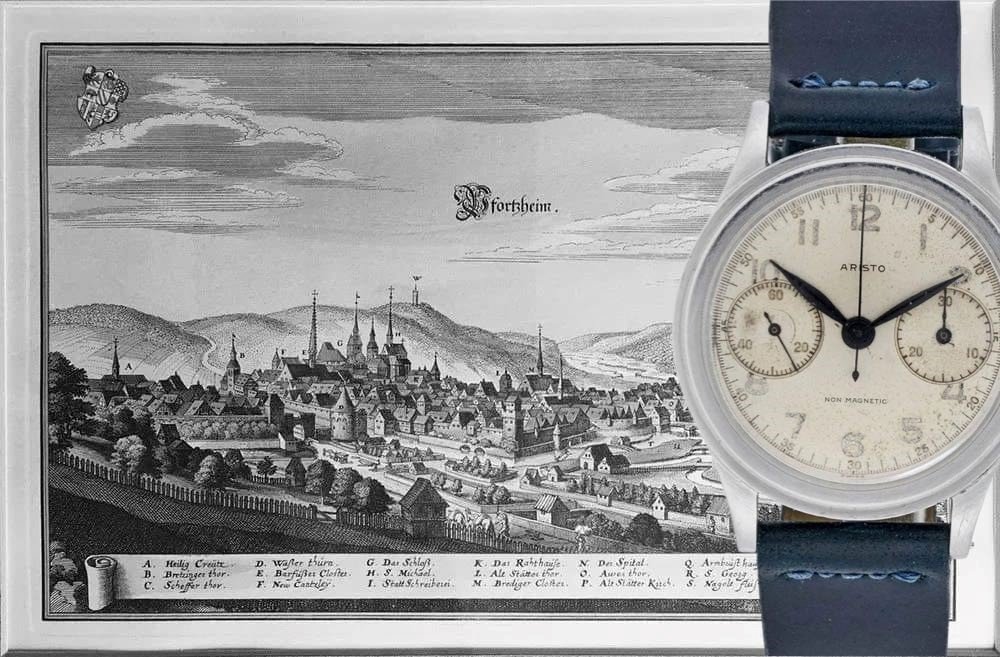
A view of Pforzheim in the early 17th century and a 1940s Aristo steel chronograph
Pforzheim, an ancient city in Southwest Germany, known as the ‘Golden City’ and the ‘Gateway to the Black Forest’, is often disregarded for more prominent watchmaking hubs like Glashütte in the east. However, it was once the epicenter of a thriving jewelry and watchmaking trade, and for over 250 years has stood as a symbol of German industry and artisanry. So, how did the story of the Golden City unfold?
There are two main periods in Pforzheim’s watchmaking history. The first was what we will call the ‘Golden Age’, when the sector exploded, as it was still in a nascent phase around the world. The second was its ‘Renaissance’, during the Interwar period, coinciding with what is often referred to as the ‘Golden Age of Weimar’.
The Golden Age of Pforzheim Watchmaking
The first period begins back in 1767, when the Grand Duke of Baden, Carl Friedrich, allowed for watch entrepreneur Jean-François Autran to set up a factory in an old orphanage in the city. The following year, this decree led to the establishment of a fine steel factory and the first vocational school in the world, the watchmaking school that is today a part of the Freunde der Goldschmiedeschule mit Uhrmacherschule Pforzheim e.V. or the Goldsmith and Watchmaking School Pforzheim.
The factory did spectacularly, also expanding into steel and gold goods production in 1768. Autran was joined by a fellow French Huguenot partner in 1769, who found a third partner, but eventually went bankrupt in 1774 (with the third partner dying – albeit after bankruptcy). The factory continued to produce watches without them, and other watchmakers in the city continued to thrive.
However, when their factory closed in 1821, this started a period of decline that coincided with the decline of the watch industry in Pforzheim. After the factory closed, the sector was more or less stagnant for the next century. Although the jewelry industry continued to grow exponentially, as a system of ‘cabinets’ had developed where jewelers working in the same workshop operated independently based on their cabinets in the workshop (essentially their own workspace). By 1900 the jewelry sector boasted 15,000 employees.
The Rebirth or ‘Renaissance’ of Pforzheim Watchmaking

Bauhaus-style Stowa from the 1930s – the original STOWA watch / Credit: Stowa Museum
The second period was that of revitalization in the watch industry in the city of Pforzheim, with companies like Laco and Stowa emerging in the 1920s and 30s, and others like Aristo, founded in 1907 by Julius Epple, benefitting from the bull market. Many of these companies gained a reputation for producing Flieger watches, those used by the Luftwaffe in World War II.
Stowa was founded in 1927 by Walter Storz in Hornberg and moved to Pforzheim in 1935. It focused on Bauhaus design and pilot watches, doing very well in the lead up to the Second World War. It was also known for its exceptional gold watches in the 1930s; which having been made in Pforzheim, a city known for its goldsmiths, were of top-notch quality. However, Stowa, along with most other companies in Pforzheim, were completely devastated due to Allied bombing in 1945.
Pforzheim: A German City Destroyed by Allied Bombing

The Bombing of Pforzheim in World War II
The RAF dropped 1,575 tons of bombs on Pforzheim setting off a terrible fire in the industrial city. After the war, many watchmaking companies in Pforzheim used Marshall Plan funds to rebuild their factories and get back to work.
Durowe, for example, reopened its production facility in 1949, and most enjoyed relative success in the 1950s and 60s. However, due to pressure from the introduction of quartz technology in the 1970s, Walter Storz’s son, Werner, created Pallas Deutsche Uhrencooperation, a group of German watchmakers who shared resources in an effort to cut costs and optimize their operations and resist the incursions of quartz watches. Members of this group were: Adora, Arctos, Aristo, Laco, Ormo, Parat, Stowa, and others. Mirroring many similar Swiss groups developed at the time, many brands were sold off or restructured. Stowa, for example, was sold to Jörg Schauer in 1996, who still retains ownership of the brand today.
Pforzheim’s prowess has continued even in recent decades, albeit without the emphasis on watchmaking. Today it is known mostly for its jewelry industry and continues to be a destination for aspiring goldsmiths, jewelers, and even some watchmakers.
By: Eric Mulder