
Longines’ Second-Setting Watch
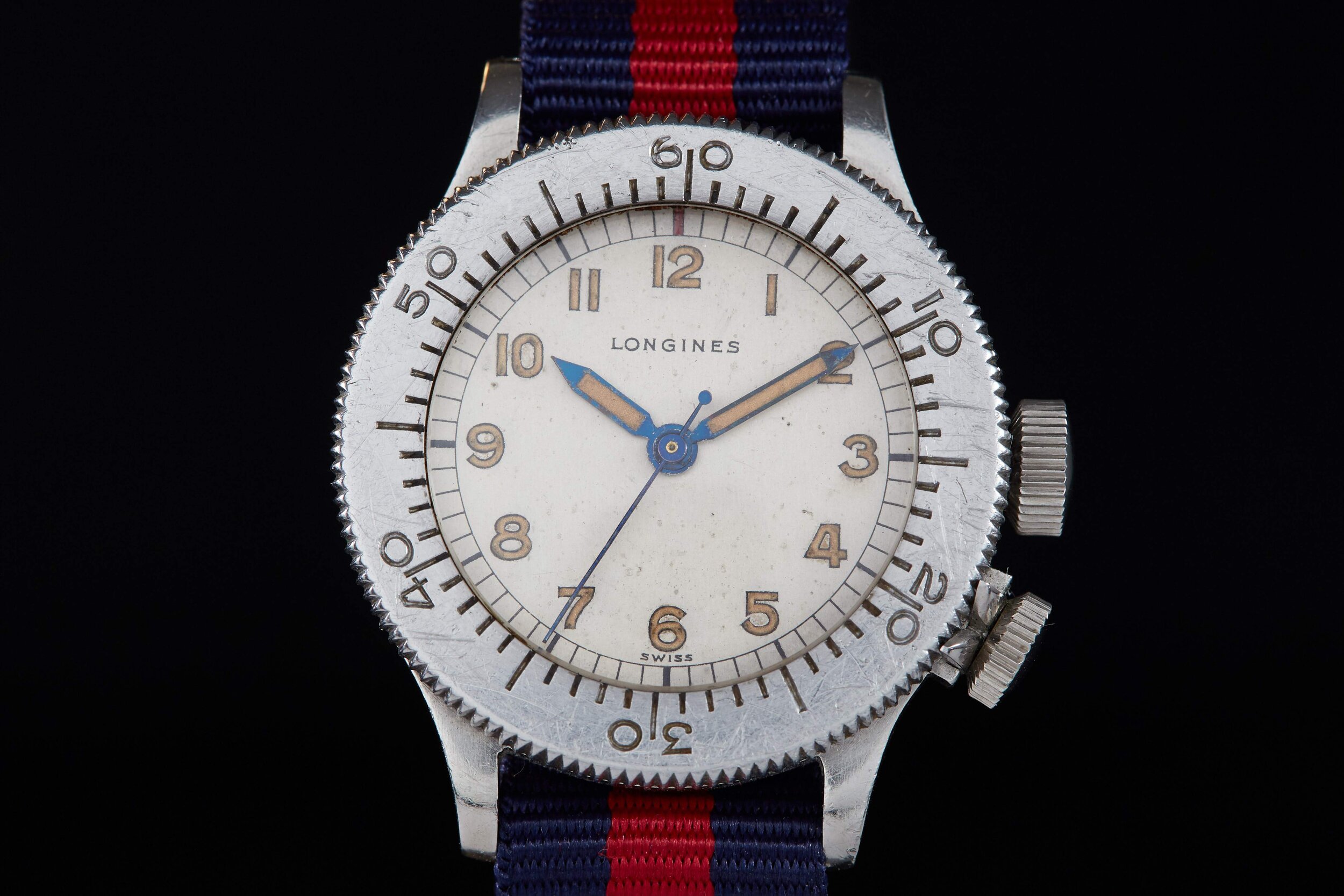
Longines Second-Setting Watch / Credit: Analog/Shift
Philip Van Horn Weems may not be a figure that is widely remembered historically, especially not in relation to vintage watches. However, he did have some pretty significant contributions to the fields of aviation, navigation, and, of course, horology.
Weems was born in Tennessee in 1889 and studied at the United States Naval Academy at Annapolis before beginning his military career. Throughout his time in the Navy, he was always very interested in navigation, something he studied deeply. As a navigator, there was a particular problem that bothered Weems. Navigators were unable to synchronize their watches precisely with their ship’s chronometer or, in a pilot’s case, their radio. To solve this, in the late 1920s, Weems had the idea of developing a new watch with an external rotating bezel that could account for the margin of error in synchronizing the wristwatches. This new invention, that he patented, was called the Weems Second-Setting Watch. Weems partnered with Longines-Wittnauer to bring his new watch to market, which they did in 1929.
The Weems watch seemed to be the solution navigators were hoping for, that is until Charles Lindbergh took it to the next level with his hour-angle watch in 1931. Lindbergh was a student of Weems’, who taught him navigation, and wanted to create a watch that allowed a pilot to quickly determine longitude. To do this Lindbergh again partnered with Longines-Wittnauer, and based his new watch largely on Weems’ earlier invention.
Weems himself also upgraded his original watch, making the A-11 version which was used by the military during WWII, in particular by the RAF. This model was also sold by other companies like LeCoultre, Zenith, Omega, and more.
So, although Weems is not regarded as particularly important to horology, he contributed both to the inception of the rotating bezel and to the trend of ‘tool’ watches after WWII.
By: Andres Ibarguen