
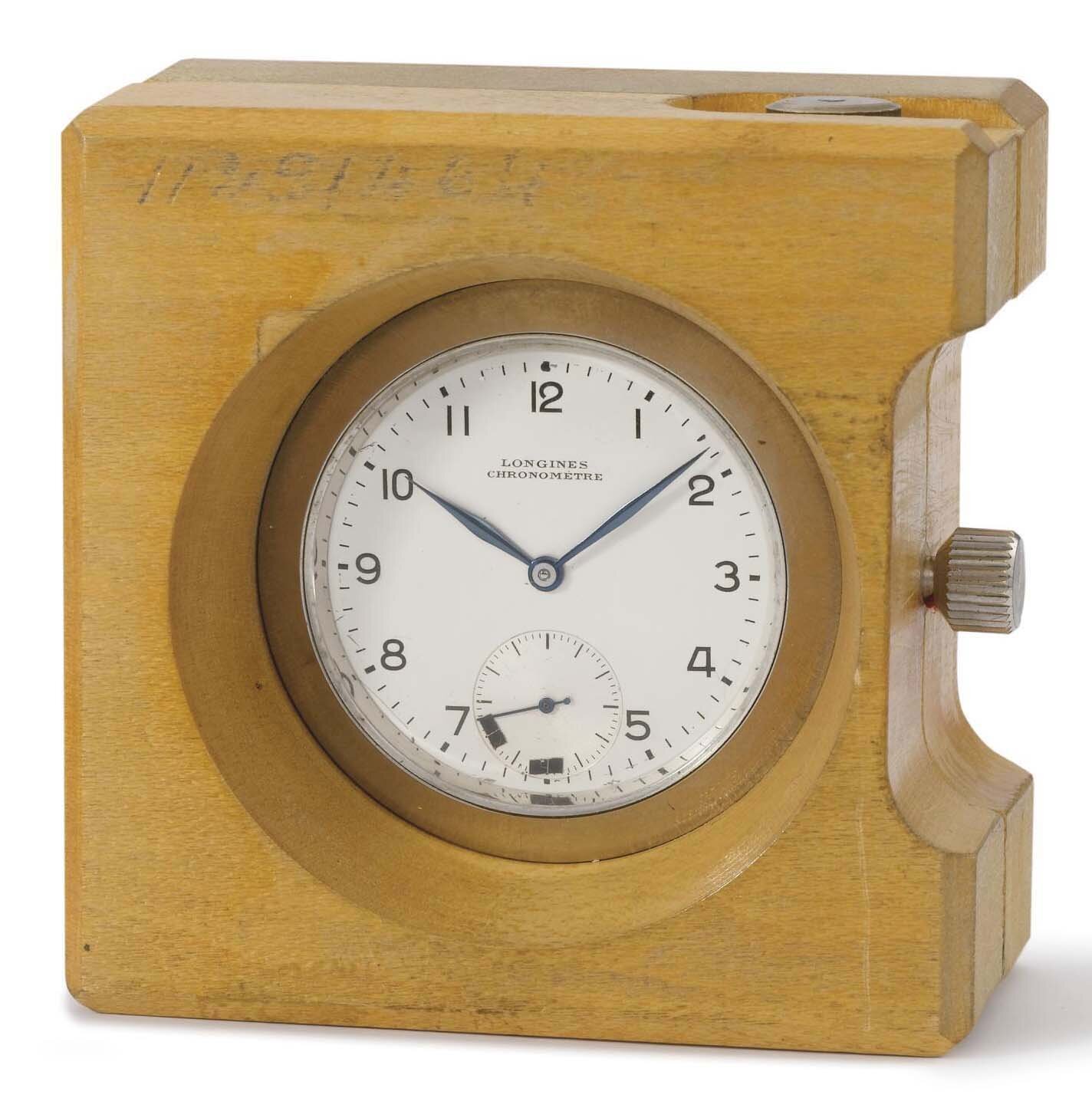
While we recently learned that the first high frequency Longines movement dates back to a pocket watch from 1914. In the 1950s, Longines again looked towards technology to keep its edge in the extremely competitive watch market of the day. This was in the late 1950s, when the watch market was still in recovery from the Second World War, tool watches were becoming increasingly popular among consumers, and dive watches were just starting to become a thing.
Looking to stand out, Longines started working on its first high frequency movement designed specifically for observatory competitions in August of 1958. By 1959 the movement was ready, and the Longines Cal. 360 was born. This was a very fine, rectangular handmade movement that beat at 36,000 bph and was fine-tuned for the Neuchâtel Observatory Chronometer competitions. With the shape of the movement actually improving its accuracy.
Only 200 pieces of this significant milestone for Longines were ever produced, made briefly between 1959 and 1963. And so, at two Neuchâtel Observatory Chronometer competitions in the early 1960s, the Longines Caliber 360 took first and second place one year for accuracy. And the following year, also claimed first, second, and third place with its incredible daily deviation of approximately 1/10th of a second.

1968 Longines Ultra-Chron Diver Cal. 431 / Credit: Longines
This fairly unknown, high frequency Longines movement was the inspiration for the eventual Ultra-Chron series and the Cal. 431. One stand-out from the Ultra-Chron line is also Longines’ first diver’s watch with a high frequency movement. The Longines Ultra-Chron Diver, released shortly after the Cal. 360 in 1968, had an accuracy of +/- one minute per month or two seconds per day. An impressive feat then and today!
While not as popular as some other more notable Longines timepieces, notably their chronographs, Longines’ history of high frequency watch production is quite remarkable. Not only record-breaking accuracy but also iconic watch designs, in particular as far as the Longines Ultra-Chron Diver is concerned.
By: Andres Ibarguen
Read more:
Editor’s note: a previous version of this article incorrectly stated that the accuracy of the Longines Ultra-Chron Diver was +/- one second per month, not one minute. Moreover, the introductory sentence erroneously implied that the first high frequency Longines movement was the 1959 movement ,not the 1914 pocket watch movement.