
HOW GUILLOCHÉ DESIGN BECAME AN ICON ON WATCH DIALS
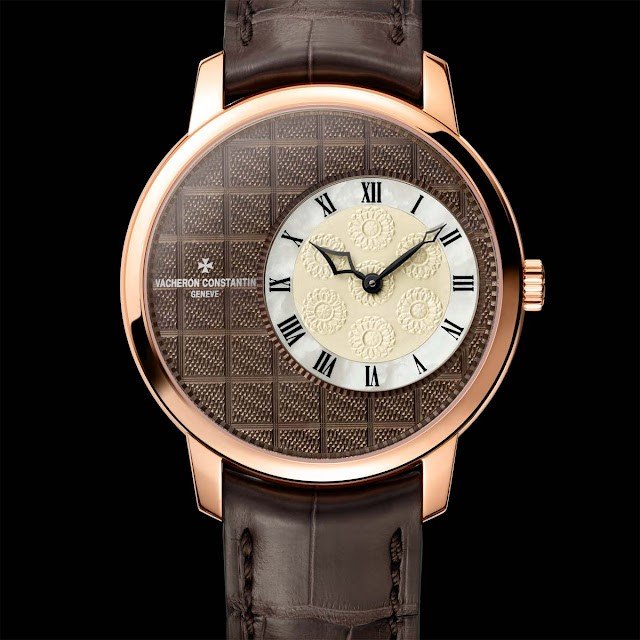
Vacheron Constantin ref. 1400U/000R-B216 Hand-Guilloché ‘Windowpane’ Pattern / Credit: Time and Tide Watches
The intricate patterns that you often see on watch dials are known as guilloché patterns. Guilloché is a type of mechanical craftsmanship that involves precision engraving materials in grids of straight, curved, or broken lines, to create a repetitive pattern. Check out these assortments of guilloché patterns:

Examples of guilloché patterns / Credit: Medium user
Each of these would be an example of a guilloché pattern. These are often found on many of our day-to-day objects, like money, for example. The guilloché patterns on money (like the ones above) can be represented as complex mathematical formulas. The design of the patterns is highly dependent on the input variables, which makes them extremely useful when creating security protocols.

The formula which represents a specific guilloché pattern
Vacheron Constantin has often used guilloché dials on their timepieces to create truly hypnotic effects. Guilloché can often be combined with other forms of art such as enamelling, engraving, gem-setting, and the use of tessellations to amplify its effects.
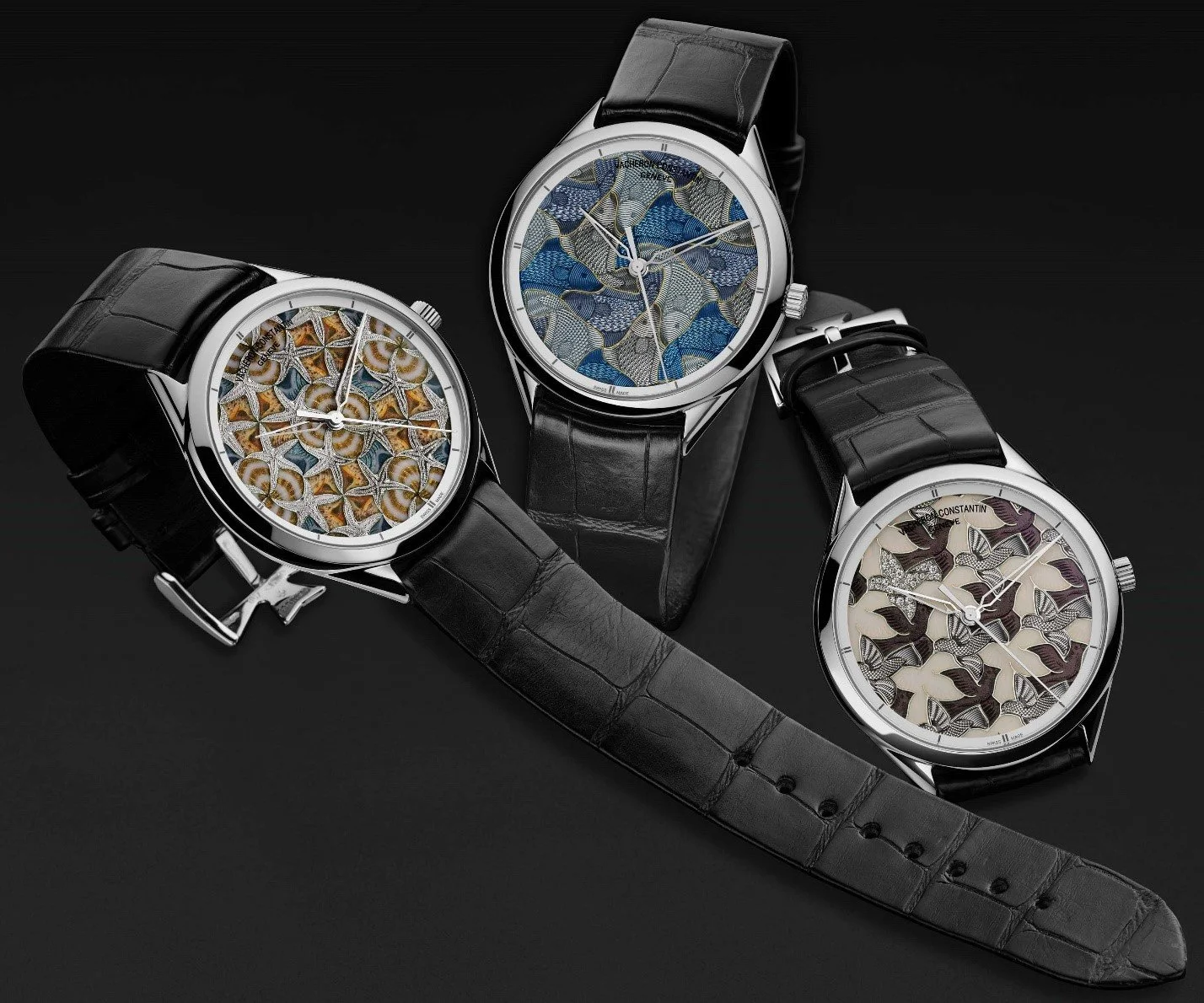
Pieces in the Métiers d’Art collection by Vacheron Constantin / Credit: La Cote des Montres
The Métiers d’Art collection by Vacheron Constantin uses a blend of decorative art techniques to accentuate the timepieces, an example of fine watchmaking and guilloché work often intertwined.
Going back to 1786, Abraham-Louis Breguet was quite the connoisseur of this type of design, which he used on his cases and other components to give them texture. But it wasn’t just texturing that Breguet noticed with this design - it added further protection against wear and tear, as polished surfaces are much more susceptible to scratches. In addition, it also had anti-reflective properties which made it easier to read the dial.

The Breguet Classique ref. 7137 Moon & Power Reserve / Credit: Monochrome Watches
Breguet also used guilloché to help compartmentalize various sections of the watch, the small seconds and power reserve being two examples. For Breguet himself, the use of guilloché was becoming ever more important. By the turn of the 18th century, these engine-turned guilloché dials outnumbered the enamel dials. The brand has remained loyal to this design technique throughout the years and has signed all their Breguet contemporary dials with “Swiss Guilloché Main”.
From 1786 to modern-day pieces like the Seiko Presage or Rolex Cellini, guilloché remains a staple in watchmaking design.
By: Eric Mulder

The Breguet N°1176 Tourbillon from 1809. Guilloché appears on the sub dials, dial, and casing. / Credit: Christies
Read more:
DeskInfinity. Fundamentals of Guilloché Art. 2018, Mumbai.
Jx, Su. “Hands-on with the stunning dials of the Vacheron Constantin Métiers d’Art les Univers Infinis (with live photos and pricing).” Watches by SJX, January 9th, 2014, https://watchesbysjx.com/2014/01/hands-on-with-the-stunning-dials-of-the-vacheron-constantin-metiers-dart-les-univers-infinis-with-live-photos-and-pricing.html.
“Guilloché dials.” Breguet, https://www.breguet.com/en/history/timeline/milestones/guilloch%C3%A9-dials.