
History of the Bern’s Clock Tower or Zytglogge

Bern’s Zytgoggle in 1830
The Bern’s clock tower or ‘Zytglogge’ is located in Bern, Switzerland indicated on the map below - more or less in between Zurich and Geneva.

Map of Bern in Switzerland / Credit: Christopher's Expat Adventure
It was built in the early 13th century. If you were wondering how old that is, that’s around the same time as when Genghis Khan and the Mongols had their run.
The clock tower has undergone many renovations throughout its 800-year existence. It has been used as a defense tower, ‘kebie’ (prison tower), clock tower, centre for community congregation, and now a civic monument. This is a major heritage site for Switzerland as a whole, and especially the city of Bern.
First being built around 1218, the Zytglogge’s initial function was to act as a defense tower for the city of Bern as part of its expansion westward following “de facto independence from the empire”.
What is “de facto independence from the empire?”
Basically, in 1218, a charter was issued declaring Bern – which is now the capital of Switzerland – an independent state after the extinction of the Zähringen dynasty.

Bern in 1638 with the clock tower circled in red
Interestingly, the tower was not initially as ‘spectacular’ as it is now. The image below shows the evolution of the tower.

Bern clock tower evolution
As you can see the tower had rather humble beginnings. The Zytglogge is rich in history from all aspects, but let's stick to horology for this article...
There was a devastating fire that ran through Bern in 1405, this tragedy is often referred to as the ‘Great Fire of 1405’. Almost the entirety of Bern (including the Zytglogge) had been destroyed. This was a result of the city being constructed with mostly wooden buildings at the time, following the disaster, the city was rebuilt in stone houses with a similar style.

1405 fire in Bern / Credit: Luminarium
The Great Fire of 1405 is an important milestone for the Zytglogge, as when it was rebuilt, it also included an astronomical clock.
This new astronomical clock, in combination with an addition of a large bell, gave the Zytglogge its name – which in Bernese German means ‘Time Bell’.
Now lets see how this clock tower looks from the inside in the 21st century.
Mechanics
In 1527, the Zytglogge’s movement had broken down. A local blacksmith by the name of Kaspar Brunner who had no previous experience in horology won the construction bid to repair the movement for around 1,000 Bernese Gulden. By 1530, Brunner had completed the astronomical clock's new movement – even adding additional new features in the process.
This new movement is still being used to power the Zytglogge today, without any major breakdowns along the way! For this great mechanical feat, Brunner is remembered fondly in Bern.

Zytglogge’s internal mechanics / Credit: Int’l Watch League user

Zytglogge’s internal mechanics / Credit: Trip Advisor user
Parts
The clock tower consists of four major parts. The Figure Plays, East Time clock, Western Time clock, and the East Astronomical register. Every single day the ‘Governor of Time’ (Essentially the clock tower’s operator for over four decades) and his assistants must physically wind the clock – a quite cumbersome task which involves pulling a set of stone weights to the top of the 179 foot tower. As the load descends throughout the day, it powers the clock.

Figure Play’s main characters / Credit: View Traveling

Figure Play’s main characters / Credit: Christopher's Expat Adventure
For the record – this performance has been going on every single day since 1530 (Although some characters were added in the 1600s) and shows no signs of stopping. Highly recommend watching a video to get the full experience – or maybe a visit in person?
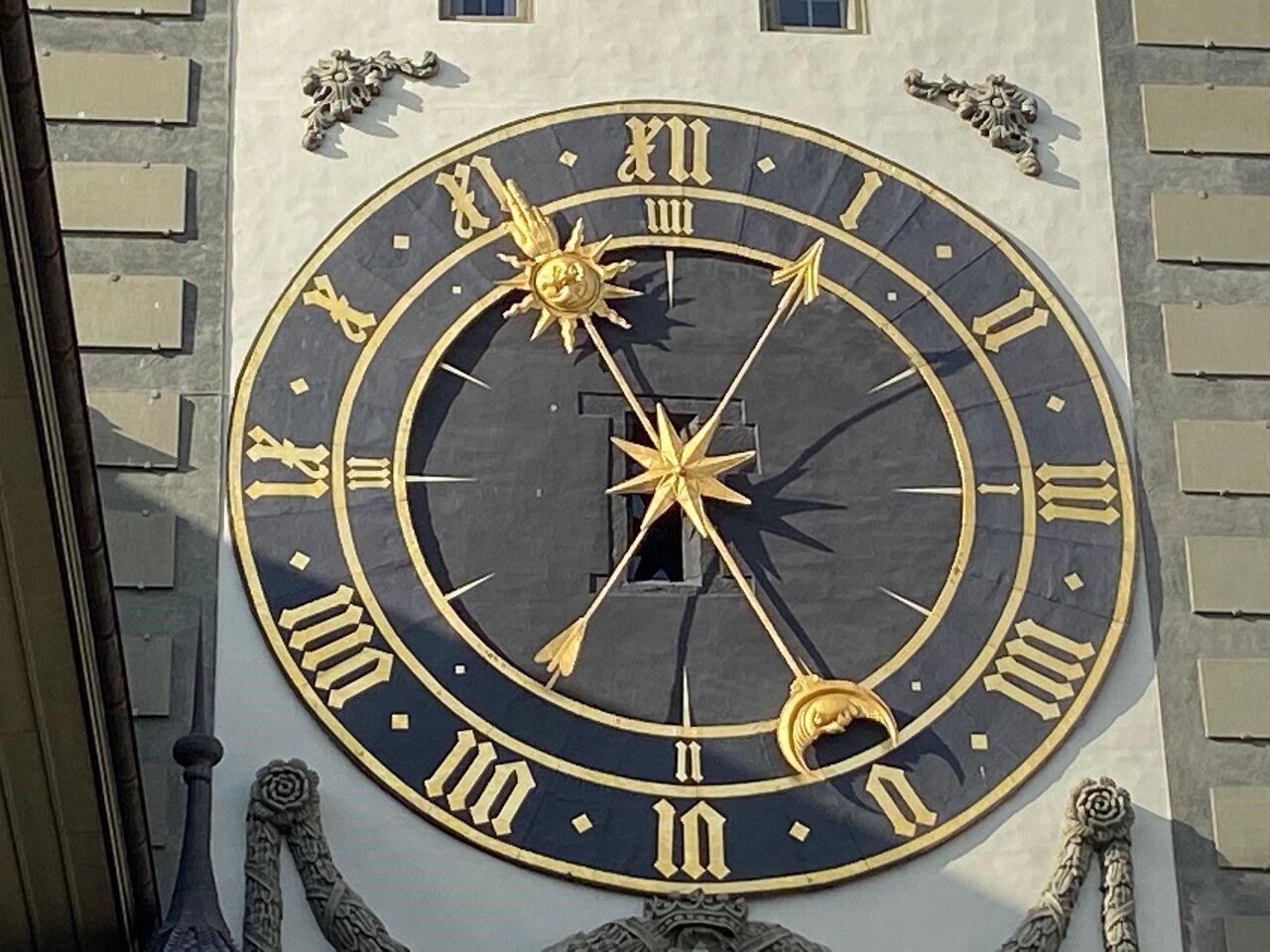
The Eastern Time Clock, a time-only dial / Credit: Trip Advisor user

Zyteglogge’s Western Time Clock, also time-only / Credit: CNN

Zyteglogge’s Eastern Astronomical Time Clock
The astronomical dial is comprised of six components:
Hours
Moonphase
Weekday
A dial which indicates dawn/dusk times throughout the year
Julian calendar
Zodiac indicator
This astronomical dial forms exact replicas of the constellations from Earth's vantage point, shows current zodiac signs, the moon’s phase, the time of sunrise and sunset, and the date. Just to mention this again…It has been running since 1530!

Zyteglogge’s Astronomical Time Clock deconstructed / Credit: View Traveling
Some pictures of the clock tower in Bern…

Zyteglogge’s Eastern Time Clock

Zyteglogge’s Western Time Clock / Credit: Encircle Photos

Aerial shot of the city of Bern / Credit: International Traveller
Well, there you have it. A small portion of the history of the Zytglogge!
P.S. If you were wondering whether the Zytglogge and Einstein are related...The Zytglogge is said to have triggered an idea inside Albert Einstein’s head that would later lead him to discover the general theory of relativity! Albert Einstein lived and worked in Bern from 1902 to 1909.
By: Eric Mulder
Read more:
“Vom Wehrturm zum Uhrturm.” Zeit Glocken Turm, http://www.zeitglockenturm.ch/geschichte/.
The Editors of Encyclopedia Britannica. “Bern.” Encyclopedia Britannica, https://www.britannica.com/place/Bern.
Larry Bleiberg. “The clock that changed the meaning of time.” BBC Travel, September 7th, 2016, http://www.bbc.com/travel/story/20160901-the-clock-that-changed-the-meaning-of-time.
“E = mc² - Einstein in Bern.” Bern.com, https://www.bern.com/en/detail/e-mc-einstein-in-bern.
Joyce Dejoice & Elizabeth “Libby” Trulove. “Albert Einstein.” NASA/HEASARC, https://starchild.gsfc.nasa.gov/docs/StarChild/whos_who_level2/einstein.html.