

We’ve talked about George Daniels before, the man who is lauded as the best modern watchmaker and has been honoured many times over for his horological achievements. One thing we haven’t gone into in too much detail is his crowning achievement: the co-axial escapement. Apart from the facts behind his creation, however, the question we ask is of the co-axial escapement’s true impact. Moreover, regarding its impact in the context of the developments of the many other types of escapements that came before it. Thus, we need to answer: why was the co-axial escapement so important?
The protagonist of our story, George Daniels, who was from London, developed a keen interest in watches and watchmaking from an early age, although he only got into it as a career later on. He eventually aspired to improve the accuracy of mechanical watches, focusing specifically on the escapement. He sought to create a movement that could in some way eliminate the sliding friction on the pallet and that did not need lubrication on the impulse surface. As a student of horology who wanted to improve the accuracy of movements, he came to learn of the effects of this sliding friction on the escapement – which effectively caused a loss of accuracy over time. The co-axial escapement’s radial friction allowed the movement to sustain a higher level of accuracy for longer. It was used in Omega’ highest grade watch movements until they were commercialized in the late ‘90s This first commercialized co-axial escapement movement was the Omega Caliber 2500 – launched at Baselworld in 1999 in an Omega De Ville.
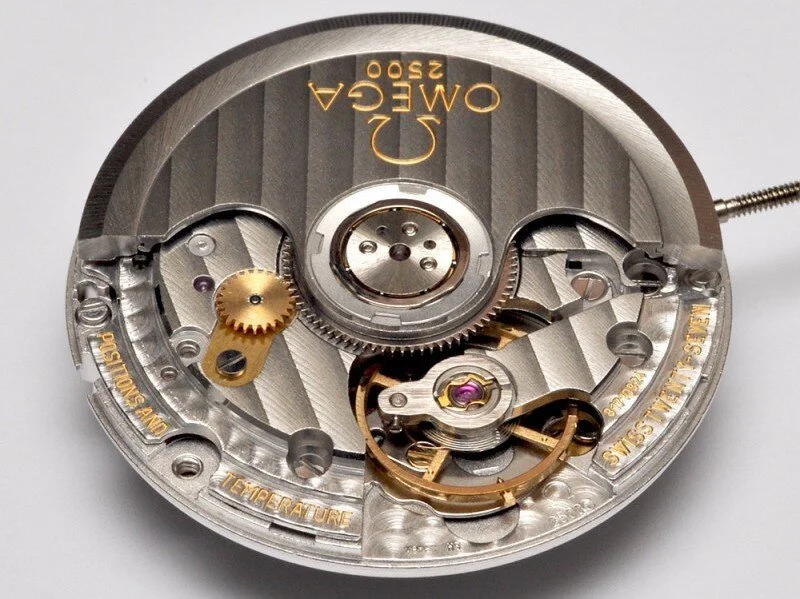
Omega Co-Axial Cal. 2500 / Credit: Millenary Watches
In short, Daniels’ movement made his new co-axial escapement more accurate over a longer period of time than the previously popular lever escapement and others. What about the others, though?
Well, consider the purpose of the escapement, regulating the timekeeping mechanism – essentially the core of the entire movement. In an ideal world the best-built escapement would be free of all external and ‘internal’ influences, with everlasting accuracy. Reaching this ideal is the quest that is at the center of horology. Consider that even the most high-end, accurate quartz still has a minimal error rate. Not to mention the effect of time and wear on the movement. This quest thus far has been never-ending, with one horologist after the next seeking to perfect, or improve upon the last generation’s work. The history of escapements is emblematic of this faithful effort.

George Daniels / Credit: The Economist
The earliest escapements were known as recoil or ‘anchor’ escapements for clocks⁵. The verge or ‘crown-wheel’ escapement was a type of recoil escapement, much like the one used in the aforementioned Salisbury Cathedral Clock. The verge was a ‘stick’ that would be attached to a ‘foliot’ – a balance wheel that would have two weights attached to it, and oscillated back and forth (regulating) with the rotation of the crown wheel that turned the verge. Adjusting the weights would adjust the regulation of the mechanism. The example from the Salisbury Cathedral is one of the earliest dating back to medieval times and was used to ring out the hours, not tell the time.
Already it was recognized that the recoil motion of the escapement itself decreased the accuracy of the movement. And so, the target was set, which led to the development of the ‘dead-beat’ escapement, which sought to eliminate that recoil. The dead-beat came around in the later 17th century but was not necessarily an improvement on the verge. Nonetheless, you can see how even from the early days of mechanical horology ‘self-improvement’, if you will, was already a central theme. The ‘recoil’ in verge escapements happened due to the contact with the pallet – each of these contacts causing a small ‘recoil’ that had to be corrected for. This was the essence of the dead-beat that essentially had two points of contact for the pallets the first that led to the ‘recoil’ and the second that propelled it forwards correcting the initial irregularity. However, as you can imagine, this second contact also created its own irregularity.
Remember it was in the pallets and surfaces of the escapement wheel that Daniels found his own solution to the question of lasting accuracy.

Verge escapement / Credit: Encyclopedia Britannica
Another extremely important escapement in this context is the détente or chronometer escapement. The ‘free’ escapement. The détente escapement sought to minimize outside influence and was thus unlike the past frictional escapements. Although the détente was more accurate it was not well-adjusted for pocket watches as it was too sensitive to outside shock. As such, the détente really gained fame for its use in marine chronometers over pocket watches.
An interesting aspect of the détente is its relation to Urban Jürgensen, who claims to have made the first détente for wristwatch. Interestingly, this was a modern horological achievement, with François Mojon and Kari Voutilainen working on it. The Urban Jürgensen movement greatly improves stability versus other chronometers meaning its range goes from +/-6 seconds (the average) to +/- 1 second.

Urban Jürgensen Cal. P8 - détente/ Credit: Monochrome
Looking back at some other developments, particularly the verge escapement, you can perhaps better understand how Daniels cluing in on the friction between the impulse surface and the pallet in the lever escapement was significant. In a way it was a mix between improving upon the traditional friction movements like the lever, but also near the concept of getting away from friction like the détente – by using radial friction instead of sliding friction.
So, just how did Daniels develop the co-axial? Well, he was commissioned by Seth Granville Atwood to ‘push the limits’ with a new horological development in the early 1970s. This led to Daniels completing his designs for the new escapement in 1974, completing the watch in 1976. He patented the escapement and after much testing and many rejections from big brands that did not want to integrate his new mechanism, the timepiece was finally adopted by Omega for commercial use. Since the escapement was adopted in 1999 by Omega, it has been used in most of its models since, truly incorporated into the production line just as Daniels had wanted. Omega used and continues to use the co-axial escapement for watches from the modern De Villes to the deep-diving Omega Planet Ocean.
Interestingly, in 2004, Philip Woodward wrote in the Horological Journal about his experience testing his Omega De Ville Caliber 2627 over the course of 36 weeks. He reported his watch did in fact live up to the standard declared by Daniels and Omega, even adding that a lever escapement could not have sustained such performance over time without a service.
Thus, what some may see as a minor change saw notable and fundamental improvements in the performance of the Daniels’ new movements, actually creating ripples throughout the industry. After centuries of tinkering, improving, and innovating; it turns out it really is the little things that matter. And George Daniels identified precisely that ‘little thing’ that could greatly improve the accuracy – importantly over time – of his timepieces. And that’s why the co-axial escapement was so important.
By: Andres Ibarguen
Read more:
Daniels, George. All in Good Time: Reflections of a Watchmaking by George Daniels. Philip Wilson Publishers, November 13th, 2012, London, United Kingdom.
Odets, Walt. “The Omega Co-Axial: An Impressive Achievement.” Timezone, January 27th, 2008, https://web.archive.org/web/20080611094453/http://www.timezone.com/library/horologium/horologium631670193290479607.
D. Betts, Jonathan, “Escapement.” Britannica Encyclopedia, https://www.britannica.com/technology/escapement#ref5668.
Anonymous & Robert Cicconetti & Janet Blenkinship. Watch and Clock Escapements. E-book. New York University Library, 2005.
Maillard, Serge. “Urban Jürgensen: The First Detent Escapement Made for A Wristwatch.” Europa Star, August 2011, https://www.europastar.com/magazine/features/1004084007-urban-jurgensen-the-first-détente-escapement-made.html.
Ramsay, Rachel. “Sale of a Master's Collection.” The New York Times, March 8th, 2012, https://www.nytimes.com/2012/03/09/fashion/09iht-acaw-daniels-09.html.
“Dr. George Daniels CBE.” Daniels London, http://www.danielslondon.com/dr-george-daniels-cbe/.
Daniels, George & Atwood, Seth. “The time museum series.” YouTube, uploaded by rwsmithwatches, June 5th, 2018, https://www.youtube.com/watch?v=PjnENHoLEaY&ab_channel=rwsmithwatches.
Woodward, Philip. “Performance of the Daniels Coaxial Escapement.” Horological Journal, July 26th, 2004 https://web.archive.org/web/20040807173930/http://www.bhi.co.uk/hj/August04AoM.PDF.