
An Expedition from Peru to Polynesia By Raft
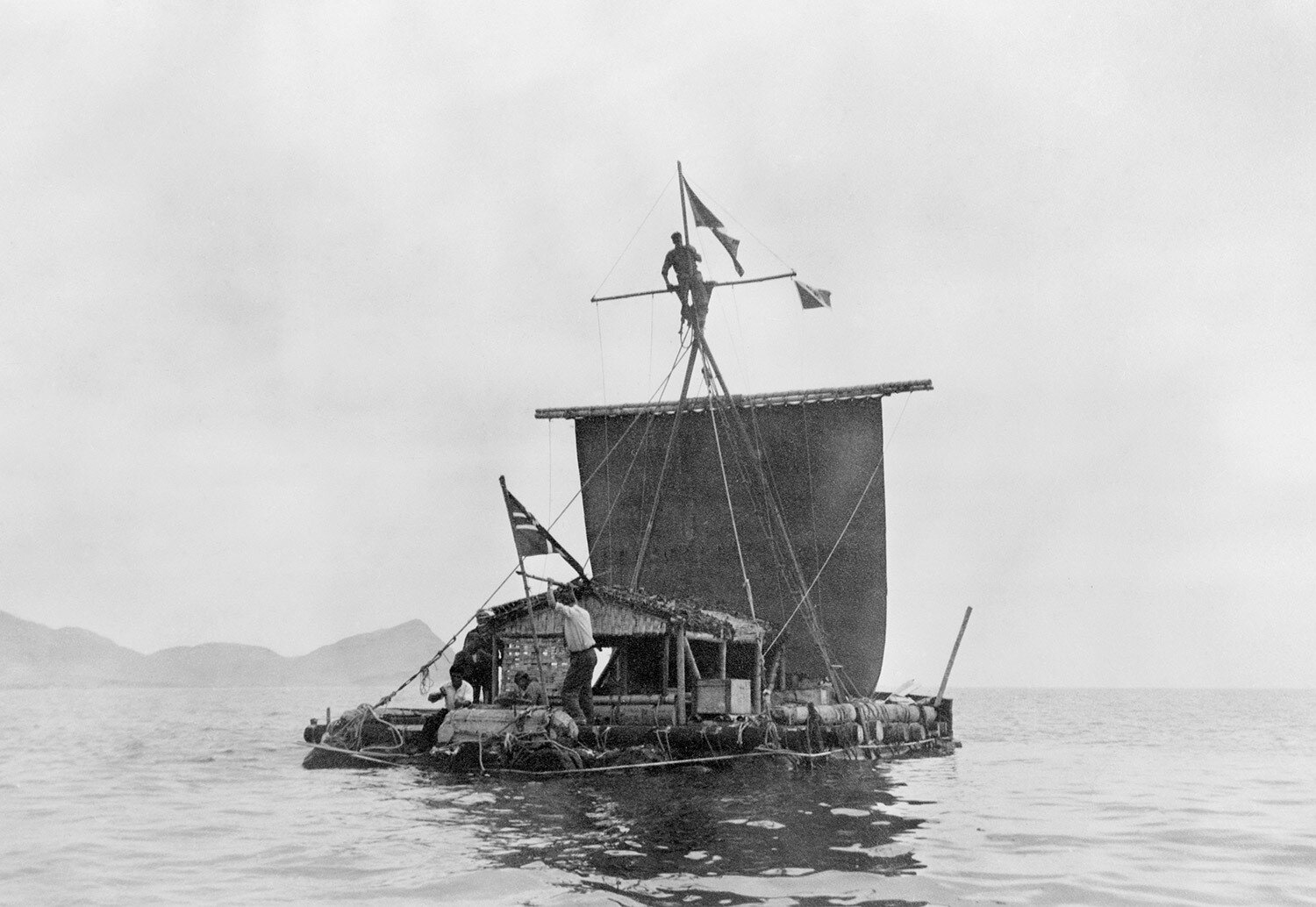
The Kon-Tiki expedition, 1947 / Credit: Kon-Tiki Museum
In April 1947, a raft made of balsa wood sailed out of Callao, Peru. The destination was Polynesia, and the captain of this boat was then 33-year-old Thor Heyerdahl.
The expedition was largely to test a hypothesis he had. Could the islands of the South Pacific be populated by South Americans? This was supported by the legend of Kon-Tiki Viracocha, who allegedly sailed west on a balsa wood raft from Peru, reaching Polynesia.
Heyerdahl would go on to discuss his theory with anthropologists who shrugged him off. But one man by the name of Herbert Spinden took him up on the theory saying, “Sure, see how far you get yourself sailing from Peru to the South Pacific on a balsa raft!”

The map of the trek needed to be completed to reach Polynesia from Peru / Credit: Wrist Chronology
Heyerdahl accepted the challenge. and quickly found a crew of 5 members. Then, they headed off to Ecuador and Peru to find the balsa timber and build the raft.
With some supplies from the American military, Heyerdahl chose Gerd Vold from the Norwegian Embassy in Washington to be the secretary who would help coordinate contact points between the raft and the shores.
The crew of the Kon-Tiki raft were as follows: Knut Haugland, Bengt Danielsson, Thor Heyerdahl, Erik Hesselberg Torstein Raaby, and Herman Watzinger (pictured below from left to right).

The crew of the Kontiki / Credit: Kon-Tiki Museum
Hesselberg had navigational skills, but no one in the crew had sailed before. This didn’t scare Hyerdahl, who still believed his crew of exceptional men could figure it out (along with the help of the Humbolt current and easterly winds). Many experts in both anthropology and seamanship highly doubted this was even remotely possible.
The crew members did not want a large maritime chronometer, and therefore reliable wristwatches were to be commissioned to each member. The company that would provide these for the crew members was Eterna.
After two weeks at sea, the experts were proved wrong and the ship was indeed able to withstand the elements. Three months later, after sailing for 101 days, the Kon-Tiki ran aground on a coral reef in Polynesia. The expedition was a success, and the hypothesis was tested and rung true – South Americans could have travelled to the Polynesian islands by balsa raft!
11 years after the famous expedition, in 1958, Eterna commemorated its involvement with the release of the new Eterna KonTiki watch!
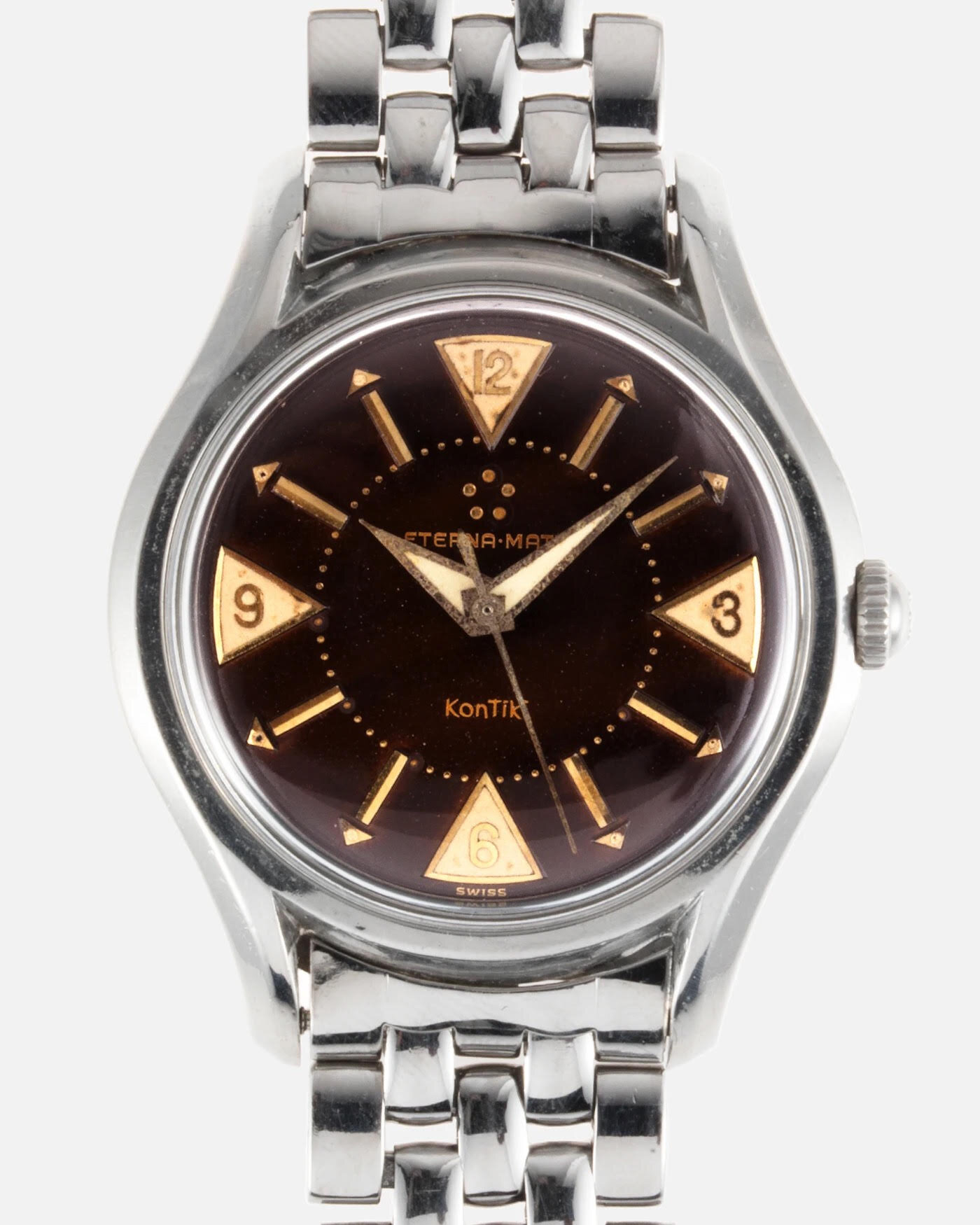
The ‘first execution’ Eterna KonTiki from 1958 / Credit: S.Song Watches
Each timepiece of the Kontiki collection has an engraved medallion of the famous raft on the caseback, this series being more ‘rugged’ than what Eterna usually had to offer.

The caseback emblem of the Eterna KonTiki / Credit: Wrist Chronology
The biggest new feature revealed in the KonTiki release was a new case design classified as ‘Super-Waterproof’. The original Eterna KonTiki was a reference 130TT whose dial, hour markers, and hands were all lumed with radium.
The modern day Eterna still continues to develop its KonTiki series, which currently has many offerings for both men and women.

KonTiki Bronze Diver 44mm / Credit: Eterna
Heyerdahl was also quite successful after this mission, his book titled ‘The Kon-Tiki Expedition’, released in 1948, has sold tens of millions of copies to date. Moreover, documentary film by the same name, shot by the crew during their 101 days at sea, won the Academy Award for best documentary in 1951.
Thor Heyerdahl’s legacy will continue to be remembered through Eterna’s KonTiki series. As Heyerdahl said, “I have never seen borders. But I have heard they exist in the minds of some people.”
By: Eric Mulder

The crew members of the Kon-Tiki expedition, 1947 / Credit: Kon-Tiki Museum
Read more:
“The Kon-Tiki Expedition.” The Kon-Tiki Museum, https://www.kon-tiki.no/expeditions/kon-tiki-expedition/.
Seabra, Miguel. “Perpetuating the KonTiki legend.” World Tempus, August 16th, 2013, http://en.worldtempus.com/article/watches/trends-and-style/eterna-perpetuating-the-kontiki-legend-15577.html.
Kolwas, Michal. “The Eterna KonTiki – A True Tool Watch.” Waha Watches, May 23rd, 2018, https://wahawatches.com/the-eterna-kontiki-a-true-tool-watch/.