
John Harrison and His Marine Chronometers
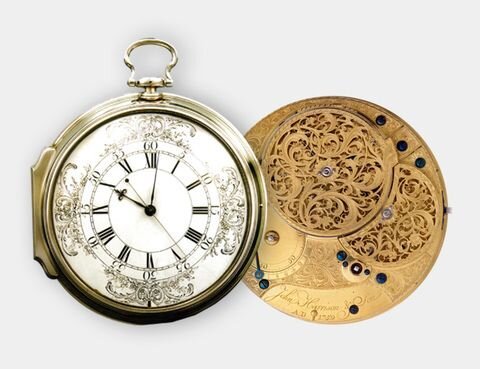
John Harrison’s H4 Marine Chronometer / Credit: Gear Patrol
What was all the rage over marine chronometers in the early 1700s? Well, bad navigation could cause dangerous – often fatal – accidents at sea, especially with 18th century naval ‘technology’. So, after a number of these incidents, the British government decided to establish the Board of Longitude via the Longitude Act in 1714, and award 20,000 pounds to the first person to develop a timekeeping device with a margin of error of only half a degree of longitude during a voyage to the West Indies.
Marine chronometers were essential for navigation as they allowed a navigator to calculate longitude and therefore ascertain their ship’s exact position. At the time, an accuracy of 3 seconds per day would’ve been necessary to make such a calculation. A level of accuracy that was unprecedented at the time. So, who took on this challenge? A young English watchmaker by the name of John Harrison, born 1693 in Yorkshire, England.

John Harrison’s H1 Marine Chronometer / Credit: National Maritime Museum
John Harrison, the Clockmaker
Harrison was already an experienced clockmaker, having made several longcase and wooden clocks in the early 18th century, also working with his brother.
The way that a marine chronometer would’ve worked at the time is that, knowing GMT at local noon, a navigator could use the time difference between the ship's position and the GMT to determine the ship's longitude. Accuracy is, of course, of the utmost importance as every second lost decreases the longitude calculation’s accuracy.
So, Harrison, a carpenter and mechanic by trade got to work, dedicating his life to this pursuit.
Harrison’s first attempt was dubbed the H1. This was completed in 1735 and subsequently brought to London for trial. Harrison and the H1 were taken on HMS Centurion en route to Lisbon, Portugal during which the watch performed well. He returned to England on the Orford, again with good results.

1748 HMS Centurion model – original built in 1732 / Credit: Wikipedia Commons
Back in London, Harrison received a relatively meager reward for his efforts, getting an advance of 250 pounds to improve upon his creation.
Harrison’s great success came another 24 years later! He finally completed and presented the H4, his most accurate watch yet that lost only one second per month. Now, there was of course two other versions in between; the H2 was never completed and the H3 was completed after nearly 20 years but inferior to the H4.
The H4 was what Harrison presented to receive his reward in 1761 – 47 years after the reward was announced! Harrison tried to collect his reward, as per the Longitude Act of 1714, from the ever-resistant commissioners on the Board of Longitude. They resisted, however. They argued for several different reasons that his watch had not passed the test. In fact, one argument went as far as to say that the fact that longitude was calculated correctly, was merely a random result from a series of errors stemming from the H4. In other words, even if you’re right you’re wrong. They tried for some time to argue that he had somehow not passed the requirements of the Longitude Act, although it was increasingly evident that he had. Finally, after many more years of struggle and even enlisting his son William to help, Harrison was paid in 1765 by Parliament (not the Board) – receiving 10,000 pounds upfront and supposedly 10,000 more after proving his chronometer could be reproduced.

John Harrison / Credit: The Ambler
He never ended up getting the full reward, it was only near the end of his life, with the assistance of King George III, that he got near the full amount from Parliament – still making away with a fortune for his achievements, despite the setbacks. The total ended up exceeding 20,000 pounds as he had received smaller amounts for his earlier inventions. However, this satisfaction came only a few years before the end.
John Harrison, the horologist who dedicated his life to solving longitude, died on March 24th, 1776 in London, England.
By: Andres Ibarguen