
VINTAGE SEIKO QUARTZ VS. VINTAGE ROLEX QUARTZ

Seiko Superior Twin Quartz 9983-8020
You know how people say, “when pigs fly…” or “when hell freezes over…” well I’d like to add a third one: when vintage Grand Seiko costs 50K.
The watch industry and the tastes of the masses are ever so dynamic. That dynamism naturally leads to change, flux if you will, even unexpected. One of such changes is the rise of Seiko – not only in popularity but even in ‘prestige’. If you look around Instagram today, you’ll see that many pages once dedicated to the likes of Rolex, Patek, and AP – now also include a Grand Seiko, King Seiko, and maybe even a Lord Marvel!
Back in May, a Grand Seiko V.F.A. 6186-8000-G sold for a ridiculous, and yes, I mean ridiculous, 44,000 CHF! As someone who is passionately involved in the world of vintage Seikos both for myself and for Toronto Vintage Watches, there is no other word to describe my sentiment other than flabbergasted. I mean, have these people ever been on Yahoo Japan!?

Rolex Oysterquartz ‘Buckley Dial’ ref. 17000 / Credit: Analog/Shift
Now, we can talk about the larger symptoms of society that lead to ‘hype’ or saturation in markets like equities, cryptocurrencies, real estate, and our beloved watches, but that’s another story. The point is that vintage Seiko and Grand Seiko are starting to be featured alongside brands that have traditionally sold for monumental sums in auction. In other words, the types of collectors who looked down upon quartz are now starting to make an exception for Grand Twin Quartz! Things are changing, and in comparing Rolex and Seiko we wanted to illustrate a dynamic that even our Eric wasn’t aware of when we were discussing upcoming articles…Seiko ˃ Rolex, when it comes to quartz.
Let’s talk Oysterquartz and Rolex Beta 21. The Rolex Oysterquartz was produced in 12 different references until 2001, with the first one being the reference 17000 – released in 1977 and dubbed the ‘Datejust Oysterquartz’! Rolex was part of the CEH consortium and thus acquired some Beta 21 and Beta 22 movements throughout the 1970s. They used the Beta 21 in several models until the development and release of their own quartz caliber. What has been called the Rolex ‘Texano’ was their first quartz watch released in 1970, also known as the ‘Rolex Quartz 5100’, powered by the Beta 21. While the ‘Texano’ was a commercial success for Rolex, the company, led by André Heiniger at the time, was also developing its own in-house movement! To achieve this Rolex hired René Le Coultre to design the new Rolex quartz calibers in 1971. 6 years later, Rolex released their first ‘Oysterquartz’!
Meanwhile, on the other side of the world…Seiko was hard at work developing the Seiko Cal. 35A in the late 1960s. They released the Seiko Astron that was powered by this new movement in 1969. And by 1977, when Rolex released the Cal. 5035 (Datejust) and 5055 (Day-Date), Seiko was a year away from producing the Superior Twin Quartz; having released the regular Superior Quartz in 1976.
The Astron was a monumental achievement for Seiko, one we’ve previously discussed many times. It really put Seiko on the map, especially as quartz took over the international watch market and Seiko led the way. Ironically, 1969 was also the year Seiko released the aforementioned 61GS V.F.A. movement. In line with the high-precision of the V.F.A., the Seiko Astron’s Cal. 35A had an incredible accuracy of ±5 seconds a month!
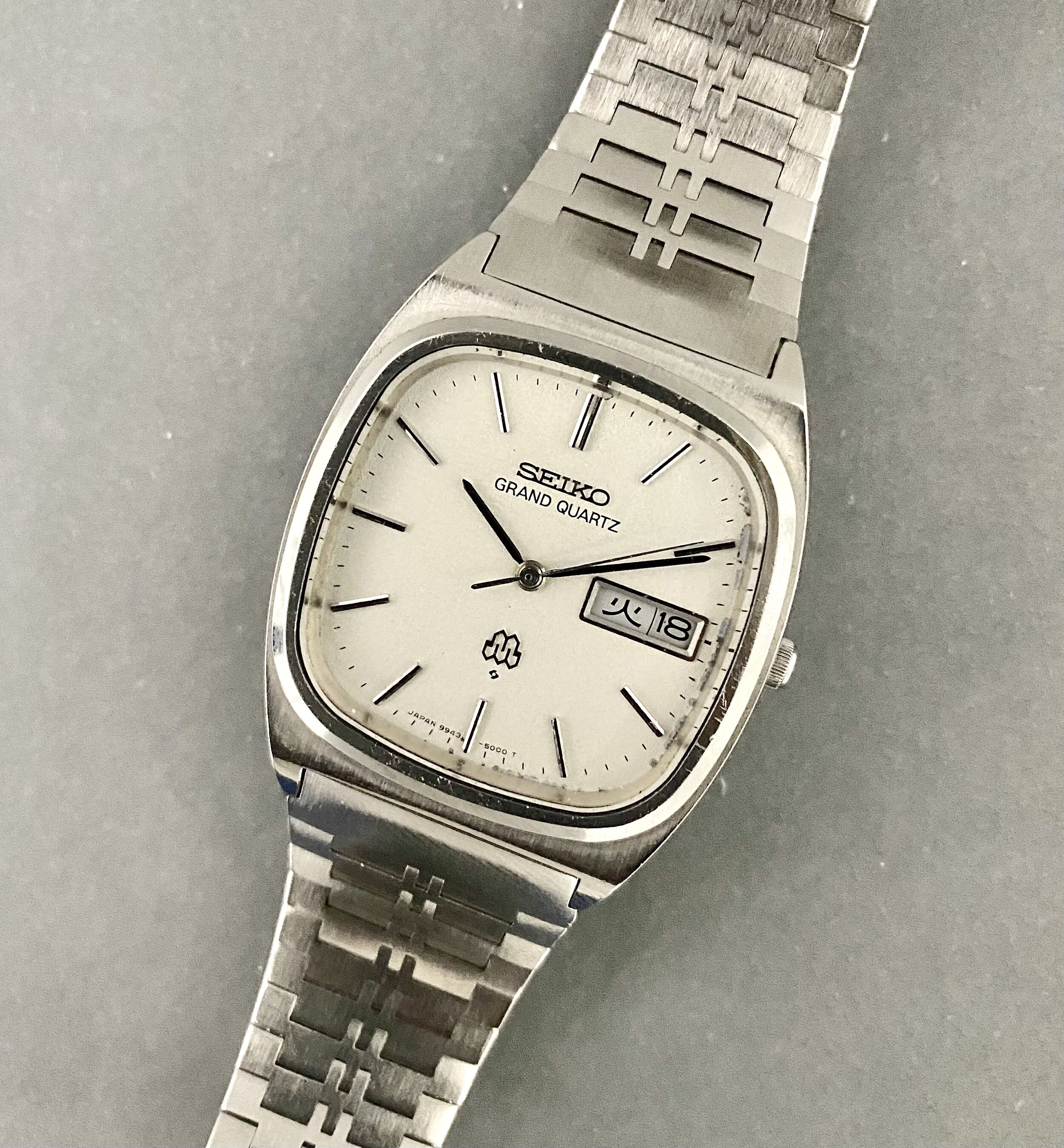
A vintage Seiko Grand Twin Quartz 9943-5000 on its original bracelet. For sale on TVW.
Now, how does that compare to Rolex’s quartz? Well, the Seiko Cal. 35A, with its 5-second per month accuracy, compares favourably with the Beta 21, which is what Rolex used in the ref. 5100 back in 1970. The Cal. 35A has the same accuracy rating as the Beta 21: ±5 seconds a month! These are both incredible feats of engineering for the late 1960s, although it is also then interesting to wonder which factors may be responsible for the delta in pricing in today’s market.
This is where the Rolex camp may start to feel a bit uncomfortable…While the CEH-developed Beta 21 was in line with the accuracy of the in-house Seiko movement, when it was Rolex’s turn to make a quartz caliber in-house, it fell short. Short! The Rolex Cal. 5035 had an accuracy of ±2-3 seconds per month…an improvement, but compared to ±5 seconds per year or ±10 per year for the Superior Twin Quartz or Grand Twin Quartz (respectively), both produced in 1978 – it was nothing! Not to mention the plethora of other Seiko Quartz watches from the same time period that blow it out of the water! Mind you, even the 1976 Seiko Quartz Superior Cal. 4883 had a monthly rating of ±1 second per month…far better than the widely lauded performance of the Oysterquartz Cal. 5035 or 5055. Divided into daily ratings for better comparability, the Rolex Oysterquartz Cal. 5035 had an accuracy of ±0.067 per day while the Seiko Superior Twin Quartz Cal. 9983 had an accuracy of ±0.014 per day.

Rolex Oysterquartz Day-Date ref. 19018 / Credit: Hodinkee
What does this mean for Seiko collectors? It means that I quite literally have a Seiko Grand Twin Quartz ref. QGB040 on the way from Tokyo right now, lest we start seeing prices reach the ridiculous levels that the V.F.A. ‘achieved’ back in April. While I know some may be disappointed in me for letting the cat out of the bag in regards to ‘our secret’ that is vintage Seiko Quartz, I think we’re safe for the time being as I don’t think we have too many readers who prefer to pay Phillips 44,000 CHF instead of paying a guy on Rakuten 500,000 yen. Two clicks and I found multiple 6186-8000-Gs for under $7,000 CAD. In all seriousness though, there are obvious differences between the Rolex Oysterquartz and the Seiko Superior Twin Quartz that have nothing to do with accuracy, some are obvious and some less so.
While I’ve previously stated that I fear the direction the watch market is going in general, in comparison to the art market. I don’t know if I fear the same for the Seiko market. I’m happy to see people become more interested in vintage Seiko, Seiko quartz, Seiko ‘Pogues’ etc. To start to respect the brand more – and respect sub-brands like Grand Seiko and Credor more. However, I’m not happy to see it become a ‘Japanese Rolex’ with even new Grand Seiko prices increasing at retail and none of those increases being reflected in the used watch market, like in the case of Rolex. I will say nothing in that regard about new Seikos. Now, of course, waitlists for Grand Seiko would be even more absurd than waitlists for Rolex, but I won’t go that far…Hopefully, you can at minimum take away from this article that: Seiko quartz blew Rolex quartz out of the water when it mattered and we should all be wary of vintage Grand Seikos that sell for 44,000 CHF.
By: Andres Ibarguen
Read more:
“The history of Oysterquartz.” Oyster Info, https://www.oysterinfo.de/en/oysterquartz/.
Povey, Ross. “Everything You Need to Know About the Rolex Oysterquartz.” Revolution Watch, https://revolutionwatch.com/everything-you-need-to-know-about-the-rolex-oysterquartz/.
Ruegger, Roger. “When Rolex Went Quartz.” WatchTime, August 1st, 2019, https://www.watchtime.com/featured/when-rolex-went-quartz/.
“A History of Grand Seiko in 10 Chapters: Vol.4 The Journey to the Ultimate in Quartz Watchmaking.” Grand Seiko, https://www.grand-seiko.com/in-en/special/10stories/vol4/1/.
Barrett, Cara. “The Beta 21.” Hodinkee, June 24th, 2015, https://www.hodinkee.com/articles/the-beta-21.
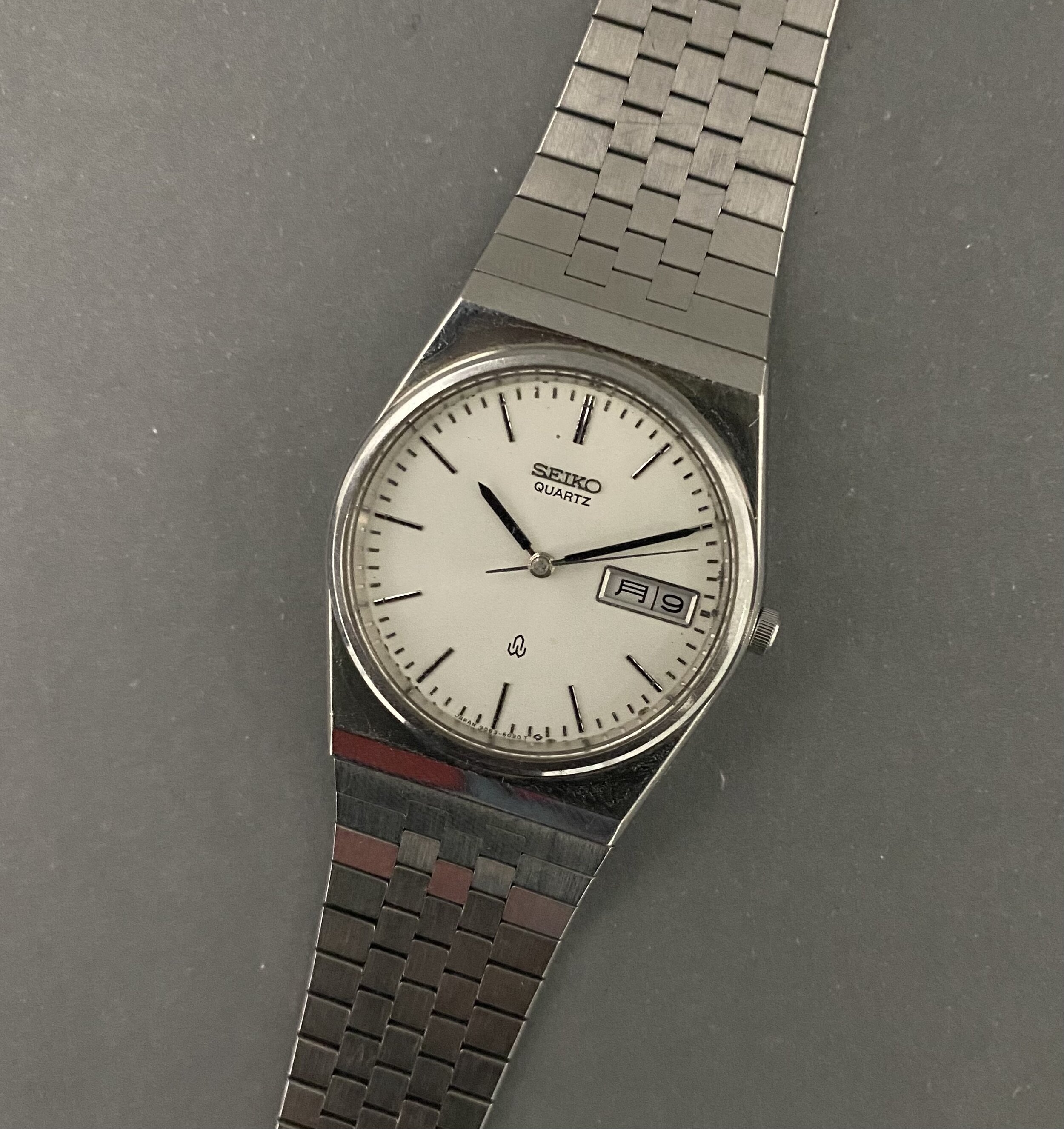
A vintage Seiko Majesta Twin Quartz 9063-6020 on its original bracelet, for sale on TVW.