
One of the World’s Most Important, and Technically Sophisticated Watches to Exist
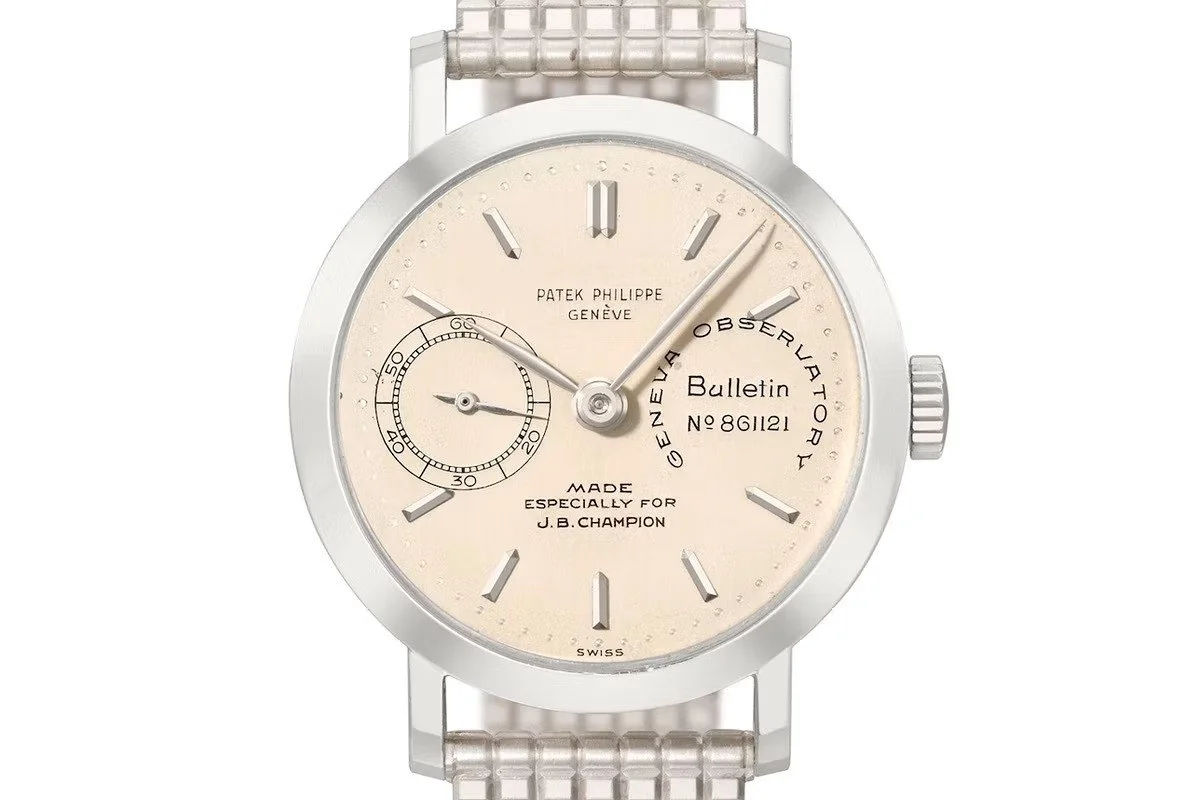
Patek Philippe Geneva Observatory Bulletin no. 861121, made especially for J.B champion ref. 2458, movement no. 861'121, case no. 673'916, manufactured in 1952 / Credit: Christie’s
Who Was J.B. Champion?

J.B. Champion: Lawyer, Family Man, and Watch Collector (1917-1975)
J.B Champion Jr. was a lawyer, a family man, and an obsessive watch collector who focused on Patek Philippe and Vacheron Constantin within his coveted collection. He was born on August 16, 1917 and died May 27, 1975 in Dallas, Texas. He attended law school at the University of Oklahoma and practiced law as a criminal defense attorney, becoming one of the most legendary and successful lawyers of the time. His love of watches was only second to his love of his family and being a lawyer.
Introduction to the Patek Philippe J.B. Champion
Patek Philippe has produced many unique, special-order watches throughout their history. The most notable representatives of this exclusive program include James Ward Packer, from Warren, Ohio the celebrated automobile manufacturer, and Henry Graves Jr., the distinguished banker and sportsman from New York.
These historical patrons of Patek Philippe were highly influential in the firm’s prewar production, while J.B. Champion was Patek Philippe’s most privileged client following World War II.
He was known to have received the very first self-winding wristwatch ever produced by Patek Philippe, a yellow gold ref. 2526 featuring the famous caliber 12””-600AT in 1953.
The world famous ‘J.B. Champion’ special-order platinum observatory chronometer wristwatch is even more coveted. It meets the requirements set by the world’s most demanding connoisseurs when evaluating a timepiece. It tops the charts in name, mechanical complexity, aesthetics, rarity, condition, history, and provenance. It is the grail watch in every sense of the word.
History of Chronometer Competitions

Seal of Geneva
In 1790, Geneva experienced the first precision contest among chronometers held at the society for Advancement of the Arts. It wasn’t until 1879 that these contests would become an institution. The precision level would be evaluated through a points system created by Emile Plantamour (1815-1882), who was the Director of the Observatory.
The system was tiered with prizes from 1st to 3rd, with honorable mentions given to deserving timepieces. It also included different classes of timepieces from marine chronometers, deck or pocket watches, and with or without any special features. This was then accompanied in 1884 by the Astronomical Observatory of Kew and Teddington in Great Britain, and in 1885, the Astronomical Observatory of Besancon, in France.
In addition to publishing the rankings in official publications, the award-winning timepieces would also receive an official certificate of accuracy based on their respective positions in the standings. Patek Philippe participated, and won, in many of these timing competitions, which were becoming important events, both nationally and internationally.
A law dated November 6th, 1886 on testing of the accuracy at the Geneva Observatory, set the conditions where the ‘Geneva Seal’ would be applied to certain watches. Certified through an official engraved hallmark, the stamp would hold the same value as an official accuracy certificate which allows it to be qualified as a “chronometer”.
These Geneva Observatory tests were interrupted in 1967, through the arrival of quartz and electronic watches. The COSC today (Controle Officiel Suisse de Chronometrie – the Official Swiss Chronometer Testing Institute) still performs accuracy testing and issues certificates.
The Patek Philippe J.B. Champion ref. 2458
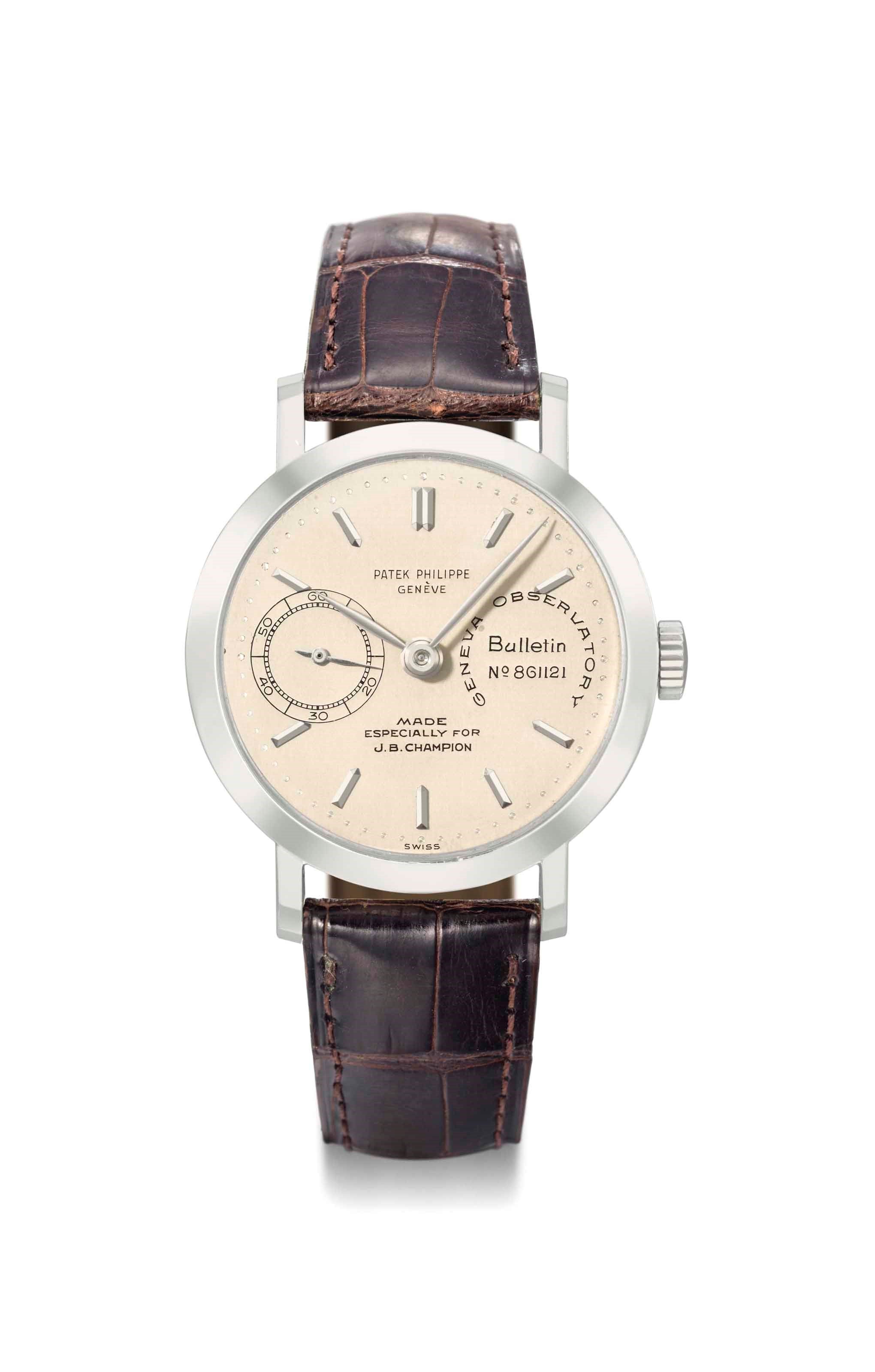
The Patek Philippe Geneva Observatory Bulletin no. 861121 / Credit: Christie’s
The Patek Philippe reference 2458 was first launched in 1958, with two movements, the caliber 12””120, and the caliber 12””40. The first models produced were mainly in yellow gold, a few in pink gold, and only one made in platinum specifically for J.B. Champion.
Only in rare cases do watch manufacturers hold onto their timepieces after they have been manufactured. But Patek Philippe did just that with their competition chronometer movements made to compete in the Geneva Observatory ‘Concours de Chronomtrie’ or precision contests. Patek Philippe made 30 wristwatch chronometer movements to participate in these trials, all but two of those timepieces have been kept back by the firm. One of which was the J.B. Champion ref. 2458, the subject of today.
The movements created for these contests had to meet specific requirements for it to be fair for all who wish to compete. The movements were built and finished to the highest standards in order to showcase each companies’ expertise. Only the finest of each companies’ watchmakers were chosen to work on these coveted pieces, and the quality would be beyond justifiable to be used towards the firm's commercial line.
The movement used in the Patek Philippe J.B. Champion, the No. 861’121, met all requirements for the observatory and included features specifically prepared for these trials. A large defining feature was the usage of a large brass Guillaume balance, mounted by a blued steel Breguet spiral, which was previously unheard of to be used in wristwatches. The movement is stamped twice with the Geneva seal and double numbered, once in the three-quarter plate bridge and once on the movement plate underneath the balance.
It is understandable that J.B. Champion decided to choose platinum for his timepiece, as it is the most precious of all materials. The case style was inspired by the existing model, the reference 2458, but had to be altered in terms of thickness and case proportions to house the modified caliber. J.B. Champion’s ref. 2458 had much more substantial lugs, and a more solid case body. Again, the only ref. 2458 to ever be housed in platinum as well.

Patek Philippe Geneva Observatory Bulletin no. 861121 / Credit: Business Insider
Another notable difference between J.B. Champion’s 2458, and the standard models, is the dial design. Visually, you can see this has the subsidiary seconds at 9’oclock vs. 6’oclock, which is directly opposite of the winding crown. To create further harmony within the dial, the ‘Geneva Observatory’ designation was placed at the 3 o'clock position, opposite of the subsidiary second circle, arranged in a perfect circle. The result was wonderful symmetry resembling a chronograph featuring two subsidiary dials positioned on the horizontal axis.
To create vertical symmetry, the dial was completed with “Made Especially for J.B. Champion” signature at the bottom of the 6 o’clock position. The watch was awarded a ‘Bulletin de Marche’ rating certificate and the individual movement number is written on the dial. An archival image from when the timepiece left Patek Philippe workshops in 1952, combined with the unique individual movement number is further proof that this was a one-off timepiece, specifically for Mr. J.B. Champion.
Since the 1980s, when the No. 861’121 entered the world of watch collecting, it has remained within the same private collection and was never available for sale. It also has no signs of noteworthy wear, and has never been restored, and after over 60 years since inception, is still in crisp and original condition.
The observatory dial has a cream-colored patina, and the subsidiary seconds track, signature, and Observatory designation are all in perfectly raised and untouched hard enamel. The case remains with impressive crisp proportions, with all four lugs still displaying sharp facets to their tips. Finally, all the platinum marks can be considered as crisp as they were when it was first manufactured.
The result of all these factors combined create one of the world’s most important, and technically sophisticated watches to exist. It checks off every box of a grail timepiece: name, mechanical complexity, aesthetics, rarity, condition, history, and provenance.
By: Eric Mulder
Read more:
Wind, Eric. “The True And Sad Story Of J.B. Champion, Jr., The Man Behind The Most Expensive Watch Without Complications Ever Sold At Auction.” Hodinkee, July 8th, 2014, https://www.hodinkee.com/articles/true-story-jb-champion.
“Lot 88.” Christie’s, https://www.christies.com/en/lot/lot-5612299.