
DO WRISTWATCHES PRESERVE VALUE?

The consumer price index (CPI), an inflation gauge that measures the cost of dozens of items, providing the public with a measure of their purchasing power over time, rose 7% in the United States in December 2021 compared to a year earlier. The fastest increase since June 1982, an indication that we are facing inflation. As a consumer, the effects of inflation may already be visceral. Groceries, cars, housing, and even your timepieces have all seen major price increases in recent times. But what is inflation?
Here is an excerpt from Ludwig Von Mises, the famous Austrian economist, on the definition: “Inflation, as this term was always used everywhere and especially in this country, means increasing the quantity of money and bank notes in circulation, and the quantity of bank notes subject to check. But people today use the term ‘inflation’ to refer to the phenomenon that is an inevitable consequence of inflation, that is the tendency of all prices and wage rates to rise.”
In 2022, we are in a global inflationary period, which means, to put it crudely, that we have too many dollars chasing too few goods. So, as the value of our money falls (by increasing its available supply), prices will inevitably increase to compensate.

As you increase the supply of money, inflation occurs / Credit: Investopedia
To understand this better, you can break down inflation into two categories:
Demand-Pull Effect
Demand-pull inflation occurs when aggregate demand for goods and services in an economy rises more rapidly than an economy's productive capacity. One potential shock to aggregate demand might come from a central bank that rapidly increases the supply of money.
Imagine a small community, where there is $10,000 total divided between the citizens and there are only 250 goats available for purchase. Now imagine this community, with $100,000 total divided between the citizens, but there are still only 250 goats available for purchase.
This demand-pull effect, of increasing the money available to individuals within that community, would inevitably cause the prices on that fixed supply of goats to increase.
This characteristic also relates to the vintage watch market. Now, while the prices are increasing because of the rapid increase of money supply injected into the world’s economy recently, there is another reason as well.
There is a trend towards luxury goods, seeing the demand for them grow substantially. According to a report by Bain, 2021 saw the luxury goods market rebound from a dip in 2020, growing 29% in the year. The market for second-hand luxury goods has also grown significantly: by 65% since 2017 and online sales growing 27% from 2020.
The only problem with this increased demand towards vintage watches? You can not manufacture an Omega Speedmaster from 1958. The supply is indefinitely capped. So, as demand increases from a variety of sources, so will the price. Modern watch companies artificially create this demand-pull effect by deliberately capping supply.

A vintage Omega De Ville Quartz ref. 192.0035 for sale on Toronto Vintage Watches.
Cost-Push Effect
Cost-push inflation, on the other hand, occurs when prices of production process inputs increase. Rapid wage increases or rising raw material prices are common causes of this type of inflation.
This will spill over into the modern-day watch market as the price of key materials in the manufacturing of timepieces continues to increase. Stainless steel, titanium, silver, gold, and tungsten are a few examples of raw materials within a timepiece that have seen relative price increases.
When you combine this increase in the price of raw materials, with employees who demand higher salaries to compensate for their loss of purchasing power and global supply chain issues, you get inflation via the cost-push effect.
Rolex started the year of 2022 by increasing the prices on their watches and you can expect other brands to follow in their footsteps. Now, while vintage watch prices won’t be directly impacted through this cost-push inflation, you have to imagine that a section of the market might start to look at vintage watches after seeing the recent price increases in modern timepieces – further increasing demand for vintage watches.
If I had to choose between modern day or vintage timepieces from an investment perspective, I would go with vintage watches, partly because of this cost-push effect. As watch manufacturers produced their products over the years, prices should have deflated due to growth in technology and other factors gradually decreasing input costs – the opposite has been the case, however.
So, you might be seeing modern timepieces increasing in price as a sheer result of the cost of raw materials and labour – and artificial price change. While improvements in watchmaking efficiency should have been making these timepieces cheaper, you can be certain vintage timepieces aren’t rising in price as a result of this, and they simply cannot be manufactured anymore, so they’re less likely to undergo any deflationary effects.
In addition, the demand-pull inflationary effects are very strong with vintage timepieces since the supply is indefinitely capped. Whereas, with modern day timepieces, you can see the statement from Rolex below:
“The scarcity of our products is not a strategy on our part…our current production cannot meet the existing demand in an exhaustive way, at least not without reducing the quality of our watches – something we refuse to do as the quality of our products must never be compromised.”
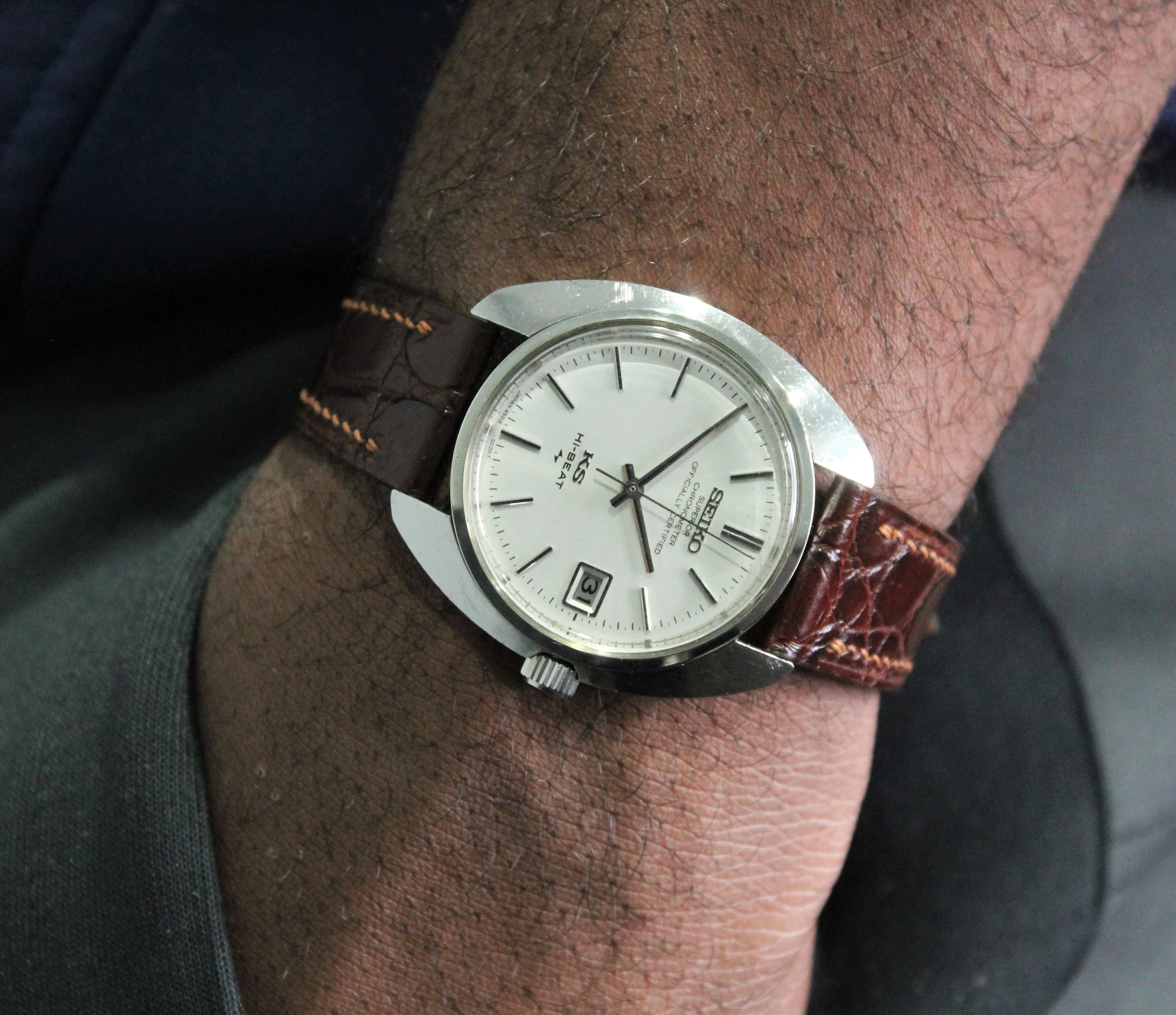
November 1969 vintage King Seiko Superior Hi-Beat Chronometer for sale on Toronto Vintage Watches.
This is just a fancy way of saying that they capped their supply, which they can, because they lead the market. But, if they truly wanted too, it is possible to increase supply which would reduce the demand-pull effect.
It is important for people to realize that inflation is not an act of God and prices don’t just magically rise every year. Prices should be decreasing because we, as humans, continually create more technologically efficient systems to do so. However, central bank monetary inflation works in the opposite direction to drive prices up for a number of reasons.
As consumers, and for a large majority of society, higher inflation is devastating. It slowly evaporates the value of a nation’s currency. It causes us to continually work harder and harder just to stay in the same place.
So, do tangible assets perform well during an inflationary period? Historically, yes, they do.
Imagine it like this – you need to create a time capsule for a future you in the year of 2050. There are two options:
In capsule 1 you include gold bars, silver bars, a 1998 Dom Perignon Brut, a Picasso painting, and a 1968 Rolex Daytona. These are tangible assets priced in currency, like real estate.
In capsule 2, instead, you can include stacks of cash equivalent in price to capsule 1. This would be an example of an asset denominated in currency, like bonds.
Which do you think would perform better in the year of 2050? With cash, you might one day open the capsule and realize that society no longer values that asset as they once did. The value of that cash would be less than it is today – just like $1,000 is worth less today than it was in 1950 – or how our grandparents were able to buy homes for less than $100,000. A 1968 Rolex Daytona, however, even in 2050, will still be a 1968 Rolex Daytona, with its value retained. Just as gold and silver have been cherished and utilized by humans for thousands of years. Their values would increase regardless of the currency used to exchange for them.
By: Eric Mulder
Read more:
Cox, Jeff. “Inflation rises 7% over the past year, highest since 1982.” CNBC, January 12th, 2022, https://www.cnbc.com/2022/01/12/cpi-december-2021-.html.
"What are some of the factors that contribute to a rise in inflation?.” Federal Reserve Bank of San Francisco, 2002, https://www.frbsf.org/education/publications/doctor-econ/2002/october/inflation-factors-rise/.
D'Arpizio, Claudia & Levato, Federica. “Luxury market rebounds in 2021, set to return to historic growth trajectory.” Bain & Company, November 21st, 2021, https://www.bain.com/about/media-center/press-releases/2021/luxury-report-2021/.
Simms, Demetrius. “Rolex Started 2022 by Increasing Prices on Some Watches.” Robb Report, January 4th, 2022, https://robbreport.com/style/watch-collector/rolex-2022-price-increases-1234656466/.