

Heuer, the company that once owned the racing watch market, today seems to find itself at a bit of a crossroads. Nonetheless, its racing watch provenance cannot be tarnished. Today its most prominent vintage watches are the Heuer Carrera and the Heuer Monaco, meanwhile their cousins, the Heuer Autavia and the Heuer Camaro, are often thought of as secondary characters. The Autavia, in particular, bitterly taking third place. Today we’d like to shed some light on the Heuer Autavia and restore it to its rightful place…a more dignified third place that is.
The Heuer Cockpit Clock
In 1933, Heuer introduced the Autavia dashboard clock. The Autavia 12-hour stopwatch was a dashboard timer that was made to meet the rigid requirements of the ‘AUTomotive’ and ‘AVIAtion’ sector; hence the name ‘Autavia’. These were the two main aspects of Heuer’s business enterprise – the production of tool watches, timekeeping devices for motorsport and cockpit instruments for civil and military aviation. In that sense, one might say that the 2017 Heuer Autavia re-issue was actually a re-re-issue given that the Autavia we know and love was reintroduced in 1962 in the form of a wristwatch instead of the cockpit clock of the 1930s.

The Autavia dashboard clock, circa 1933 / Credit: TAG Heuer
The Inception of the Heuer Autavia
In 1962, Heuer launched a new chronograph and set the model name "Autavia" above the Heuer logo on the dial.The Autavia was the first Heuer chronograph to receive a name apart from its reference number. The first Heuer Autavias were the ref. 2446 (triple register) and the ref. 3646 (double register); they were powered by the manually wound Valjoux 72 and 92, respectively. The watch's main selling point was its rotating bezel, which came with 60-minute or 12-hour timers. Over its 20-plus year lifespan, over 200 executions of the Heuer Autavia were produced. With features like the GMT, which was introduced in 1967, and self-winding movements, the first of which was Caliber 11 – introduced in 1969. The production timeline for the Heuer Autavia wristwatch was between 1962 and 1985.
The Original Heuer Racing Watch
What made the Heuer Autavia so special over the years, is that despite the buzz that the Heuer Carrera and Monaco get, the Autavia was the original Heuer racing watch, and it was so at least three decades before any of the other famous Heuer models. Racers and pilots, as well as gentleman sportsmen, would have chosen the Heuer Autavia throughout the 1930s for their timing needs. Many famous racers have even worn the Heuer Autavia in competition, for example Jo Siffert. And thus, although it may not have the same cachet as a ‘Steve McQueen Monaco’, the Autavia certainly has a place amongst the premier Heuers of the past and present.
Jo Siffert’s Heuer Autavia

Heuer Autavia ‘Jo Siffert’ ref. 1163 early execution / Credit: Analog/Shift
During the ‘60s and ‘70s, the Heuer Autavia was embraced by the racing community. Jo Siffert, the driver who inspired Steve McQueen’s character in Le Mans, wore an Autavia. The Swiss driver played an integral role in the successful synergy between Heuer and Formula One in the 1960s and early 1970s. He was an extremely successful brand ambassador for Heuer – even said to convince fellow drivers to buy watches off him while on the grid.

Jack Heuer and Jo Siffert / Credit: Monochrome Watches
By the early 1970s, Siffert’s success on the track, particularly with Porsche in the World Sportscar Championship, made him a legend in the motorsport world. As part of the deal Jack and Jo had agreed upon, Siffert was to wear the Heuer logo on his overalls and the Heuer Autavia ref. 1163T on his wrist.
Jo Siffert’s Heuer Autavia chronograph is distinguished by its white dial and black sub-dials. This was combined with unique blue accents and a central blue chronograph hand – now one of the most sought after vintage Heuer Autavia models.
On October 24th, 1971, not realizing that his car had been damaged earlier in the race, Siffert crashed during the 15th lap at Brands Hatch. Unable to escape from his burning car, Jo Siffert died from smoke inhalation. This led to a massive safety reform in Formula One.
Jack Heuersaid that enlisting Siffert was one of the greatest marketing decisions he ever made. Jo Siffert lives on through the watch that unofficially bears his name, the Heuer Autavia ‘Jo Siffert’ ref. 1163T.
Jochen Rindt's Heuer Autavia

Heuer Autavia ‘Rindt’ ref. 2446 / Credit: Analog/Shift
The Heuer Autavia is highly collectible with a host of relevant references for collectors. One in particular however, stands out for its association to a famous Formula 1 driver: the ‘Jochen Rindt’ Autavia.
By the late 1960s, Jochen Rindt was already a well-known Formula 1 driver, especially in Austria. This was also around the time the Heuer Autavia ref. 2446’s third execution was released. The third execution differed from the first two in a few ways and also differed from the transitional case model. Notably, the bezel was thinner and it had a screwdown case, the dial also varied from the first two executions of the Autavia Heuer, with large steel markers with lume plots at the end. This model was paired with a Gay Frères bracelet and a manual winding Valjoux 72 movement.

Jochen Rindt wearing a Heuer Autavia in Hockenheim, 1970
Jochen Rindt was known to wear the triple-register Heuer Autavia ref. 2446 third execution, which has been dubbed the ‘Jochen Rindt’ Autavia by collectors. He was the 1970 Formula 1 Champion and was presented the trophy by Prince Rainier and Princess Grace of Monaco.
Unfortunately, that same year, on September 5th, 1970, Rindt was killed while practicing for the Italian Grand Prix, going through the guardrail. The racing legend Jochen Rindt died in Monza where his idol, Count Wolfgang von Trips, also died nearly a decade earlier.
Bruce Springsteen’s Heuer Autavia
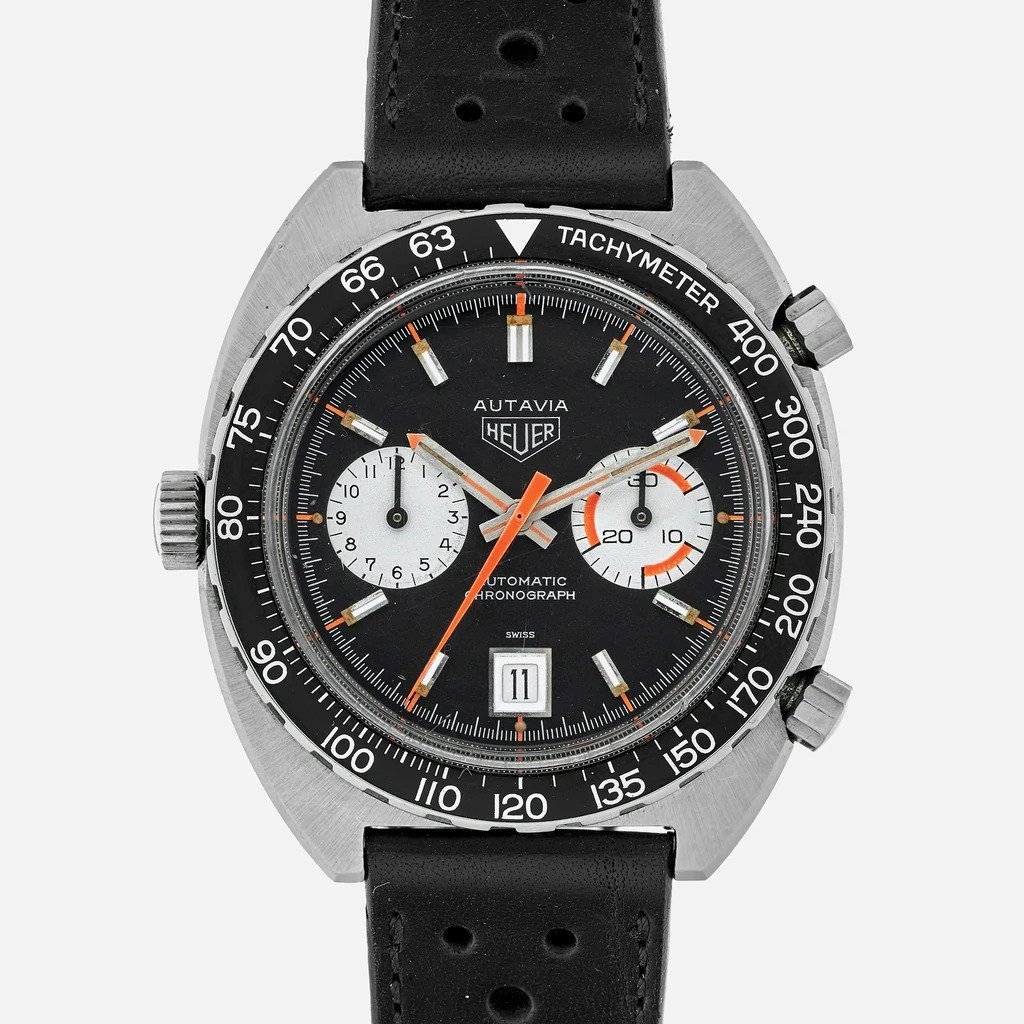
Heuer Autavia ‘Orange Boy’ ref. 1163 / Credit: Hodinkee
This ‘Big Orange’ Heuer Autavia ref. 1163, worn by Bruce Springsteen, is one of the more collectible Autavia models. Not that many were made and all the orange accents, hands, and sub-dials combine for a truly beautiful design. Bruce Springsteen has also been spotted wearing one of Heuer Autavia’s close comrades – the TAG Heuer Monaco.
The Kenyan Air Force’s Heuer Autavia

Heuer Autavia ref. 11630 for the Kenyan Air Force, circa 1975 / Credit: Analog/Shift
Some of the more unusual, but charismatic Autavia from the 1970s were issued to the Kenyan Air Force. An example being the Autavia reference 11630. About 200 pieces have locally been worn in military actions. These models are extremely rare and were never featured in original catalogues or sales material. The majority of the known examples have “KAF” engraved on the caseback, which stands for Kenya Air Force.
The Heuer Autavia, along with the Monaco and Carrera, are TAG Heuer’s foundational products today. With inspiration from the dashboard clocks of race cars and planes dating back to the early 1930s, these designs live on today in their modern form.
By: Eric Mulder
Read more:
“Heuer Autavia.” Classic Heuer, https://www.classicheuer.de/en/chronograph/heuer-en/autavia-en/.
Wolf, Cam. “Bruce Springsteen's vintage Heuer Autavia is born to run.” GQ Magazine, November 7th, 2020, https://www.gq-magazine.co.uk/watches/article/bruce-springsteen-heuer-autavia.
“Jo Siffert and the Heuer ‘Siffert’ Autavia.” Crown and Caliber, https://blog.crownandcaliber.com/jo-siffert-heuer-siffert-autavia/.
Goulard, Brice. “Introducing Heuer Autavia Jo Siffert Collector’s Edition by Calibre 11.” Monochrome Watches, February 2nd, 2018, https://monochrome-watches.com/heuer-autavia-jo-siffert-collectors-edition-by-calibre-11-price/.