

There is a lot that people say about vintage watches coming from India, the term ‘Mumbai Special’ comes to mind. However, it is also interesting to note how India very much has its own ecosystem when it comes to watches and brands people collect. Specifically, there were some Swiss watch brands that set up subsidiaries to sell watches in India. One of those companies was Favre-Leuba.
There are a few vintage watch brands popular in India. brands like Titoni, Rado, West End Watch Co., and Favre-Leuba come to mind. However, Favre-Leuba is one of the most interesting as it is the oldest and, unlike some of the others, not overly associated with the Indian market.
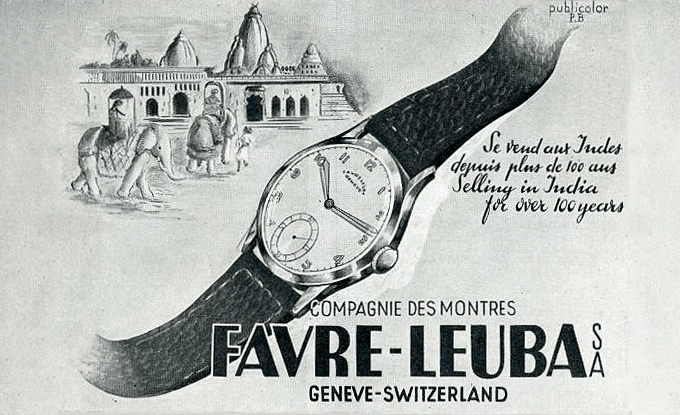
Old Favre-Leuba ad
According to Favre-Leuba itself, the company traces its roots back to 1737 when Abraham Favre is mentioned in an official document as being a watchmaker. He started his career almost 20 years earlier and supposedly set up his own operation after some time. He also later became ‘Maître horloger du Locle’ in 1749. In 1815, Favre & Fils (Abraham’s sons’ successor company) became Favre-Leuba after they merged with Auguste Leuba. Favre-Leuba pocket watches were popular on an international scale by now, with sales all over Europe and America. So, it was Fritz Favre, Abraham’s great-grandson, who traveled to India in the 1860s and launched Favre-Leuba in India – the first Swiss company to do so – in 1865. This would prove critical to the brand as India became one of their most important markets. Moreover, India was a market they could rely on, from their country head quarters in Bombay, after the turmoil caused in Europe by the Second World War.

Favre-Leuba pocket watch circa 1890 ‘Bombay’ / Credit: Heritage Auctions
Even though it might not look like it today, as vintage Favre-Leuba is often discounted by collectors, seen as a relatively low-end brand; you could say it was pure luck that Favre-Leuba ended up being a sort of pioneer in India. It was and remains a very lucrative luxury goods market – for the right product. As such, Favre-Leuba designed watches specifically for the Indian market, with different details meant to appeal to this different demographic. Notably, sales from the Indian market were crucial for Favre-Leuba to recover its position in different key markets around Europe - with sales from India sustaining the company while they were facing losses elsewhere.
Unfortunately, Favre-Leuba was largely gone from India by the 1980s, supposedly due to the underlying economic conditions in the country. The brand was eventually acquired by Titan – the Tata subsidiary – after some time of inactivity, and re-launched with homages of old, popular watches from their heyday. Favre-Leuba remains very popular in the vintage market, especially their dive watches in the West. In India, it is a popular brand all around, with a rich history that many collectors in the country can connect to personally.
By: Andres Ibarguen