
A Horological Perspective on the French Revolution

Louis XVI executed by guillotine in 1793
Abraham-Louis Breguet is widely lauded, not only as a watchmaker but also as the namesake of the brand, Breguet. From his time as an apprentice and then his early years working in Paris, Breguet was quickly identified as a promising watchmaker. And as he rose up the ranks and started to get more and more aristocratic and international clients, he himself started to become intertwined into the political events of the day. The biggest of such events in his lifetime was arguably the French Revolution.
One of the main issues that the Third Estate, eventually formally named the National Assembly, had with the government of Louis XVI, was his lavish spending that the middle class had to bear the brunt of in the form of taxes. Marie-Antoinette being an eager customer of Breguet’s was certainly part of this issue. In fact, Marie-Antoinette audaciously ordered one last timepiece from Breguet even while she was incarcerated in the Temple Prison in Paris.
Breguet had been at a high in his career before the revolution, with international clients and a reputation to match it. However, like most other men in France at the time, Breguet had to pick a side.
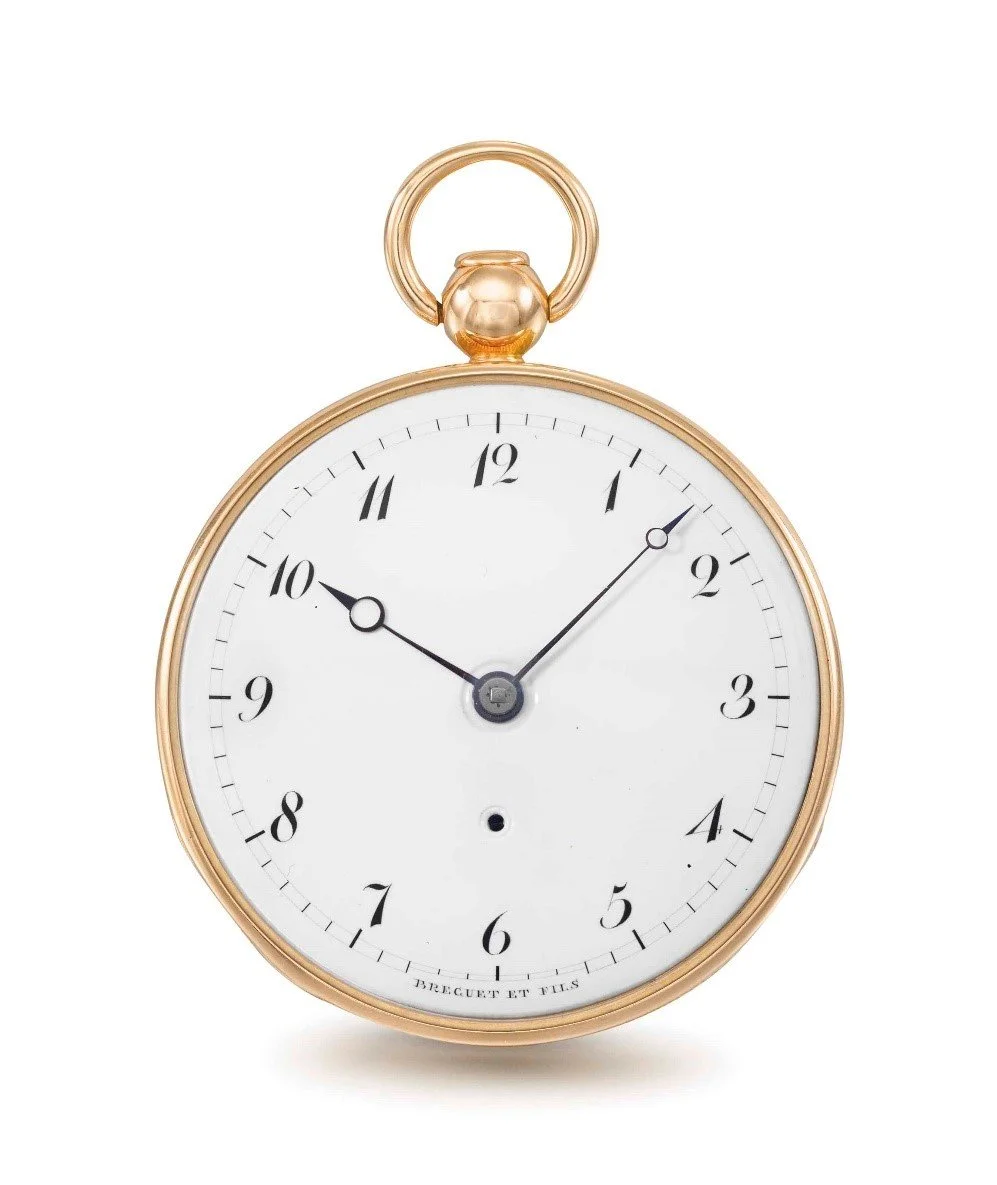
Breguet no. 2161 ‘Montre à répétition à quarts’, circa 1807 / Credit: Christie’s
Many of Breguet’s acquaintances were politicians so although he did not experience the early events of the revolution like the Declaration of the Rights of Man and the Citizen first-hand, he lived in the heart of Paris and would hear vivid accounts from said acquaintances of the daily happenings. He was also friends with Revolutionaries however, and once helped his friend and politician, Jean-Paul Marat, escape an angry mob by disguising Marat as a woman and guiding him through the crowd.
All of this political uncertainty put his company in a precarious position, and Breguet had taken to visiting London to get in touch with the French aristocracy that had fled the country. He also met with his friend, John Arnold. Despite his efforts, Breguet’s firm was seeing decreasing prices, lower sales, and evermore difficulties in procuring parts from Switzerland. Even his once reliable clients in French court had trouble paying, notably the King’s sister-in-law, the Comptesse de Provence.
Breguet had been a Jacobin until late 1792 when he started to turn towards the right; he was also made a member of the National Guard around the same time. However, by 1793 the situation had changed dramatically, with Louis XVI executed and Marie-Antoinette soon to face the guillotine. Breguet was now fully a supporter of the Girondins and carried out a couple of duties for them that got him into hot water. Breguet was placed on the list of banned citizens after the Girondins were arrested (and then executed) and forced to leave France, which he could not do so safely without a valid passport. His old friend Marat, who had stayed on the side of the dominant Montagnards, was able to influence the deciding committee and get him a passport. Although he was assassinated shortly after.

Abraham-Louis Breguet / Credit: Breguet
So, it was with great dismay that Breguet and his family left Paris for Switzerland in 1793. In Switzerland, he would move around from city to city before settling for some time in Le Locle. During this time however, Breguet’s financial woes seemed to worsen; having already departed Breguet & Co. after disagreements with his old partner, Xavier Gide; now the house in Quai de l’Horloge was also declared state property. Throughout his exile Breguet maintained contact with his friends and acquaintances around Europe. It was finally after the downfall of Robespierre in 1794, that Breguet was able to return to Paris in 1795 and restart his business. This was facilitated by his friend Antoine-César, the Duc de Praslin.
Although Breguet was once again in Paris and his business was recovering very well, there were new challenges to face under the reign of Napoleon.
By: Andres Ibarguen