
Gallet’s Roots Date All the Way Back to 1466

An illustration of Gallet’s factory in La-Chaux-De-Fonds in 1911
On April 18th, 1466, Humbertus Gallet became a citizen of the Republic of Geneva, with his profession being listed as a clockmaker. Centuries later, French King Louis XIV abolished the Edict of Nantes in 1685, significantly reducing the rights of French Huguenots in the country. Other members of the Gallet family, who largely were goldsmiths and watchmakers, joined their relatives in Geneva, fleeing religious persecution. It's unclear what the family did during that period of 200 years, but we know that Humbertus was a clockmaker in the 15th century, as was Philippe Gallet, a descendent of his who moved to Geneva over 200 years later.
Philippe Gallet, the son of Jacques Gallet and Marie Bouvier Gallet, was included on the Geneva registry of jewelers and watchmakers since the turn of the 18th century. Philippe then went on to have a son, Pierre Gallet, who married Jeanne Renée de Rabours in 1742. Philippe was a goldsmith and watchmaker, and Pierre’s occupation was listed as a master goldsmith on his marriage certificate. In 1744, Jeanne Renée gives birth to a son, Jacques, who would also become a jeweller and watchmaker. Jacques Gallet then fathered a son, Jean-Louis Gallet in 1774.
In 1798, when Napoleon annexed Geneva, Jean-Louis Gallet became a French citizen and continued his father’s jewellery and watch business until he died prematurely in 1809, aged 35.
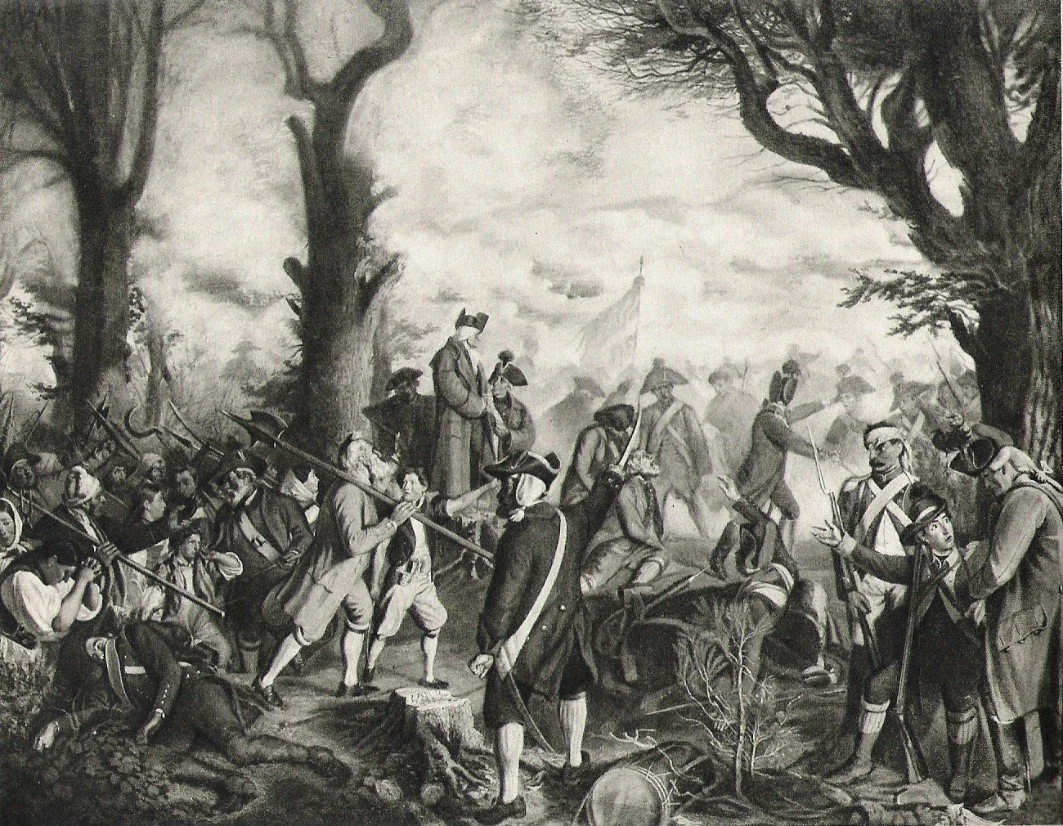
The French invasion of Switzerland occurred from January to May 1798 as part of the French Revolutionary Wars / Credit: Friedrich Walthard
Before his death, Jean-Louis had a son named Julien, who was born in 1806. When Julien was about 20 years old, he relocated his watchmaking business to La Chaux-de-Fonds, a major center for watch production in Switzerland. By this time, the company was officially named ‘Gallet & Cie’ or ‘Gallet & Co’ in English. Julien then had two sons, Leon and Lucien, who, upon his death at age 43 in the late 1840s, took over the operations along with their mother Louise.
By the mid-1850s, Leon Gallet was now leading Gallet & Cie, which was experiencing massive growth at the time. He expanded the company through the acquisition of Grumbach & Co., adding further workshop space and a new watch brand named ‘Electa’. Gallet & Cie was renamed ‘Electa Gallet & Cie’ and began producing watches under both the Electa and Gallet brand names.
Gallet & Cie then decided to expand into the American market in 1864. Leon’s brother, Lucien, opened their first office in Chicago, then followed up with another office in New York City. Lucien had the help of Jules Racine (Enicar), who was a cousin of the Gallet brothers living in the United States, to establish their business in America.
By 1876 , large American watch manufacturers were starting to expand to Europe and created fierce competition among the watchmakers already there. This is when an unlikely synergy was created. Leon Gallet, together with Louis and Jules Courvoisier of Courvoisier Frères, Ernest Francillon of Longines, and Constant Girard-Gallet of Girard-Perregaux, created the Intercantonal Company for Industrial Development of the Jura Industries. Unifying their manufacturing resources allowed each company to benefit from one another. This helped sustain their sales dominance throughout Europe and, in particular, the United Kingdom, that formerly dominated the market. This group eventually combined with the Swiss Watchmakers Federation founded in 1924 to create the Federation of the Swiss Watch Industry, headquartered in Bienne today.
In the early 1880s, Leon handed over management of Gallet to his older son Julien. The company name was temporarily changed to Julien Gallet & Cie to reflect the new ownership of the business. Leon would remain active in the business until his death in 1899. Leon’s younger son, George, was also active in the business, helping his older brother with operations while simultaneously working part-time at Courvoisier Frères. Around this time, Gallet is producing over 100,000 watches per year.

Final assembly of watches in Gallet’s factory in La-Chaux-de-Fonds in the late 19th century / Credit: Time Maven
It is in 1893 that the daughter of Louis Courvoisier, Berthe Courvoisier, married George Gallet, the son of Leon. This is important as she was an heir to the family watch company. Thus, a new line of company management emerges for Gallet. Emile and Berthe Courvoisier, her brother, now manage Courvoisier Frères with Georges Gallet and his sister, Henriette. Georges Gallet being the co-director of the company.
Also in the 1890s, Gallet introduced the first mass-produced wristwatches for both men and women in a highly controversial but innovative move. It was a total disaster. While bold, retrospectively it is easy to see how it was far too early to introduce wristwatches so widely. Thus, all the unsold inventory was returned to Switzerland for disassembly in 1895. The following year is better for Gallet, as they start producing railroad pocket watches with chronometer-grade movements and, later that year, win a silver medal at the Swiss National Exhibition in Geneva.
Leon Gallet passed away in 1899. As part of his will, he donated 43,000 Swiss Francs (roughly $1 million USD in today's terms) to the town of La Chaux-de-Fonds, with 25,000 Swiss Francs going to the construction of the Musée international d'horlogerie. George Gallet then donated over 100 timepieces from Gallet, Electa, and Courvoisier to the museum. This would serve as the initial collection of timepieces and George would serve as the director of the museum for the next two decades.

The Musée international d'horlogerie in La Chaux-de-Fonds / Credit: Time Maven
After Leon Gallet’s death, the company’s name is changed back to Gallet & Cie, a fresh start for a new century…However, another change came in 1906 and the company name was registered as ‘Gallet & Cie, Fabrique d’horlogerie Electa’. This was done again to showcase the company's ownership of Electra, the brand through which Gallet produced some of its highest quality timepieces.
Gallet was again ready to venture into the market of wristwatches by the early 1910s. They developed the first mass-produced wristwatch which included a full-size seconds hands in the center of the dial. This watch became extremely useful in situations where timing in seconds was more crucial than minutes or hours, like measuring a heart rate. These wristwatches were then issued to military medics and nurses for the First World War.
The British military were equipped with Gallet ‘wristlets’ in 1914. Although worn on the wrist, these could be classified as pocket watches in the ‘transition phase’ to wristwatches. That same year, Gallet won the grand prize in the chronometer category at the Swiss National Exhibition in Berne. Gallet also started supplying cockpit clocks to the British air force during the First World War.
In 1918, Henri Jeanneret-Brehm began manufacturing timepieces under the name Excelsior Park, aimed at the American market. Gallet and Excelsior Park began to cooperate on creating new movements, including the Cal. 40, some of which are shared with Zenith and Girard-Perregaux. While Gallet continued to seek out and infiltrate new markets for their timepieces, including with new watches aimed at the medical profession, they survived the Great Depression by relying on supplying ‘tool watches’ to their military and industrial clients. After the Great Depression, by the mid-1930s, Gallet increased production, expanding to boat clocks and military stopwatches, along with wristwatches. By the time the Second World War started, Gallet’s production once again surmounted 100,000 pieces annually, just as it had done in the early 1880s.
Also in the 1930s, Gallet introduced the first water resistant cases for chronographs. This new feature, the Gallet ‘Clamshell’ cases, became popular and were utilized in their Multichron and Flying Officer pilot watches. The cases were patented in 1937.

The Gallet MultiChron 30M ‘Clamshell’ Chronograph, considered the first waterproof chronograph wristwatch / Credit: Hodinkee
Gallet’s water resistant chronographs were also made for the U.S. Air Force in the late 1930s. These timepieces included an assortment of innovative new features, and Harry Truman even wore a Gallet Flying Officer during his two terms as U.S. President later on. There were also changes at Gallet after the war. A year after WWII officially ended, Leon assumed management of Gallet after the death of Georges. He was able to transition Gallet’s military watches into trendy chronographs for civilian use.
Gallet, continuing its tradition of designing and manufacturing chronographs, introduced the Excel-O-Graph, in the mid-1960s. This was a pilot watch with an integrated slide rule, making calculations during flight much easier.
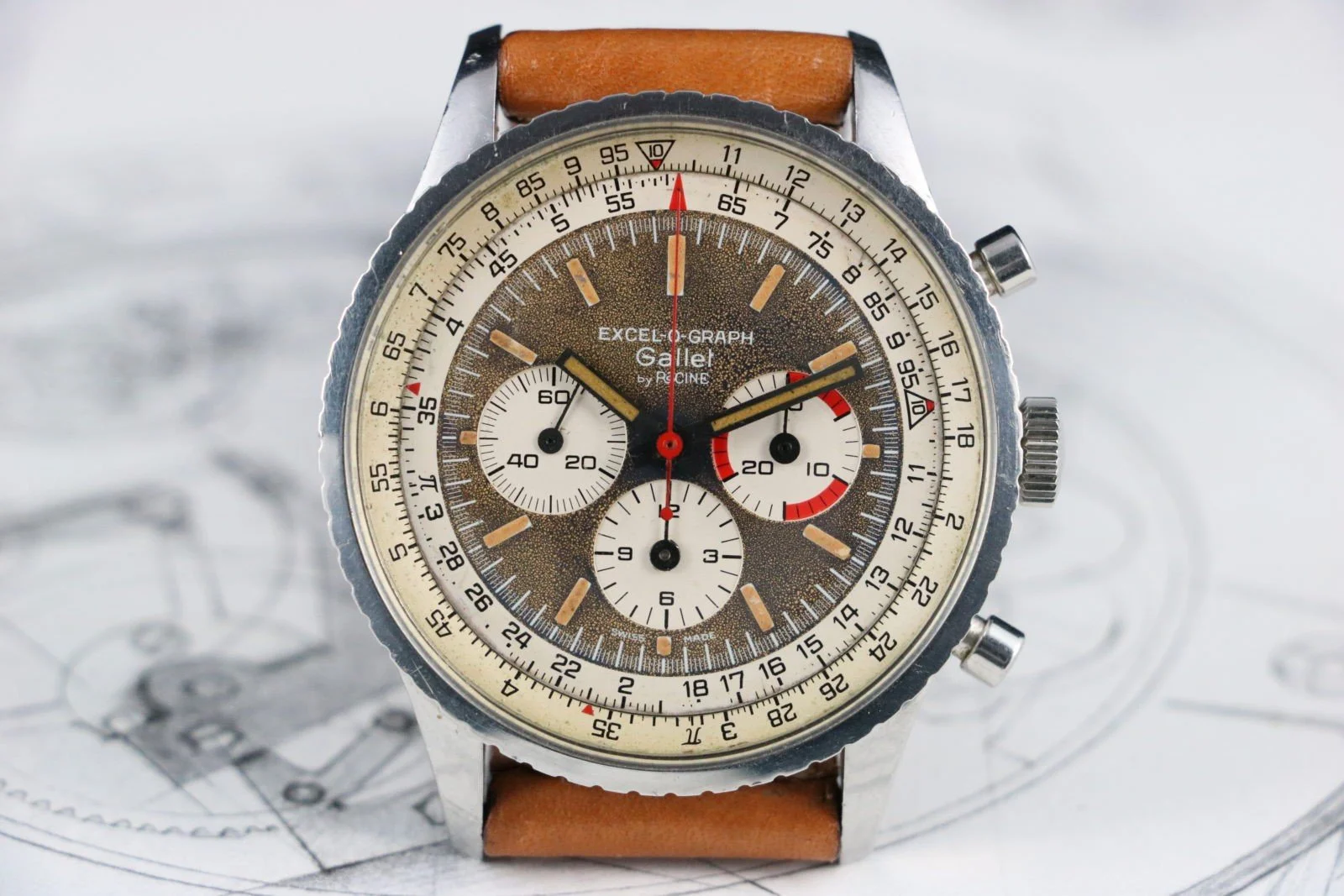
Gallet Excel-O-Graph Cal. EP 40 / Credit: Stetz Watch Co.
Gallet again survived the ‘Quartz Attack’ in the early 1970s, which caused many a watch manufacturer to go under. The key to their survival being the kinds of clients they catered to, military and industrial, along with those interested in tool watches. Leon Gallet then passed away in 1975, leaving management responsibilities to his sons Pierre and Bernard. Gallet also acquired the Racine Company, behind Enicar, at the time.
Canadian watch brand Marathon is also related to Gallet. Wein Brothers, a Canadian distributor, contracted Gallet to manufacture military-grade wristwatches for the American government. The watches were branded as ‘Marathon’, a previously held Gallet trademark. Marathon continues today and is the most prominent Canadian watch brand. Gallet supplied 30,000 ‘Navigator’ watches to Marathon for the U.S. military, watches tested under extreme conditions to meet rigid requirements. They were famously used during the Gulf War, in the early 1990s, by American soldiers.

1990s Marathon Gallet USAF Navigator watch / Credit: Horse Unit
Bernard Gallet took control of the company in the early 1990s and developed a relationship with the Neresheimer family, with Walter Hediger of the Neresheimer family eventually taking over Gallet as chief executive in the early 2000s.
The storied family business was finally out of the hands of the Gallets.
While not exactly linear, Gallet has a rich history that stretches back over 550 years. And although they are not as popular as they once were, they still hold the prestige of being one of the world’s oldest watchmakers. Looking through their history, they had an amazing ability to create synergistic relationships with people and corporations, and identify and infiltrate new and innovative markets. Nowadays, we can be extra grateful to Gallet for helping establish the Musée international d'horlogerie and Federation of the Swiss Watch Industry, both of which are still flourishing to this day.
By: Eric Mulder

President Harry S. Truman and his Gallet Flying Officer
Read more:
“Gallet Watch History,” Gallet World, http://www.galletworld.com/gallet_watch_history_time_line.html.
“Our History.” FH, https://www.fhs.swiss/eng/fhhistory.html.
“Joining the Confederation.” Ville de Geneve, https://www.geneve.ch/en/what-geneva/discover-geneva-districts/geneva-through-ages/joining-confederation.

A vintage King Seiko Hi-Beat Chronometer 5626-7060 for sale on Toronto Vintage Watches.