
Exploring the Watches That Define Cartier
Cartier Tank
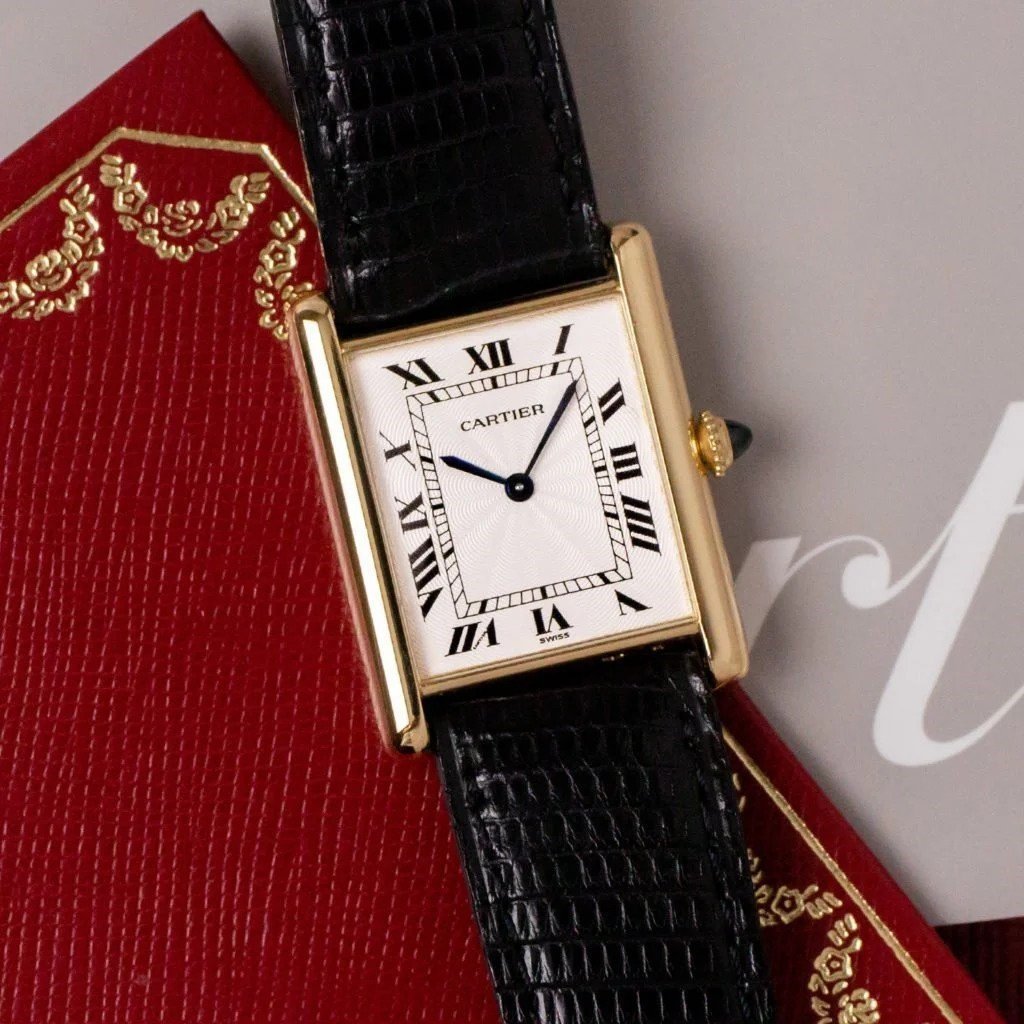
Cartier Tank Louis circa 1990 / Credit: Amsterdam Vintage Watches
Not too long ago, we celebrated the 100-year anniversary of a very notable watch. The Cartier Tank is often not thought to be linked to military history, however, this legendary watch was developed in the midst of one of the greatest military conflicts in history and was supposedly inspired by Renault FT-17 tanks, used on the Western Front. The watch is truly Cartier’s premier timepiece and has been worn by notables such as Andy Warhol, Princess Diana, and Elizabeth Taylor. But how did this watch become such a cultural icon?
The Cartier Tank was first created by Louis Cartier in 1917. According to horology legend, the first was gifted to US General John Pershing in 1918. The following year, it was officially released to the public with a production run of 6 watches. Cartier was very focused on creating a unique design when he conceived the Tank, there were two key aspects of the Cartier Tank’s design, apart from its shape, that underlined that commitment.

The Cartier Tank wristwatch design / Credit: The Business Times
First, the watch had an integrated strap, so the strap was not interchangeable, but it was one with the watch – very rare in the era of wristlets. Second, he added an iconic hallmark to the Tank that is still present today – a blue sapphire on the crown. Given its eccentricity for the time, and reports of Pershing being the first of its owners, the Tank was immediately adopted by stars of the day. Rudolph Valentino, the famous Hollywood actor of Roaring ‘20s, was known for wearing a Cartier Tank, as were other figures like Jackie Kennedy and Yves Saint-Laurent. In fact, Valentino famously wore his in The Son of the Sheik, perhaps the first movie appearance for a famous watch model. Moreover, many other brands started to create their own versions of the Cartier Tank; today there are Zenith, Omega, Patek, and Rolex tanks, among many others.
It seems that, much like many Rolexes, the Cartier Tank became a cultural icon by associating itself with the notable figures of the day. Rudolph Valentino, Jackie Kennedy, and Andy Warhol are excellent examples, much like Rolex associating itself with figures like Paul Newman. Perhaps a lesson for watch marketers today.
Panthère de Cartier

Panthère de Cartier / Credit: Haute Living
The history of the Panthère de Cartier is not only over 100 years old, but it is also, luckily, fairly well documented. Now, the Panthère de Cartier is an iconic watch, women's wristwatch, but also an iconic piece of jewelry design from Cartier. Cartier's ‘Panthère' pattern is famous and goes back to the early 20th century and a woman called Jeanne Toussaint.
Jeanne became acquainted with Louis Cartier (with whom she had a romantic affair) and also earned the nickname ‘The Panther’ for her elegance, which was a name given by Louis Cartier. She was born to a working-class family in Belgium and moved to Paris as a teenager with a nobleman. In 1914, Louis Cartier commissioned the painting of ‘Lady With a Panther’ to George Barbier – the same year the first Cartier ‘Panthère’ wristwatch was released, with the familiar Cartier Panthère pattern made of onyx and diamonds – and on a ladies wristwatch. Jeanne was also active in the company, now as a designer and eventually the equivalent of creative director today. She was the head woman between 1933 and 1970, and instrumental to developing this famous design emblem, among others.

Jeanne Toussaint was instrumental in Cartier’s Panthère legacy
Now, Cartier produced several pieces with the Panthère pattern throughout the 20th century, even making a chatelaine watch that was acquired by Pierre Cartier, with the Panthère pattern. Cartier made brooches, cigarette cases, bracelets, and rings all with the same Panthère pattern incorporated. Notably, in 1948, a Cartier Panthère brooch was made for the Duchess of Windsor, and, in the 1950s, Aga Khan was a customer; buying two Cartier Panthère earrings and a bangle.
The modern version of the Cartier Panthère de Cartier wristwatch came about in the early 1980s and was produced for about 20 years until the early 2000s. It was made mostly in metals like gold, as it was also a piece of jewelry, but in the early 1990s steel models were also introduced. This would be the Panthère de Cartier that we’d be most familiar with, that was powered by quartz. The same Panthère de Cartier was reintroduced in 2017, and comes in a variety of styles and metals. And again, all are powered by quartz.
Santos de Cartier

Cartier Santos 2018 / Credit: Deployant
In 1904, Louis Cartier made for his friend, Alberto Santos-Dumont, a wristwatch for flying – eliminating the annoyance of checking one’s pocket watch while in the air. The significance of this piece, the Santos de Cartier, is well-known, it was Cartier’s first wristwatch and one of the first pilot wristwatches ever made, it was also one of the first mass-produced wristwatches for men. But what about Alberto Santos-Dumont? Who was this mysterious aviator for whom the watch was named?
Alberto Santos-Dumont was born in 1873 in Cabunga, Brazil to a wealthy family of coffee producers. His father was an engineer of French descent who made himself a fortune developing cost-saving techniques for his coffee plantations, earning himself the title of ‘Coffee King of Brazil’.
However, as a result of a horse-riding accident, Alberto’s father was paralyzed in 1891 and moved his family to Europe where he sought treatment. In Paris, after seeing hot air balloons, Alberto developed a keen interest in flight, even buying an account of Salomon Andrée’s expedition to the North Pole.
After his father’s death in 1892, Alberto continued to spend time in Paris, studying with a private tutor and visiting Brazil on vacation. He arranged for his first flight with Alexis Machuron and was soon designing his own balloons. His first design, the Brésil, was first flown in 1898. Soon after, Dumont designed his first steerable balloon called a ‘dirigible’, building a total of 11 by 1905. It wasn’t all success however, in 1901 he lost during his first attempt at the Deutsch de la Meurthe, but he was back later that year winning first prize. This win made Alberto Santos-Dumont an international celebrity and he was invited to meet Theodore Roosevelt during a 1904 trip for the Louisiana Purchase Exposition. It was upon his return to Paris that he asked Louis Cartier about making him a wristwatch for flying, the watch that became known as the Santos de Cartier, still sold by Cartier today.

Cartier Santos from early 1900s
Cartier designed a flat wristwatch with a square bezel and gave it to Alberto Santos-Dumont, with the watch eventually catching on with Cartier’s other customers.
In 1911, when the Santos de Cartier first hit the shelves, it was offered in platinum and yellow gold models. These would typically be equipped with brown or black leather straps and a gold folding buckle. Cartier continued selling the Santos model throughout the 20th century, right up until the Second World War. Wartime requirements demanded round watches, which meant that more obscure square designs like the Santos’ saw steady decline. This decline has continued into modern day.
Despite his tragic death, Alberto Santos-Dumont is idolized as a maverick aviator, engineer, and international celebrity, remembered for his daredevil attitude and his regular flights around the rooftops of Paris. And of course, as the inspiration for the Santos de Cartier.
Cartier Crash

Cartier Crash circa 1991 / Credit: Amsterdam Vintage Watches
Cartier is a brand steeped in legacy and romance, with creativity being at the forefront of their design considerations. It is no surprise that this design essence has captured the hearts of the greatest watch collectors of our time.
The inception of the Cartier Crash traces back to their flagship store in the United Kingdom. This is Cartier’s London Boutique on Bond Street – a location which has produced more innovative designs for Cartier than any other. A key feature to the success of this flagship store was the innovative spirit of Jean-Jacque Cartier and the autonomy and trust that his team operated with.

Cartier’s Flagship store on Bond Street / Credit: Architectural Digest
The Cartier Crash’s unique design is based on the subtle play of basic forms, in which they are either bent, elongated, or compressed in refined ways. Similar to Gerald Genta who would use basic forms in his designs – octagonal for the Audemars Piguet Royal Oak, square for the Patek Philippe Nautilus, and round for the IWC Ingenieur. This was done to the utmost extremes with the design of the Cartier Crash.
Although many people have claimed the design of the Cartier Crash is based on the distorted timepiece in Salvador Dali’s famous painting ‘The Persistence of Memory’, that is actually not the case. Another theory is that its inspiration is derived from a Cartier Baignoire which was heavily damaged in an automobile accident in 1967. Whatever the true inspiration was, the Cartier Crash resembles an oval that was compressed and ‘crashed’ into. A true symbol of asymmetry, non-conformism, and creative freedom.
Despite first appearing in the 1960s, the Cartier Crash still appeals to many modern-day collectors, with Kanye West, Jay-Z, and Tyler the Creator being a few notable wearers. Its abstract and defiant nature made it a hit when it was first released, with that success continuing over 60 years later. In fact, in May 2022, the most expensive Cartier Crash was sold at auction for a price of $1,503,888 plus buyer’s premium.
Cartier Tortue Monopoussoir CPCP

Cartier Tortue Monopoussoir CPCP / Credit: Phillips
The tonneau-shaped ‘tortue à pattes’ or ‘turtle on legs’ Cartier watch was first designed in 1912 by Louis Cartier. The model into a single button chronograph in the 1920s, with the ‘monopoussoir’ released in 1928. Launched at the SIHH in 1998, Cartier introduced their Collection Privée Cartier Paris (CPCP), marketing Cartier’s return to a maker of luxury timepieces. The Cartier Tortue Monopoussoir Chronograph would be a part of this coveted series; a portfolio of the company’s most iconic watches drawn from its archives.
The design for the Cartier Tortue Monopoussoir allowed for the wearer to start, stop, and reset the functions using only the crown. Although not as famous as the watches discussed above, it is still a staple in the collection. Cartier, still lacking the ability to create the movements for this collection, reached out to THA Ébauche to help manufacture these timepieces. THA Ébauche, interestingly enough, helped create three of today’s greatest watchmakers, F.P. Journe, Vianney Halter, and Denis Flageollet. It was this trio of watchmakers who suggested Cartier include it as a Collection Privée Cartier Paris model.
By: Eric Mulder