
Seiko’s Braille Watches and Other Horological Tools for the Visually Impaired
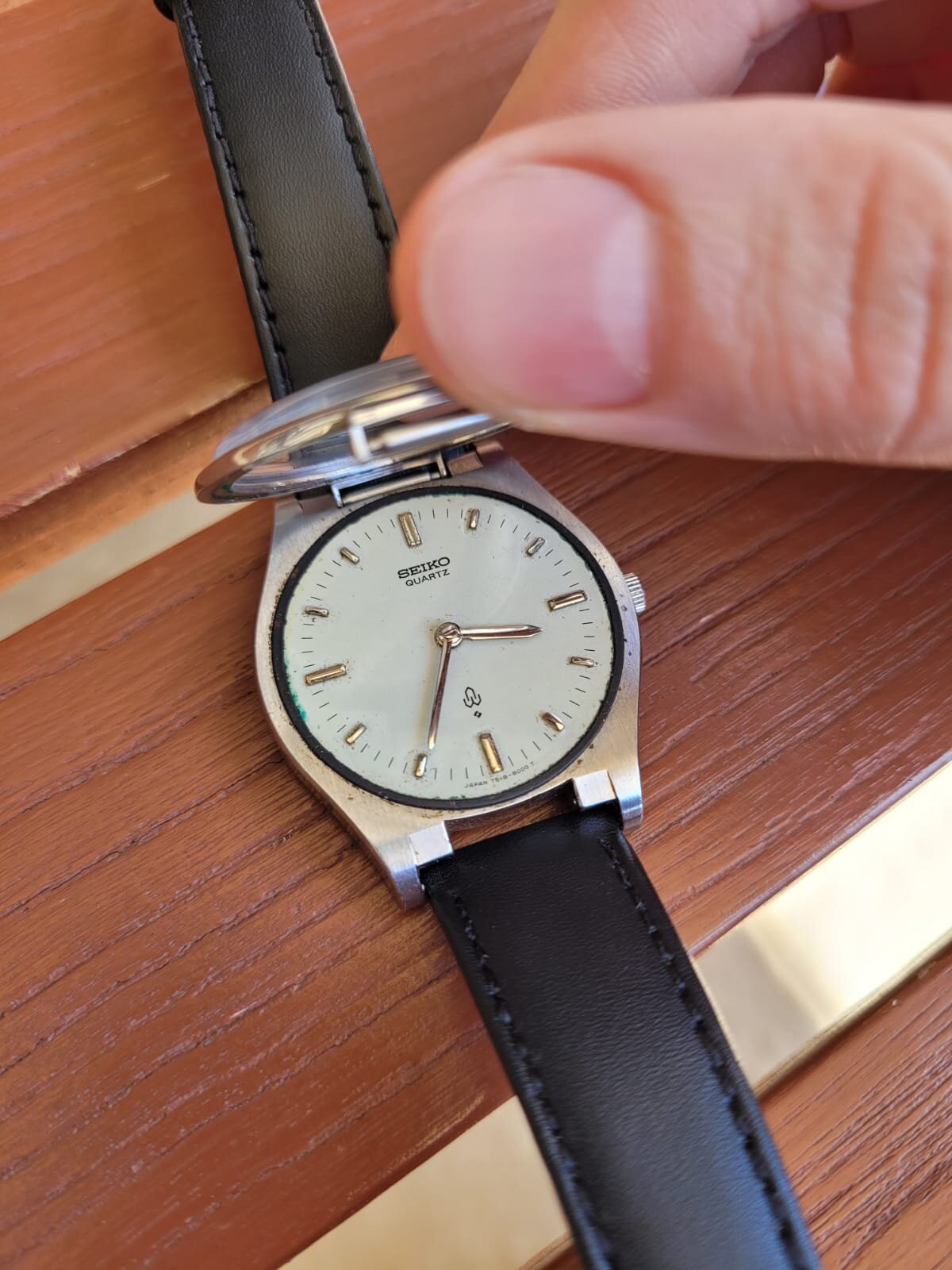
1982 Seiko Braille Watch 7518-8000
Watch enthusiasts and watch collectors tend to come in a few general categories, so it’s easy to forget that an entire group of people is effectively blocked from using our most precious objects. Solutions for this group of people have been far and few between, going back to the 17th century in England when the first ‘versions’ of the ‘répétition minutes’ (or clocks with chimes/bells) were being developed. These were early clocks that made a noise, chimed, to indicate different times throughout the day – some even similar to the current, modern versions of the complication. Although there were many uses for the répétition minutes, one of the main ones was being able to tell time in the dark. And so, you may have already guessed it, the group of people referred to above are the visually impaired. Those who are not accommodated be it by regular analog watches or even many smartwatches.
There have been a relatively limited number of timepieces made for the blind, however, one brand that stands out in this effort is definitely Seiko. Seiko made a very particular series of watches for blind people from the 1970s to the 1990s. There were quartz analog watches and digital ‘talking’ watches. This is not like their retro Wrist Talk series but watches made with Braille markers on the dial specifically for blind people – or with audio instruction meant to aid the visually impaired with their time telling endeavors.
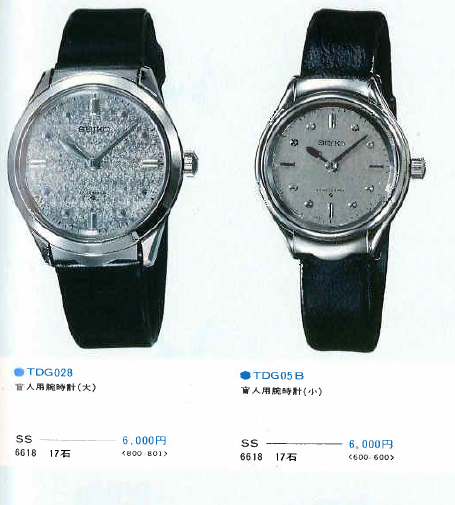
1975 JDM catalogue screenshot
Seiko’s first Braille watches were released in the late 1960s, with the very first appearing in the 1968 JDM catalogue beside the 6215-7000. At first they only made the men’s version of the 6618-8000, which was produced until 1979, for just about a decade. These featured the Cal. 6618 which was a 17 jewel manual winding movement.
It was only in 1975 that a women’s version of this watch appeared in the JDM catalogue. The pair cost 6,000 Japanese Yen each at the time and were powered by the same 6618 movement. Above there is a screenshot from the 1975 JDM catalogue featuring these two early Braille watches, the ref. TDG028 for men and the ref. TDG05B for women. What was so unique about these was the crystal could be lifted by the wearer so as to actually touch the markers with their hands – markers that were in Braille and could indicate to the user, visually impaired or otherwise, what the time was. Talk about a tool watch!
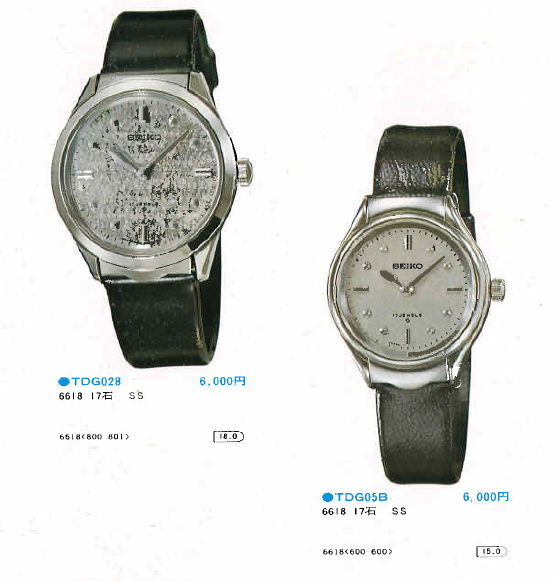
1976 JDM catalogue screenshot
The above references with the 6618 movement were produced between 1974 or 1975 and 1979 when they were last in the catalogue. After a hiatus of a couple years between 1980 and 1981, the Braille watches were back in the JDM catalogue in 1982, but this time upgraded to the quartz Cal. 7518 for men and 7918 for women. They still came in men’s and women’s models, and the crystal still opened, but now there were four references – two with steel bracelets and two with leather straps. This brings our total ‘Braille movement’ count to three with the 6618, the 7518, and the 7918.
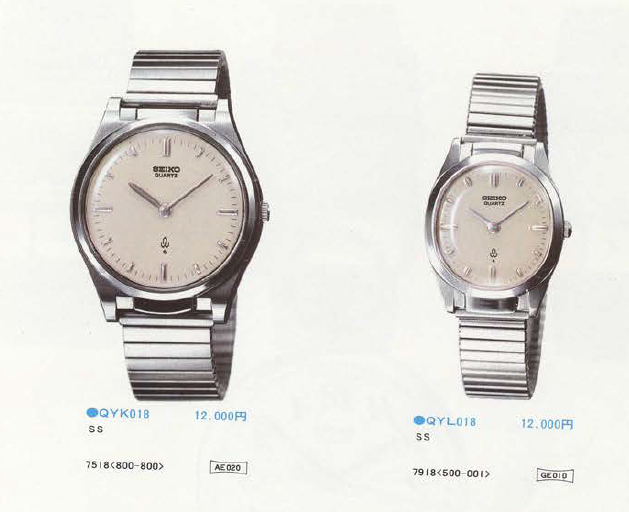
1982 JDM catalogue screenshot
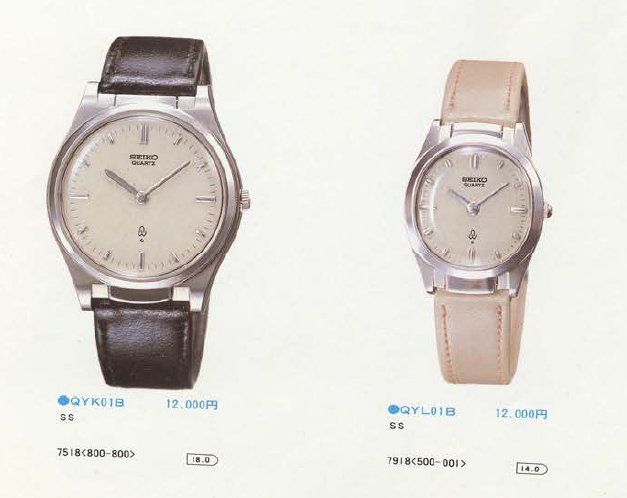
1982 JDM catalogue screenshot of the leather strap models
These new references continue production between 1981 or 1982 and 1985, when two new ladies’ models were introduced: the ref. QWK014 and QWK018, featuring the Cal. 2A27.
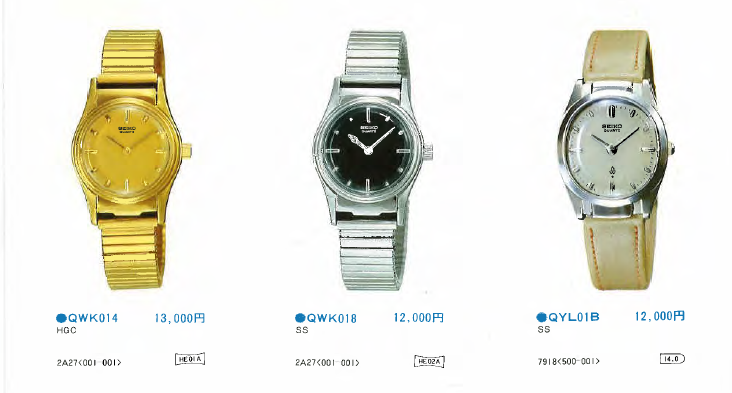
1985 JDM catalogue screenshot of the three women’s Braille models
Now, 1986 was a totally different story. The 7518 and 7918 were no longer, those references discontinued. In their stead came the modern and more plastic 7C17 movements to match the 2A27 before them.
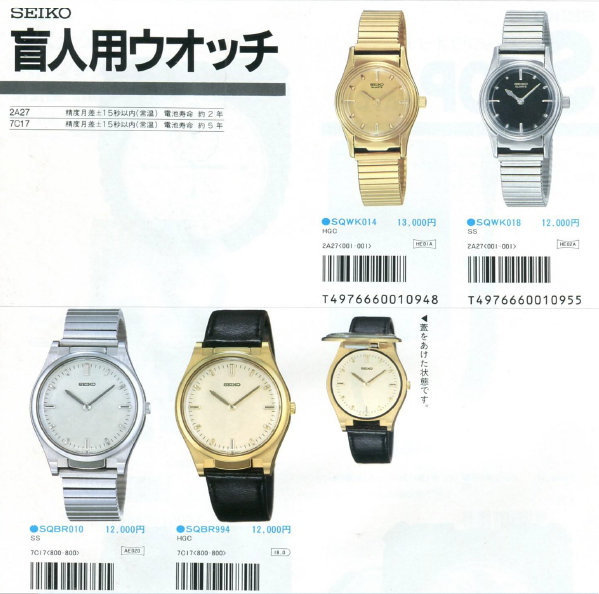
1986 JDM catalogue screenshot
These Braille watches continues to be produced into the 1990s, however, apart from these Braille watches there were also the aforementioned talking watches. These were retro digital watches that had voice command functions and gave the user information using pre-recorded voices in different languages. For example, we have an A860-4000 from 1988. These were presumably JDM models only available in Japanese language, whereas other models were available in other languages. Similar to the more popular Wrist Talk A966 series but different, especially in their purpose. Today these models are all fairly rare, especially in good, original, and working condition.
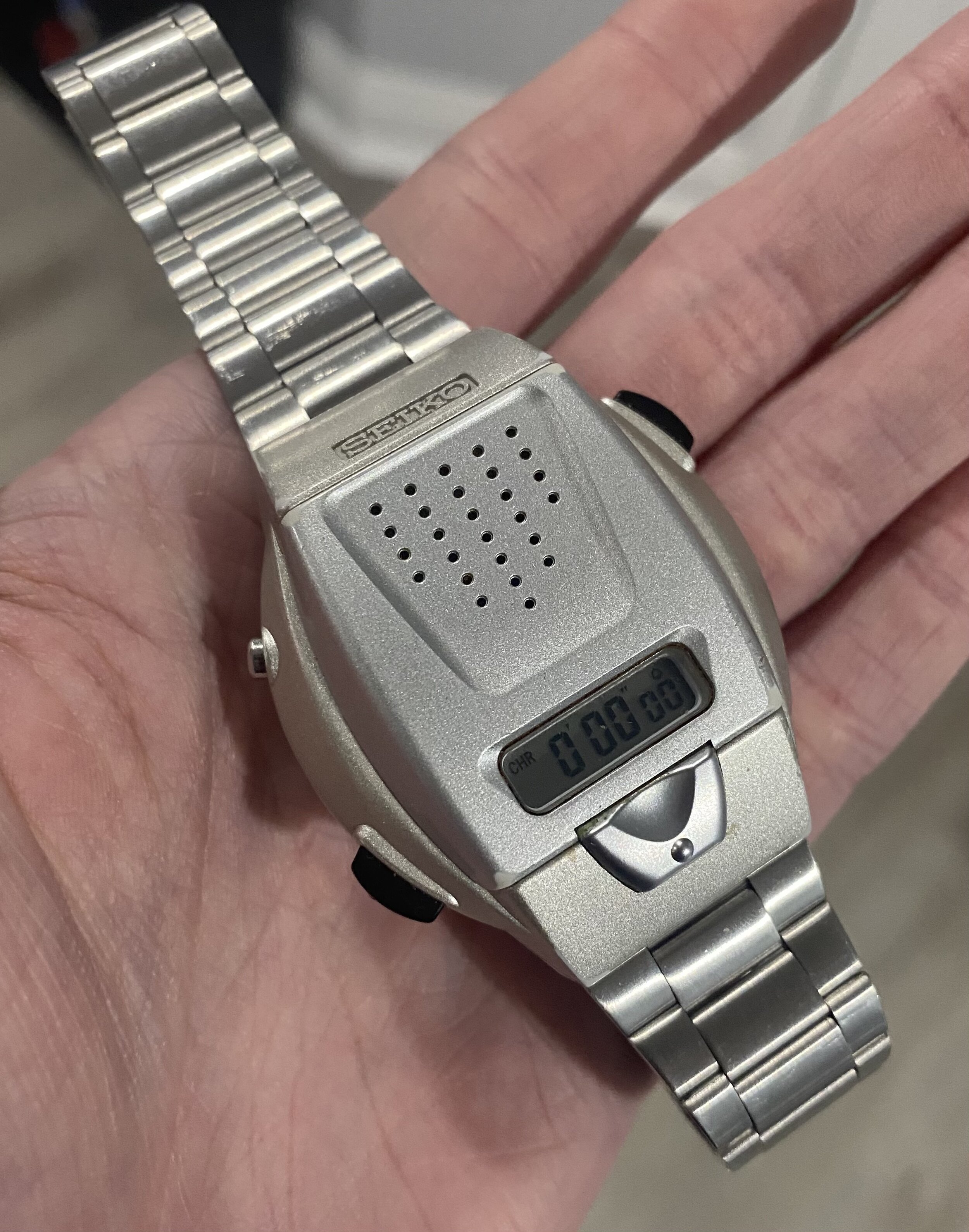
1988 Seiko A860-4000 on its original bracelet for sale here.
Going through old Seiko catalogues to try to understand the gist of this alternative series of timepieces, it becomes clear that this is really a display of Seiko’s unique and often unwritten history; the kinds of pieces that completely pass even somewhat seasoned watch collectors by. It’s also a great show of the diversity that vintage watches have to offer, in particular the oft overlooked retro/digital era.
So, next time you’re at a garage sale and hear a creepy voice announce the time in Japanese – you never know, it could be an A860!
By: Andres Ibarguen
Read more:
See Seiko JDM catalogues from the mid-1970s until the late 1980s.
Editor’s note (24/04/2021): Some important amendments were been made to this article since discovering that the men’s version of the 6618 was actually produced alone since 1967 or 1968 and also correcting where had previously been written that the 6618 was a quartz movement.
Editor’s note (24/05/2021): Another important change was made after discovering that there were actually some Seiko Braille watches produced into the 1990s.