
An Overview of the Five Most Compelling Vintage Heuer Watches

Vintage Heuer Camaro ref. 73443T / Credit: Analog/Shift
Of all the vintage Heuers, we wanted to pick five that we thought were the best at representing what the Heuer brand really means – or at least once meant. Trying to avoid the more mainstream Heuer Autavias and Monacos was a bit hard, although admittedly, they were top of mind when making this list. Outside of those, these are our top five.
Vintage Heuer Camaro

Vintage Heuer Camaro ref. 73443T / Credit: Analog/Shift
The Heuer Camaro is my favourite vintage Heuer and one of the most underrated in the vintage Heuer lineup. The Heuer Camaro has lived in obscurity for far too long. As we’ve discussed, and as you may have ascertained, so much in watchmaking history comes down to marketing. And yet, despite being the black sheep in the vintage Heuer racing family, and the lack of attention it’s gotten over the years, some Heuer Camaros still go for 5-figures plus.
So, what makes the Heuer Camaro so unique? Well, it had a production run of only four years and was only ever released with manual-winding movements. This was really the effect of bad timing, as after its 1968 release, Heuer turned its focus to the Caliber 11 and its automatic chronographs; the Camaro was treated as sort of a middle child, eventually completely cut out in 1972. Notwithstanding this, the Heuer Camaro was never made to be a secondary model, Jack Heuer originally named the Heuer Camaro after the Chevrolet Camaro, released in 1966, as a ploy to strengthen the watch company’s position in the American market. In fact, this was one of the few vintage Heuers not named after a location tied to motorsport. The Heuer Camaro watch used three top notch movements: the Valjoux 72, 92, and 773x. The Camaro’s case design was a bit of a mix between the classic Carrera and the contemporary square Monaco, the Heuer Camaro adding a millimeter in diameter to the Carrera and having a rounder case than the Monaco.
I personally think that the Camaro would’ve done much better had it had its life been extended by a few years. It missed out on the opportunity for any major endorsement; there was no Jo Siffert or Steve McQueen for the Heuer Camaro.
Vintage Heuer Carrera
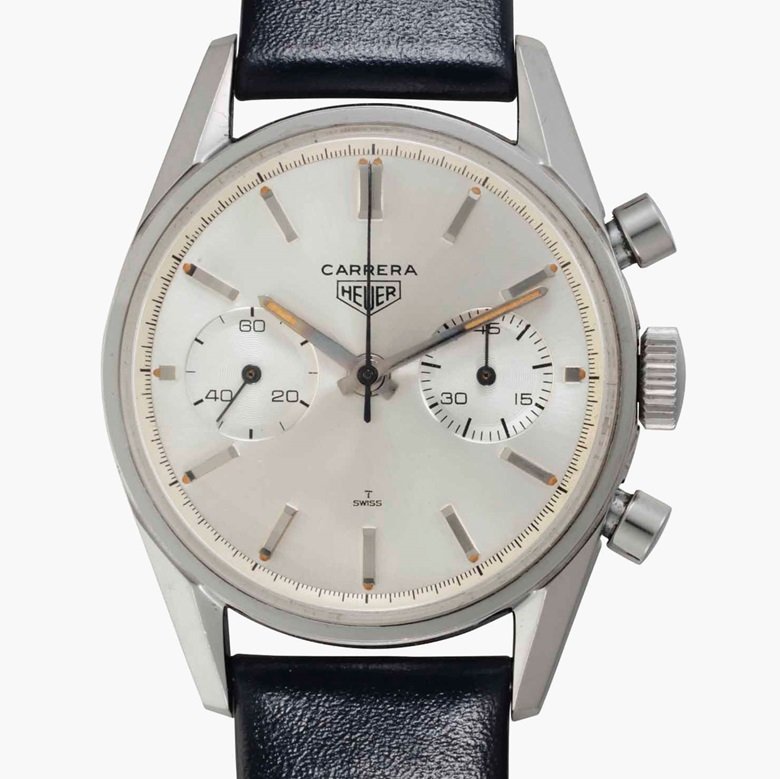
Vintage Heuer Carrera ref. 3647S / Credit: Christie’s
Jack Heuer, great grandson of the company’s founder, had a great influence over the development of Heuer’s catalogue during his two decades at the helm of the company, from 1962-1982. In fact, it was in 1962 that Jack decided to take a look at Heuer’s offerings, and, following the success of the Autavia, ended up developing the concept for the Carrera (meaning ‘race’ in Spanish), which was launched in 1963.
The original watch was designed by Jack Heuer himself and named for the famous Carrera Panamericana, which ran from 1950 to 1954 in Mexico. It featured an ETA movement and came in varieties such as: the Carrera 12, the Carrera 45, the Carrera Tachy, and the Carrera Black; three register chronograph dials with panda or reverse panda designs, gold cases, and more. Notably, most Heuer Carrera models originally sold for under $100, which is certainly not the case anymore. The Heuer Carrera, like the heuer Autavia before it, was very successful in the watch market, largely due to its sleek, simple, and aesthetically pleasing design. The first generation lasted until 1970, when everything was changed by the development of the infamous Caliber 11. The model continued to grow in popularity over the years, as new features were added, but was eventually discontinued in 1984.
Ultimately, the Carrera’s lifespan largely coincided with that of Jack Heuer’s tenure leading his namesake company, until pressures from the spread of quartz technology became too great to bear and the watch model was discontinued. However, the Heuer Carrera didn’t spend too much time on the bench and was relaunched under new ownership (TAG Heuer) in 1996 at Monza. Despite the trials and tribulations the watch has gone through, it has always stood out as an important and eventually iconic timepiece among Heuer offerings, remaining prominent in their catalogue to this day.
Vintage Heuer Monza
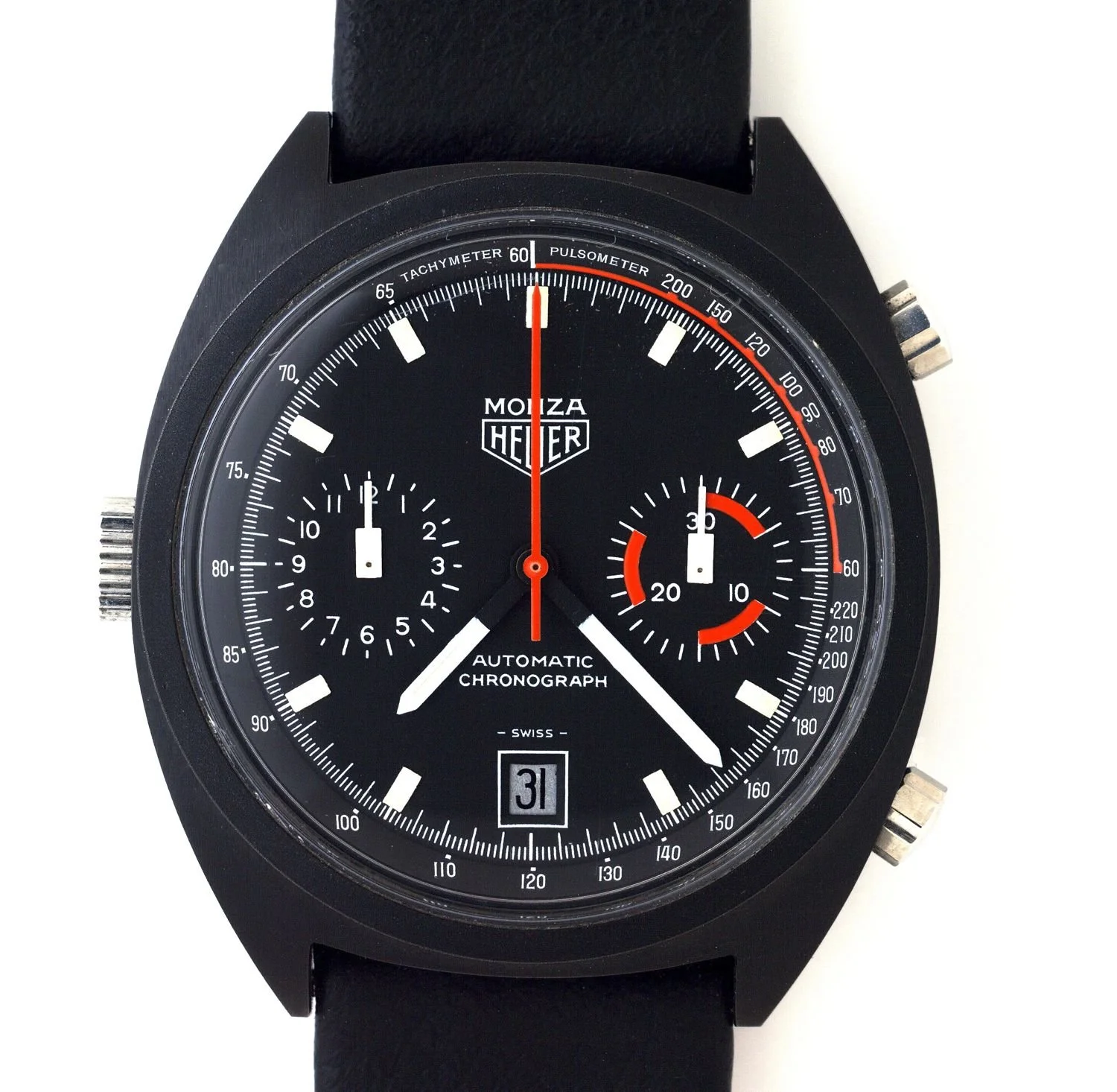
Vintage Heuer Monza black PVD / Credit: Calibre 11
For a long time, when I thought of Monza, I thought of the small city just north of Milan that I had been to maybe once and that that guy from work’s aunt was from. As I started to get more into racing watches years ago, I eventually stumbled upon the Heuer Monza – one of the many vintage Heuer models named after a city famous for its connection to racing.
1975 was a pretty chaotic year for Formula One racing: American driver Mark Donohue died after a crash in Austria and Graham Hill, of the Embassy Hill team, died with another driver in a plane crash later in the year. Niki Lauda also had a rocky start to the year, but ended up winning a championship in his Ferrari 312T – only his second year on the Ferrari team. His Ferrari was said to be technically superior to any other car that year. It was designed by Italian engineer Mauro Forghieri and built by Scuderia Ferrari to put out 510 bhp! For his awesome comeback season and win in 1975, Jack Heuer decided to dedicate the Monza to the champ who had come in third place in the Italian Grand Prix that year in Monza (Heuer was the unofficial sponsor of Ferrari at the time). As such, the Heuer Monza we know today was released in 1976, with some real racing inspiration under the hood.
The Heuer Monza came in a variety of different versions, with the reference numbers 110.XXX and 150.XXX that came in either all black PVD, steel, or ‘economy’ versions. This followed the trend of black PVD racing watches, like the aforementioned Heuer Pasadena. Interestingly, there was also another Heuer named after another nearby Italian city…the Heuer Modena (ref. 150.511) – nearly identical to the Monza and made for the German market only in 1977!

Vintage Heuer Monza / Credit: Calibre 11
So, the 1970s Heuer Monzas are cool and all, however, much like with the Heuer Autavia, the real story of the Monza begins in the early 1930s…
In the early 1930s, Heuer released a manually wound, single-pusher chronograph dubbed the ‘Monza’. These watches were small, at 33 mm in diameter, and were the inspiration for a more recent Heuer re-issue from 2000: the TAG Heuer reference CR2111. You can see that the numerals and hands of these watches are especially alike. The TAG Heuer ref. CR2111 was also powered by an automatic chronograph movement: the Heuer Cal. 36 chronometer (an El Primero-based movement). In 2011, another version was released, the TAG Heuer ref. CR5112 in an edition of 1,911 watches – also featuring the Heuer Cal. 36.
And finally, Heuer once again took the chance to benefit from its racing provenance in releasing the Heuer Monza Caliber 17 in 2016. Their final and most recent re-edition…
Takeaways? Don’t discount the multitude of worthwhile vintage Heuers that are out there, and never underestimate the strange and obscure locations Jack Heuer was willing to name his watches after!
Vintage Heuer Pasadena

Vintage Heuer Pasadena black PVD / Credit: Calibre 11
As automatic chronographs gained popularity in the 1970s, Heuer came together with the Valjoux 7750 after a long run of in-house chronograph movements. The Valjoux 7750 is, of course, the very well-known chronograph movement, released in 1973. It powered many a Swiss chronograph, but Heuer first used it in their not especially popular Heuer Kentucky. The Heuer Kentucky was one of many Heuers named after cities in America, also realized in a quartz version that also isn’t especially sought after amongst Heuer collectors today. Retrospectively, it is easy to say that the Kentucky was ill-advised, but you can imagine Heuer’s will to continue with automatic chronographs after the breakthrough of the Caliber 11, while also mixing in a quartz version of the watch to stay with the trends of the day. Nonetheless, Heuer continued making watches named after cities, eventually reaching Pasadena.
At the time, Heuer also made chronographs for other brands, some of which we’ve already mentioned, like Abercombie & Fitch and their Seafarer. When the Orfina Porsche Design chronograph was first released as the first all black PVD chronograph – clearly inspired by motorsport – it was very well received. This, of course, inspired other competitors in the racing chronograph market to put out their own watches, in this case, the Heuer Pasadena. The Heuer Pasadena, had an integrated steel bracelet, was luminous, had a tachymeter scale, and used the Valjoux 7750. It came out in the late 1970s along with other brands like LeJour, D&W, Titus, and even Desotos, that released similar black PVD Valjoux 7750 chronographs at the time – seeing Orfina Porsche Design’s success. The watches were extremely similar and based on the Orfina Porsche Design chronograph. They all had the same black on white script tachymeter with different things like “Automatic” or the model name on the dial. All of these would be collectible although the Orfina and Heuer Pasadena would be the most sought after. These black PVD chronographs are great watches, albeit somewhat difficult to find in good condition given the quality of PVD at the time.
Vintage Heuer Montreal
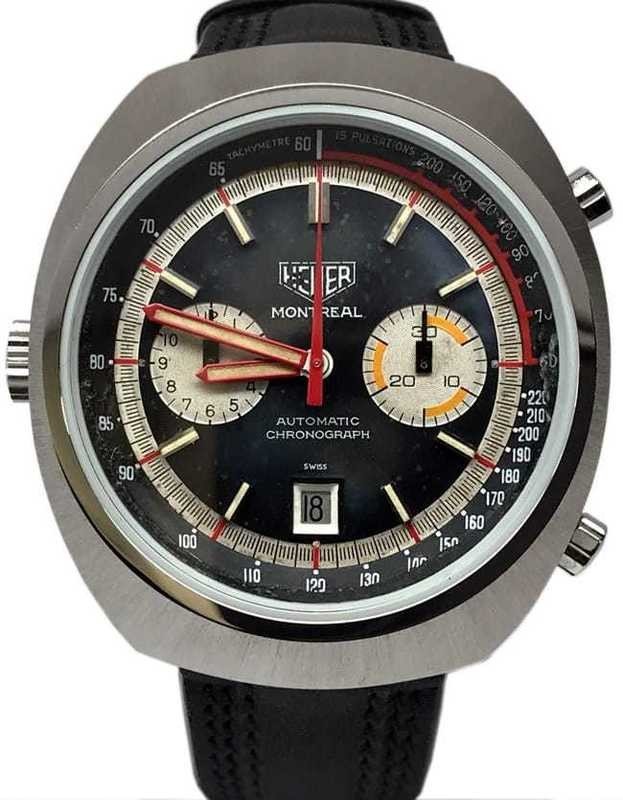
Vintage Heuer Montreal / Credit: Exquisite Timepieces
Usually ignored for the more prominent Heuers from an earlier time period, the Heuer Montreal is certainly worth the story…and some would say it’s the only ‘Canadian’ Heuer ever made.
Many rightly assume that the Heuer Montreal was named after the Montreal Grand Prix, it being Heuer that’s not a bad assumption. However, the Montreal Grand Prix was only moved to Montreal from Bowmanville, Ontario in 1978, and the Heuer Montreal was released in 1972, so that’s unlikely. An alternative explanation is that it was named for the 1976 Olympics, given that they were awarded to Montreal in 1970, but there’s really no definitive answer. The original Heuer Montreal hosted a Caliber 12 movement, which came out only a year before the watch’s release, in 1971. The Montreal was especially popular for its design, in particular the classic 1970s case and the colour contrast of the indices on the dial. Ironically, the white dial versions with blue and red indices are particularly reminiscent of the Habs’ jersey colours, adding to the mystery of the origins of the watch’s name. Unfortunately, the Caliber 12 was phased out in only 4 years and replaced with the venerable Valjoux 7750. The Heuer Montreal stayed in the Heuer lineup for a few more years, but was completely retired by the early 1980s.
Although less popular and less expensive today than other vintage Heuers like the Heuer Autavia, the Carrera, and the Monaco, the Heuer Montreal still holds a special place in the Heuer world. And as a Canadian, I’d even say a special place among Canadian watch enthusiasts, for being one of the few important watches with a connection to the Dominion – even if we aren’t sure what that connection is. Who knows, maybe Jack Heuer, like so many others, was simply fond of Montreal and its famous joie de vivre.
By: Andres Ibarguen