
The Three-Part Collection from Ulysse Nardin

The Ulysse Nardin Astrolabium Galileo Galilei ref. 839-70, Tellerium Johannes Kepler ref. 889-70, and Planetarium-Copernicus ref. 999-70 / Credit: Sotheby’s
During the 16th century, Nicolaus Copernicus (1473-1543) refused to believe the geocentric theory of the solar system and demonstrated that the Sun must be at the center of the solar system and that the Earth revolves around the Sun.
Galileo Galilei (1564-1642), after developing the telescope, found evidence to support Copernicus' theory. He discovered Jupiter’s four moons, Galilean satellites, that orbit the planet and this, along with other discoveries, became evidence supporting Nicolaus Copernicus’ theory.
Johannes Kepler (1571-1630) developed the laws of planetary motion confirming Nicolaus Copernicus’ theory. He was a key player in the 17th century scientific revolution.
Fast forward to 1984, two Swiss watchmaking powerhouses – Rolf Schnyder, who was responsible for reviving Ulysse Nardin, and Dr. Ludwig Oeschslin – joined forces. The Trilogy of Time watches were the result of that synergy. Rolf Schnyder owned Ulysse Nardin at the time and allowed Dr. Ludwig Oeschlin, a known polymath, to express his extraordinary creative vision. This also helped move the company into a segment where there was little to no competition.
The Trilogy of Time Collection
The Astrolabium Galileo Galilei: this was the very first of the Trilogy of Time collection, released in 1985. It was directly inspired by Dr. Oeschslin’s personal astrolabe clock. It indicates the position of the Sun, the Moon and the Stars from anywhere on earth. In addition, it specifies sunrise / sunset, moon phases, and eclipses. It also holds additional astronomical complications.

The Ulysse Nardin Astrolabium Galileo ref. 901-22 / Credit: Touch of Modern
The Planetarium Copernicus
This model was released in 1988. The Planetarium showed a view of the five main planets (Mercury, Venus, Mars, Jupiter, and Saturn) in relation to the Earth and the Sun.

The Ulysse Nardin Planetarium Copernicus / Credit: Wrist Review
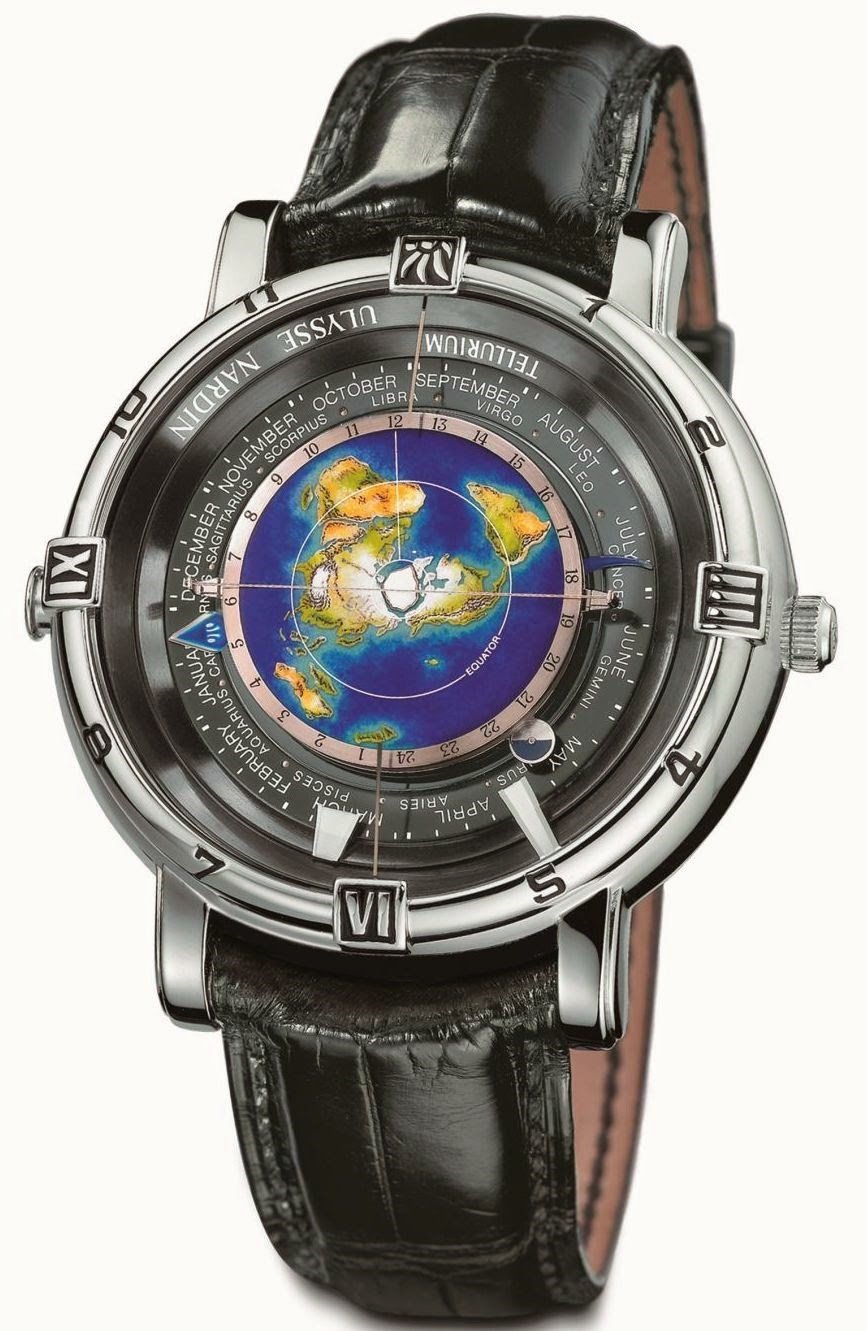
The Tellerium Johannes Kepler
Released in 1992, the Tellerium was the last of the Trilogy of Time collection. This watch shows the earth from the vantage point above the North Pole, as well as a variety of astronomical complications including the eclipses of both the Sun and Moon.
The Ulysse Nardin Trilogy of Time are among a group of watches that are historically and mechanically innovative. The various models were developed by Dr. Ludwig Oechslin, a brilliant horologist, among many other things, alongside the vision of Rolf Schnyder. The two were able to make a completely original collection of watches still relevant today. Dr. Ludwig Oechslin then continued to work with Rolf in later years and developed several original mechanisms for Ulysse Nardin. Rolf Schnyder is remembered for his role as owner and CEO of Ulysse Nardin, until his death in 2011. Dr. Ludwig Oechslin is now the curator for the Musée International d’Horlogerie in La Chaux-de-Fonds.
By: Eric Mulder
Read more:
“ULYSSE NARDIN | THE TRILOGY OF TIME A SET OF THREE LIMITED EDITION.” Sotheby’s, https://www.sothebys.com/en/buy/auction/2020/watches-online-3/ulysse-nardin-the-trilogy-of-time-a-set-of-three.
“ASTROLABIUM.” Fondation Haute Horlogerie, https://www.hautehorlogerie.org/en/watches-and-culture/encyclopaedia/watches/watch/astrolabium/.
Forster, Jack. “In-Depth A Ulysse Nardin Tellurium Johannes Kepler, One Of The Three Original Trilogy Of Time Watches From The 1990s.” Hodinkee, July 20th, 2017, https://www.hodinkee.com/articles/a-ulysse-nardin-tellurium-johannes-kepler-one-of-the-three-original-trilogy-of-time-watches-from-the.
Editor’s note: A typo, that Galileo discovered Venus’ four moons, was corrected and replaced with Jupiter.