
A Visual Representation of the Cathedral of Notre-Dame and Astronomical Clock
The Cathedral Notre-Dame de Strasbourg is situated in the Alsace region of France. The Cathedral is located just off Rue Merciere which is the most popular medieval street in Strasbourg. The Cathedral is known to be one of the finest examples of Gothic architecture in the world, and it is the most visited cathedral in France apart from Notre-Dame de Paris.
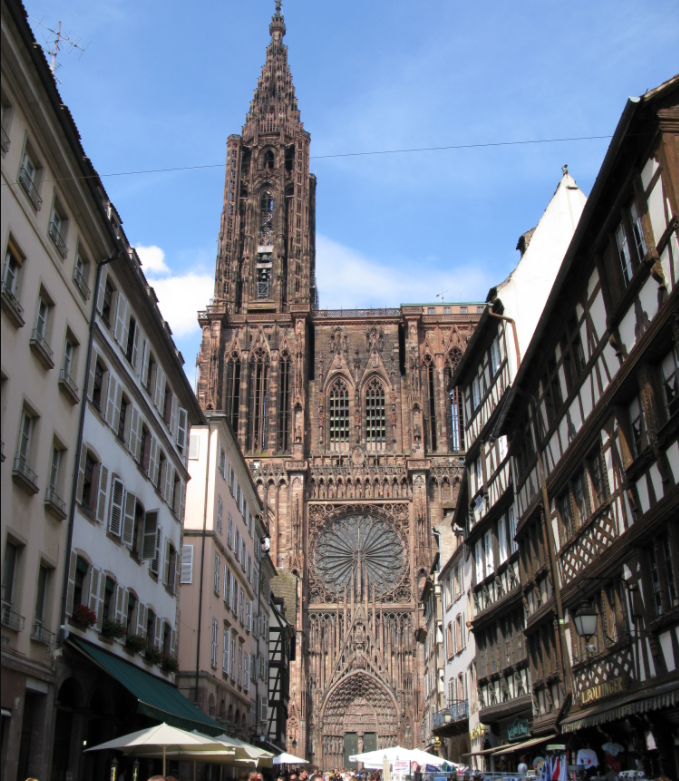
The Cathedral of Notre-Dame shown from Rue Merciere Street. / Credit: FEC Strasbourg
The Strasbourg Cathedral is a Roman Catholic church renovated and essentially rebuilt (from the original church from 1015) at the end of the 12th century in a Gothic architectural style after the original church had burnt down. It was constructed mainly of pink sandstone from the Vosges Mountains, giving it a unique colour, while the delicate workmanship makes it the ultimate symbol of Strasbourg. Construction of the spire was finished in 1439, marking the end of the three-century construction project. To give an idea of the scale of the project, it took nearly the entire 13th century just to build the navel!

The Cathedral of Notre-Dame seen towering over Strasbourg. / Credit: Xavier Boymond

Entrance illuminated at night, the optics enhance the ‘influence’ of Gothic architecture. / Credit: Xavier Boymond

As the sun beams on the limestone, it will seem like different colours throughout the day. / Credit: Condé Nast Traveler
Just by gazing at the Cathedral’s facade, you can see its multitude of characters. In fact, these aren’t just characters, they are telling a story. For example, on the right portal of the main facade the Tempter is shown, surrounded by the Wise and Foolish Virgins. On the left portal, you’ll see the Battle of Vices and Virtues. Between the two, the central portal illustrates the passion and resurrection of Christ.

Intricate details of Gothic architecture shown on the main facade. / Credit: Society of Architectural Historians

A story showcased through figurines on the main facade. / Credit: Society of Architectural Historians
The Cathedral was the driving force for the UNESCO World Heritage designation of Strasbourg, which declared the entire area a world heritage site in 1988.
It endured many ‘wounds’ from different wars but has always remained standing. It was set on fire during the Franco-Prussian War. During WWI, the Notre-Dame Cathedral saw all but one of its bells removed to avoid the metal being used for the war effort. And as depicted in The Monuments Men directed by George Clooney, Hitler ordered the stained glass windows to be taken, only to be recovered from a salt mine at the end of the war.

The Cathedral of Notre-Dame illuminated. / Credit: Xavier Boymond

The Cathedral was the tallest building in the world for 227 years, from 1647 to 1874./ Credit: Planet Ware

The Great Organ, with its polychrome-sculpted wood case. / Credit: Adventurous Miriam
Strasbourg Cathedral’s organ with its golden filigreed casing, measures 20 meters high and was built in 1489. It was rebuilt in 1716 with 3 keyboards, 2,200 pipes, and covers 3 octaves in range.

Intricate details of the Cathedral’s ornament chest. / Credit: Society of Architectural Historians

The magnificent rose window, measuring 14 meters in diameter. / Credit: James Lawton
There are over 4,500 panels dating between the 12th and 14th centuries among the stained-glass artworks. Like most glass windows in Cathedrals these contain religious stories from the Bible.
In front of the famous astronomical clock stands the Pillar of Angels which is a representation of the Last Judgement.

The Pillar of Angels / Credit: Clare Dunkle
There are four evangelists with symbols carved below them and above that are the four angels blowing their horns to raise the dead to heaven. Above this stands three more angels and Christ on his throne.
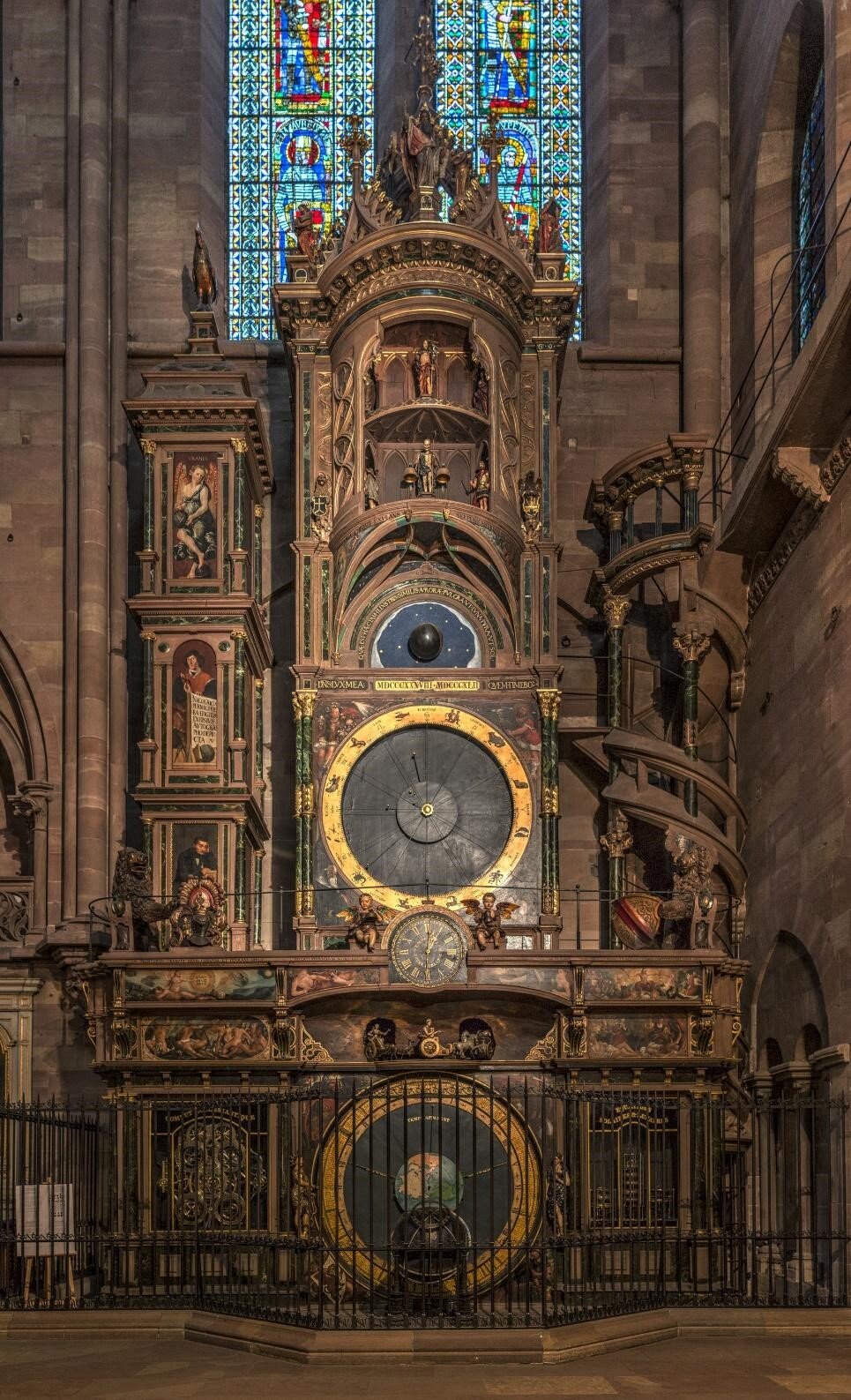
The Astronomical Clock
The astronomical clock in this case goes back to medieval times - with the first iteration in the 1350s. This first clock was repaired towards the end of the 14th century and eventually replaced in 1547.
Christian Herlin was one of three famous mathematicians who formed the team tasked with designing the new, second clock. Conrad Dasypodius, formerly a student of Herlin in Strasbourg, commissioned Isaac and Josia Habreht to finish the project.
Josias Habrecht and his brother, Swiss, were born to a watchmaking family that dates back to the 16th century. They were both charged by Dasypodius to continue work on the Strasbourg Cathedral, installing the second clock in 1574.
The second clock was stunning, a fusion of mechanics and art.

The Strasbourg Cathedral clock completed in the mid-1840s / Credit: Dong World
While the second clock functioned for about 214 years, it stopped working in the late 1780s and was left dormant for decades, only to be recovered in the mid-19th century by Jean-Baptiste Schwilgué.. As such, the current clock is only about 180 years old - not merely close to the world’s oldest clock as is sometimes claimed. Josias and Isaac’s clock which stopped working in the late 18th century. It is currently residing in the Strasbourg Museum.
The clock also calculates leap years, equinoxes, and even Easter under the complicated Gregorian rule.

The Strasbourg Cathedral clock / Credit: Dong World
There is also a figure play that happens, described as follows: at half past noon an angel blows a horn, and all of the figures come out. The apostles then pass before Christ, saluting him, commemorating as the four ages of Life move past Death. This figure play is similar to the ‘Zyteglogge’ as written about in our article on Bern’s famous clock tower. This procession of the figures of Christ and the Apostles is a highlight of the clock for visitors.

The Strasbourg Cathedral clock’s figure play / Credit: Dong World
A legend of the Strasbourg Cathedral tells the story of the man who built it saying that he should have his eyes removed so he could never build something so beautiful somewhere else.
What do you think?
By: Eric Mulder
Read more:
The Editors of Encyclopedia Britannica. “Strasbourg.” Encyclopedia Britannica, https://www.britannica.com/place/Strasbourg#ref290510.
Chang Pao-Chi & Swenson, Alfred. “Construction.” Encyclopedia Britannica, https://www.britannica.com/technology/construction/Romanesque-and-Gothic.
“Strasbourg, Grande-Île and Neustadt.” UNESCO World Heritage, https://whc.unesco.org/en/list/495/#:~:text=The%20initial%20property%2C%20inscribed%20in,Strasbourg%2C%20structured%20around%20the%20cathedral.
“The world's tallest structures through history.” The Telegraph, September 28th, 2018, https://www.telegraph.co.uk/travel/galleries/tallest-structures-in-the-world-through-history/structures4/.
“The Violence and Beauty of the Strasbourg Cathedral.” European Waterways, https://www.europeanwaterways.com/blog/violence-beauty-strasbourg-cathedral/.
Skidmore, Monique. “Strasbourg Cathedral: A Gothic Masterpiece.” Trip Anthropologist, May 18th, 2020, https://tripanthropologist.com/strasbourg-cathedral-a-gothic-masterpiece/.
Grandidier, Philippe André. Essais historiques et topographiques sur l'église cathédrale de Strasbourg. Paris, 1782.
Oestmann, Günther. The Astronomical Clock of Strasbourg Cathedral: Function and Significance. Leiden; Boston, Brill, 2020.
“JOSIAS HABRECHT.” Fondation de la Haute Horlogerie, https://www.hautehorlogerie.org/en/encyclopaedia/famous-watchmakers/s/josias-habrecht/.
Goran, David. “A wonder of 1800’s engineering: the historic Strasbourg Astronomical Clock.” The Vintage News, May, 10th, 2017, https://www.thevintagenews.com/2017/05/10/a-wonder-of-1800s-engineering-the-historic-strasbourg-astronomical-clock/.
Schickelé, M. “L’Horloge Astronomique de Strasbourg.” Info Bretagne, http://www.infobretagne.com/horloge-astronomique-strasbourg.htm.